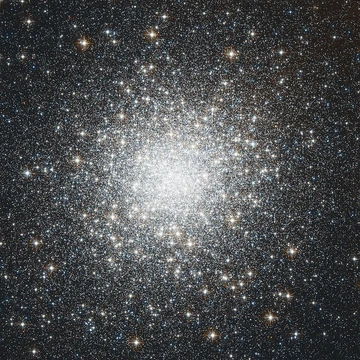
NGC 1850
A young double cluster in the Large Magellanic Cloud.

NGC 1850 is a double cluster and super star cluster found in the constellation Dorado, within the northwestern part of the Large Magellanic Cloud's bar. It lies about 168,000 light-years (51.5 kiloparsecs) from the Sun and was first spotted in 1826 by Scottish astronomer James Dunlop. What makes this system stand out is that its main cluster looks like a globular cluster, but unlike the Milky Way's globulars, it consists of young stars. The only Milky Way object similar to it is Westerlund 1. The main cluster appears globular-like and is around 100 million years old. A second, looser sub-cluster sits about 30 arcseconds to the west, with an age of roughly 4.3 million years. There are signs the two clusters are interacting: the larger component is irregular and has a tail stretching toward the northwest. The main cluster itself is around 100 million years old, with a tidal radius of 10 light-years and an overall radius of 16 light-years. Its mass is estimated at 42,000 times that of the Sun. Its stars split into two main sequence groups: about a quarter are blue and hotter, while the rest are redder and cooler. The entire cluster is embedded in an ionized region called Henize 103. The much younger sub-cluster, often labeled NGC 1850A, hosts many massive O/B-type stars that are on or near the main sequence, spread out up to 1 arcminute from its central clump. Seven of its members have masses of 35 solar masses or more, and two of those exceed 50 solar masses. Lower-mass members, up to about 3 solar masses, are still in the pre-main-sequence stage. The age spread of the sub-cluster's stars suggests star formation has been nearly continuous since it began. The eastern side of the sub-cluster is more obscured and contains fewer OB stars. In November 2021, astronomers using the MUSE instrument on the Very Large Telescope announced the discovery of a stellar-mass black hole in NGC 1850, named NGC 1850 BH1. They detected it by observing its gravitational influence on a nearby star's motion, marking the first direct dynamical detection of a black hole in a young massive cluster.
Quick Facts
- Epoch
- J2000.0
- Constellation
- Dorado
- Ra
- 05 · 08 · 50.190
- Dec
- −68 · 45 · 35.65
- Appmag V
- 9.0
- Radius Ly
- 4.97 ±
- Radius Tidal Ly
- 3.01 ±
- Age
- ~100 Myr
- Metal Z
- −0.3
- Names
- NGC 1850, ESO 056-SC070, h 2780, GC 1060
Facts from the source article.
Lore & Background
NGC 1850 was discovered by Scottish astronomer James Dunlop in 1826. The main cluster has the appearance of a globular cluster with an age of around 100 million years, while a second, more loosely distributed sub-cluster has an age of 4.3±0.9 Myr and lies 30″ to the west. There are indications of interactions between the two, with the larger component being irregular and showing a tail toward the northwest. The main cluster is around 100 million years old, with a tidal radius of 10 light years and an overall radius of 16 light years, and an estimated mass of 42,000 times the mass of the Sun. Its stellar component is split into two main sequence populations: about a quarter of the stars are in a blue (hotter) group and the rest in a redder (cooler) population. The cluster is embedded in an ionization region designated Henize 103.
Reader's Guide
NGC 1850 is notable as an unusual cluster system because its main distribution of stars is like a globular cluster, but it is composed of young stars—the only similar object in the Milky Way is Westerlund 1. The much younger subcluster, often designated NGC 1850A, contains a number of young, massive O/B-type stars on or near the main sequence, distributed up to 1′ from the central clump. Seven subcluster members have masses of ≥ 35 M☉, and two of those are ≥ 50 M☉. Lower mass members up to ~3 M☉ are still on the pre-main-sequence stage. The age distribution of the subcluster members indicates star formation has been active almost constantly since its formation. In November 2021, astronomers using MUSE on the Very Large Telescope reported the discovery of a stellar-mass black hole in NGC 1850, NGC 1850 BH1, by viewing its influence on the motion of a star in close proximity. This was the first direct dynamical detection of a black hole in a young massive cluster.
More in Globular Clusters 1-24
Spotted an error? Know more?
Reader corrections go straight into our review queue. Suggest an edit · How this site is sourced