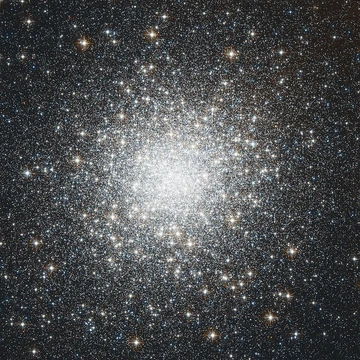
FSR 1758
A massive, obscured globular cluster possibly from an accreted dwarf galaxy.

FSR 1758, also called the Sequoia Cluster, is a globular cluster in the Milky Way that is both large and bright, though heavily obscured. It lies about 11.5 kiloparsecs from the Sun and roughly 3.7 kiloparsecs from the galactic center, hidden behind the galactic bulge by foreground stars and dust. First spotted in 2007 in 2MASS data, it was initially thought to be an open cluster, but observations from the Gaia mission in 2018 confirmed it is a globular cluster. Its size and brightness may match or even surpass those of Omega Centauri, which is widely considered the remnant core of a dwarf galaxy that merged with the Milky Way. Because of this, FSR 1758 might itself be the nucleus of a dwarf galaxy, tentatively named the Scorpius Dwarf. It could also resemble Messier 54, known as the core of the Sagittarius Dwarf Spheroidal Galaxy. After Barbá and colleagues used the term "Sequoia" to describe the cluster’s size, Myeong and colleagues applied the name differently, proposing that FSR 1758 was one of five globular clusters belonging to a dwarf galaxy they renamed the Sequoia dwarf. That dwarf was absorbed into the Milky Way during the Sequoia Event, and its members travel in retrograde galactic orbits. This naming has been adopted by several other research groups. In 2025, a study using the Very Large Telescope examined the metal-poor star BPM 3066, a candidate member of either the Sequoia galaxy or the accreted Thamnos galaxy. The star follows a retrograde orbit and showed unusually high levels of lithium and beryllium in its spectrum. One explanation is that it was once near a hypernova, though some chemical abundances support this idea while others contradict it. An alternative hypothesis is that the star engulfed a rocky planet rich in lithium and beryllium.
Quick Facts
- Credit
- Legacy Surveys / D. Lang (Perimeter Institute) & Meli thev
- Epoch
- J2000
- Constellation
- Scorpius
- Ra
- 17 · 31 · 12
- Dec
- −39 · 48 · 30
- Dist Pc
- 11.5 kpc
- Appmag V
- <7
- Absmag V
- <–8.6
- Mass Msol
- ~10 / 7
- Radius Tidal Pc
- 150 ± 45 pc
- Radius Pc
- 10 ± 1 pc
- Metal Fe
- −1.5
Facts from the source article.
Lore & Background
FSR 1758 was first noticed in 2007 in 2MASS data and initially believed to be an open cluster, until data from the Gaia mission revealed in 2018 that it is a globular cluster. It lies behind the galactic bulge and is heavily obscured by foreground stars and dust. Its size and brightness may be comparable to or exceed that of Omega Centauri, which is widely believed to be the nucleus of a dwarf galaxy that merged into the Milky Way in the past. Therefore, FSR 1758 may be the nucleus of a dwarf galaxy tentatively named Scorpius Dwarf galaxy. It may also be similar to Messier 54, which is known to be the nucleus of Sagittarius Dwarf Spheroidal Galaxy.
After Barbá et al. used the term Sequoia to describe the size of FSR 1758, Myeong et al. used the term Sequoia in a slightly different way. They believe that FSR 1758 was one of five globular clusters that populated a dwarf galaxy that Myeong et al. re-name as the Sequoia dwarf galaxy. This dwarf was accreted into the Milky Way in the Sequoia Event. The members of Sequoia have a retrograde galactic orbit. This term has been adopted by several other groups.
In 2025 a study used the Very Large Telescope to observe the metal-poor star BPM 3066, a candidate member of the Sequoia galaxy or the accreted Thamnos galaxy. The star is in a retrograde galactic orbit and showed unusual high amounts of lithium and beryllium in its spectrum. One suggestion is that it was close to a hypernova in the past, though some chemical abundances speak for and some against this hypothesis. An alternative is that the star engulfed a rocky planet rich in lithium and beryllium.
Reader's Guide
FSR 1758 is significant as a heavily obscured globular cluster that may rival Omega Centauri in size and brightness, suggesting it could be the remnant nucleus of a dwarf galaxy, tentatively named the Scorpius Dwarf galaxy. Its discovery history—first noted in 2007 as an open cluster and reclassified in 2018 via Gaia data—highlights the role of modern astrometric surveys in revealing obscured structures. The cluster's association with the Sequoia dwarf galaxy, as proposed by Myeong et al., places it within a broader narrative of galactic accretion events, specifically the Sequoia Event, whose members share a retrograde galactic orbit. This term has been adopted by several groups, indicating its growing acceptance. The 2025 observation of candidate member star BPM 3066, with its unusual lithium and beryllium abundances and debated origins (hypernova or planetary engulfment), adds further complexity to understanding the cluster's parent galaxy. FSR 1758 thus serves as a key object for studying the assembly history of the Milky Way through accreted dwarf galaxies.
Did You Know?
- It was reclassified as a globular cluster in 2018 using data from the Gaia mission.
- Candidate member star BPM 3066 shows unusual high amounts of lithium and beryllium, possibly from a hypernova or engulfing a rocky planet.
Discovery Behind the Galactic Bulge
FSR 1758, a large and luminous globular cluster in the Milky Way, spent most of its observable existence hidden from astronomers. Situated roughly 11.5 kiloparsecs from the Sun and about 3.7 kiloparsecs from the galactic center, it sits directly behind the dense stellar and dusty bulge of our galaxy, which shrouds it in foreground material. Because of this heavy obscuration, it did not catch the attention of early surveys. It was only in 2007, when researchers examined data from the Two Micron All-Sky Survey, that the object was first flagged. At that time, its appearance led observers to classify it as an open cluster. That identification stood for over a decade until the Gaia mission delivered precise astrometric data in 2018, which revealed the true nature of the system: a globular cluster of considerable scale and brightness. The reclassification fundamentally changed how astronomers understood the object's origins and its place among the Milky Way's stellar populations.
A Rival to Omega Centauri
One of the most striking aspects of FSR 1758 is its sheer scale. Its size and luminosity appear to match or even surpass those of Omega Centauri, the globular cluster long regarded as the remnant core of a dwarf galaxy that was swallowed by the Milky Way in the distant past. This comparison immediately raised the possibility that FSR 1758 itself may be the surviving nucleus of an entirely separate dwarf galaxy, one tentatively labeled the Scorpius Dwarf galaxy. The parallel to Messier 54 is particularly instructive: that cluster is now well established as the central remnant of the Sagittarius Dwarf Spheroidal Galaxy, a system currently in the process of being consumed by the Milky Way. If FSR 1758 truly is the core of a former companion galaxy, it would represent one of the most massive known globular clusters and a direct fossil of early galactic assembly. The heavy dust obscuration that hides the cluster from easy view also complicates precise mass and size measurements, leaving some uncertainty about exactly how it stacks up against Omega Centauri.
The Sequoia Event and Retrograde Orbits
The name Sequoia entered the literature around FSR 1758 in two distinct ways. Barbá and colleagues first applied the term to describe the cluster's enormous physical size, drawing an analogy to the towering redwood trees. Shortly afterward, Myeong and co-authors adopted the same word but with a broader meaning: they proposed that FSR 1758 was one of five globular clusters that together formed the body of a dwarf galaxy, which they renamed the Sequoia dwarf galaxy. According to their model, this compact galaxy was accreted into the Milky Way in what they termed the Sequoia Event. A key dynamical signature of this scenario is that the surviving members of the Sequoia system, including FSR 1758, follow a retrograde galactic orbit, meaning they travel in the opposite direction to the Milky Way's overall rotation. This retrograde motion is a strong indicator of an external origin, since stars born within the Milky Way's disk typically share its prograde rotation. The Sequoia terminology has since been embraced by several independent research groups, cementing the cluster's identity as a piece of galactic archaeology.
Chemical Clues from a Distant Star
In 2025, astronomers turned the Very Large Telescope toward BPM 3066, a metal-poor star that may be a surviving member of either the Sequoia dwarf galaxy or another accreted system called Thamnos. The star traces a retrograde orbit around the Milky Way, consistent with an extragalactic origin. What made the observation remarkable was the star's spectrum, which revealed unusually elevated abundances of lithium and beryllium, elements that are typically scarce in old, metal-poor stars. One proposed explanation is that BPM 3066 once passed close to a hypernova, a cataclysmic stellar explosion that would have seeded its outer layers with these light elements. However, the chemical evidence is mixed: some abundance ratios support the hypernova scenario while others argue against it. An alternative hypothesis suggests the star simply engulfed a rocky planet whose composition was rich in lithium and beryllium. Resolving which story is correct will require further spectroscopic work, but either outcome would make BPM 3066 a valuable probe of the harsh environments that shaped the early Milky Way.
More in Globular Clusters 1-24
Spotted an error? Know more?
Reader corrections go straight into our review queue. Suggest an edit · How this site is sourced