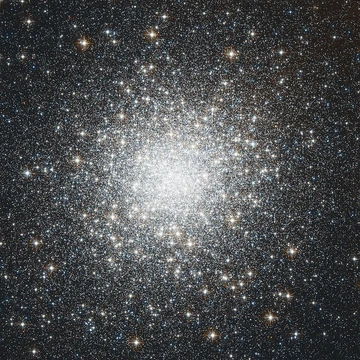
47 Tucanae
Second brightest globular cluster, with a dense core and millions of stars.

47 Tucanae (also known as NGC 104, Caldwell 106, or just 47 Tuc) is a globular cluster in the constellation Tucana. It sits about 14,500 light-years from Earth, spans 120 light-years across, and is visible to the naked eye at magnitude 4.1. Under ideal conditions, its full extent covers roughly 44 arcminutes—about the size of the full moon. Because it lies only 18 degrees from the south celestial pole, European astronomers didn't spot it until the 1750s, when Nicolas-Louis de Lacaille first recorded it from South Africa, initially mistaking it for a comet's nucleus. He listed it as "Lac I-1," the first entry in his deep-sky catalogue. The number "47" came from Johann Elert Bode's 1801 star catalogue, who reordered Lacaille's objects by constellation and right ascension without observing the cluster himself. Benjamin Apthorp Gould later assigned it the Greek letter Xi (ξ Tucanae), but that name never caught on.
47 Tuc is the sky's second-brightest globular cluster, after Omega Centauri, and is one of the Milky Way's most massive, containing millions of stars. Its core is notably small, bright, and dense. Though it appears next to the Small Magellanic Cloud, that galaxy is over fifteen times farther away at about 200,000 light-years. A Hubble Space Telescope survey searched the core for planets by looking for partial stellar eclipses, expecting ten to fifteen detections based on nearby star rates, but found none. A later ground-based survey in the cluster's outer regions also came up empty, suggesting that low metallicity—not crowding—makes planets rare in globular clusters. The cluster hosts at least two stellar populations with different ages or metallicities, and its dense core contains at least 21 blue stragglers. Gravity sorts stars by mass, with heavier ones sinking toward the center.
Hundreds of X-ray sources reside in 47 Tuc, including stars with enhanced chromospheric activity from binary systems, cataclysmic variables where white dwarfs accrete from companions, and low-mass X-ray binaries with neutron stars that emit X-rays from their hot surfaces even when not actively accreting. The cluster has 35 known millisecond pulsars—the second-largest pulsar population in any globular cluster, after Terzan 5. These pulsars likely spun up by accreting material from binary companions during an earlier X-ray binary phase.
Quick Facts
- Epoch
- J2000
- Class
- III
- Ra
- 00 · 24 · 05.539
- Dec
- −72 · 04 · 53.20
- Dist Pc
- 4.45 ±
- Appmag V
- +4.09
- Constellation
- Tucana
- Radius Ly
- 60 ly
- V Hb
- 14.2
- Metal Fe
- −0.78
- Age
- 13.06 Gyr
- Notes
- 2nd brightest globular cluster after Omega Centauri
Facts from the source article.
Lore & Background
The cluster was recorded in 1751–2 by Nicolas-Louis de Lacaille, who initially thought it was the nucleus of a bright comet. Lacaille listed it as 'Lac I-1', the first object in his deep-sky catalogue. The number '47' was assigned in 1801 by Johann Elert Bode in his catalogue, though Bode did not observe the cluster himself. In the 19th century, Benjamin Apthorp Gould assigned the Greek letter ξ (Xi) to the cluster as ξ Tucanae, but this was not widely adopted.
47 Tucanae is about 4.45 kpc from Earth and 120 light years in diameter. It appears roughly the size of the full moon in the sky under ideal conditions. Though it appears adjacent to the Small Magellanic Cloud, the latter is over fifteen times farther. The cluster contains at least two stellar populations of different ages or metallicities, and its dense core contains at least 21 blue stragglers. It also contains hundreds of X-ray sources and 35 known millisecond pulsars, the second largest population of pulsars in any globular cluster.
The cluster's brightest star in visible and ultraviolet light is a blue giant star of spectral class B8III with a luminosity of about 1,100 times that of the Sun. Known as the 'Bright Star', it is a post-AGB star currently fusing helium, with an effective temperature of about 10,850 K and about 54% the mass of the Sun.
Reader's Guide
47 Tucanae is significant as the second brightest globular cluster in the sky, visible to the naked eye with an apparent magnitude of 4.1. Its dense core and massive size make it a key object for studying stellar dynamics and evolution. The cluster was the subject of a major Hubble Space Telescope survey for planets, which found none despite expectations, indicating that planets are relatively rare in globular clusters, likely due to low metallicity rather than crowding. It contains a rich population of exotic stars, including blue stragglers, cataclysmic variables, low-mass X-ray binaries, and millisecond pulsars. 47 Tucanae was the first globular cluster detected in gamma-rays, via its millisecond pulsar population. The presence of a central black hole remains uncertain: Hubble data constrain any black hole to less than about 1,500 solar masses, while a 2017 study suggested a black hole of about 2,200 solar masses based on pulsar motions, but a later analysis of more extensive timing data found no solid evidence. In January 2024, a team detected a previously undetected radio source at the cluster's heart that could be a supermassive black hole.
Did You Know?
- 47 Tucanae is the second brightest globular cluster after Omega Centauri.
- It contains 35 known millisecond pulsars, the second largest population in any globular cluster.
- A Hubble Space Telescope survey for planets in the cluster's core found none, though ten to fifteen were expected.
- The cluster's brightest star, a blue giant, has a luminosity about 1,100 times that of the Sun.
Discovery and the Question of Identity
The cluster's position 18 degrees from the south celestial pole kept it hidden from European observers for centuries. It was not until Nicolas-Louis de Lacaille, working from South Africa in the early 1750s, that 47 Tucanae entered the astronomical record. Intriguingly, Lacaille first mistook the dense knot of light for the nucleus of a bright comet before recognizing it as a far more permanent object. He entered it as "Lac I-1," making it the very first entry in his deep-sky catalogue. The familiar numeral "47" arrived much later, in 1801, when Johann Elert Bode compiled his general star description in Berlin. Bode never pointed a telescope at the cluster himself; he simply reorganized Lacaille's list by constellation and right ascension, and the number stuck. In the nineteenth century, Benjamin Apthorp Gould proposed the Greek letter xi for the object, designating it xi Tucanae, but that label never gained traction. Today the cluster is most commonly called 47 Tucanae, though it also carries the designations NGC 104 and Caldwell 106.
A Laboratory of Exotic Stars
Telescopically, 47 Tucanae reveals roughly ten thousand stars packed into a small, intensely bright core, though the full population runs into the millions. The cluster harbors at least two distinct stellar populations differing in age or metallicity, and its dense heart hosts at least 21 blue stragglers—stars that appear to defy their expected evolutionary stage. Hundreds of X-ray sources populate the cluster, including binary systems with enhanced chromospheric activity, cataclysmic variables where a white dwarf strips material from a companion, and low-mass X-ray binaries containing neutron stars. Perhaps most striking is the population of 35 known millisecond pulsars, the second-largest such collection in any globular cluster after Terzan 5. These rapidly spinning neutron stars are believed to have been spun up by accreting matter from binary companions in an earlier X-ray binary phase. One system, 47 Tuc W, appears to be in the act of completing that transition. The Chandra X-ray Observatory has individually detected X-ray emission from most of these pulsars, and the Fermi Gamma-ray Space Telescope has captured gamma-ray emission from the pulsar population, making 47 Tucanae the first globular cluster ever detected in gamma-rays.
The Black Hole Question
Whether 47 Tucanae harbors a central black hole remains one of the cluster's most contested mysteries. Hubble Space Telescope observations place an upper limit on any such object at roughly 1,500 solar masses, suggesting that if a black hole exists, it would be of intermediate mass. In February 2017, a team of astronomers announced what they believed was a black hole of approximately 2,200 solar masses, identifying its gravitational signature through the motions and spatial distributions of the cluster's pulsars. However, a subsequent analysis drawing on an updated and more extensive pulsar timing dataset failed to produce solid evidence supporting the black hole's existence, leaving the question unresolved. Then in January 2024, a team led by the International Centre for Radio Astronomy Research in Western Australia reported the detection of a previously unknown radio source at the very heart of the cluster, which they suggested could be a supermassive black hole. The evidence continues to shift, and the true nature of 47 Tucanae's center remains an open problem in astrophysics.
Planets, Age, and Modern Surprises
The cluster's dense core has been scrutinized by the Hubble Space Telescope in a search for planets transiting their host stars. Despite expectations of finding ten to fifteen planets based on discovery rates around nearby Sun-like stars, the survey turned up none. A follow-up ground-based study targeting the less crowded outer regions also failed to detect any planets, leading researchers to conclude that the low metallicity of the globular cluster environment, rather than stellar crowding, is the likely cause of the paucity. In May 2015, astronomers announced the first evidence of mass segregation in 47 Tucanae, a process by which the cluster efficiently sorts its stars, sending the most massive ones toward the center. The Hertzsprung-Russell diagram suggests stellar ages of approximately 13 billion years, making the population unusually old. In December 2008, Ragbir Bhathal at the University of Western Sydney claimed the detection of a strong laser-like signal from the cluster's direction. These varied findings underscore that 47 Tucanae continues to yield surprises more than two and a half centuries after Lacaille first sketched it.
More in Globular Clusters 1-24
Spotted an error? Know more?
Reader corrections go straight into our review queue. Suggest an edit · How this site is sourced