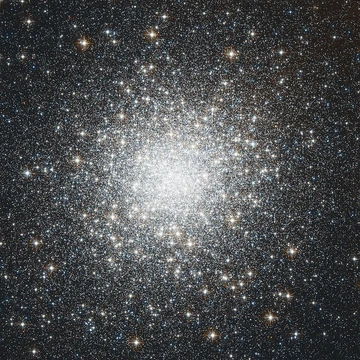
Mayall II
Brightest globular cluster in the Local Group, orbiting Andromeda.

Mayall II—also cataloged as NGC-224-G1, SKHB 1, GSC 2788:2139, HBK 0-1, M31GC J003247+393440, or Andromeda's Cluster—is a globular cluster that orbits the Andromeda Galaxy (M31). It lies about 130,000 light-years (40 kpc) from Andromeda’s core. With an absolute visual magnitude of −10.94 and a luminosity equal to two million Suns, it is the brightest globular cluster in the Local Group by absolute magnitude. Its apparent magnitude in the V band is 13.81. The cluster is thought to be about twice as massive as Omega Centauri and may harbor a central intermediate-mass black hole of roughly 20,000 solar masses.
American astronomers Nicholas Mayall and Olin J. Eggen first identified it as a possible globular cluster in 1953, using a Palomar 48-inch (1.2 m) Schmidt plate exposed in 1948. Because its stars show a wide spread in metallicity—indicating multiple generations of stars and an extended period of star formation—many astronomers argue that Mayall II is not a true globular cluster but rather the stripped core of a dwarf galaxy that was consumed by Andromeda.
The cluster is named after Nicholas U. Mayall, who co-discovered it with Olin J. Eggen in 1953. The designation SKHB 1 honors Wallace L. W. Sargent, Charles T. Kowal, F. D. A. Hartwick, and Sidney van den Bergh, who also called it G1 in 1977. HBK 0-1 was assigned by John Huchra, J. P. Brodie, and S. M. Kent in 1991.
Quick Facts
- Epoch
- J2000
- Constellation
- Andromeda
- Ra
- 00 · 32 · 46.51
- Dec
- +39 · 34 · 39.7
- Dist Ly
- 2.52 ± 0.14 Mly
- Dist Pc
- 770 ± 40 kpc
- Appmag V
- +13.81
- Mass Kg
- 237
- Mass Msol
- 17
- Radius Ly
- 21.2 ± 1.0 ly (6.5 ± 0.3 pc) (Half light radius r / h / ) and tidal radius 263.2 ± 12.7 ly (80.7 ± 3.9 pc)
- Age
- ~ 12 Gyr
- Names
- SKHB 1, HBK 0-1
Facts from the source article.
Lore & Background
Mayall II was first identified as a possible globular cluster by American astronomers Nicholas Mayall and Olin J. Eggen in 1953 using a Palomar 48-inch (1.2 m) Schmidt plate exposed in 1948. It is located 130,000 light-years from the Andromeda Galaxy's galactic core and has an apparent magnitude of 13.81 in V band. The cluster is considered to have twice the mass of Omega Centauri and may contain a central, intermediate-mass black hole of about 2×10^4 solar masses.
Reader's Guide
Mayall II's significance lies in its status as the brightest globular cluster in the Local Group, with an absolute visual magnitude of −10.94 and a luminosity equivalent to 2 million Suns. Its mass, twice that of Omega Centauri, and the possible presence of an intermediate-mass black hole make it a key object for studying cluster dynamics and black hole formation. However, because of the widespread distribution of metallicity in the cluster—indicating multiple star generations and a large stellar creation period—many contend that it is not a true globular cluster but rather the galactic core of a dwarf galaxy consumed by Andromeda. This unresolved debate adds to its scientific importance, as it may represent a transitional object between globular clusters and dwarf galaxy remnants. The cluster was discovered in 1953 by Nicholas Mayall and Olin J. Eggen, and later designated G1 by Sargent, Kowal, Hartwick, and van den Bergh in 1977, and HBK 0-1 by Huchra, Brodie, and Kent in 1991.
Did You Know?
- Mayall II is also known as Andromeda's Cluster.
- Many contend it is not a true globular cluster but the core of a dwarf galaxy consumed by Andromeda.
Discovery and a Tangle of Catalog Names
In 1953, American astronomers Nicholas Mayall and Olin J. Eggen made a remarkable identification while examining a Schmidt plate that had been exposed back in 1948 on the Palomar Observatory's 48-inch (1.2-meter) telescope. What they spotted was a possible globular cluster in the halo of the Andromeda Galaxy, and it would go on to bear Mayall's name as its primary designation. Yet the object's identity never settled into a single label. Over the following decades, other teams of astronomers added their own catalog entries: Sargent, Kowal, Hartwick, and van den Bergh assigned it the designation SKHB 1 (and separately called it G1 in 1977), while Huchra, Brodie, and Kent gave it the label HBK 0-1 in 1991. Additional identifiers such as NGC-224-G1, GSC 2788:2139, and M31GC J003247+393440 further clutter its record. Even the informal nickname "Andromeda's Cluster" has stuck. This proliferation of names reflects both the object's prominence and the fact that it was independently recognized by multiple research groups working across different eras of observational astronomy.
A Colossus Among Stellar Swarms
Few objects in the Local Group rival Mayall II in sheer stellar output. Orbiting the Andromeda Galaxy at a distance of roughly 130,000 light-years (40 kiloparsecs) from M31's galactic core, this cluster shines with an absolute visual magnitude of −10.94, making it the brightest globular cluster in the entire Local Group by that measure. Its total luminosity is equivalent to about two million Suns burning in concert, though from Earth it appears modest at an apparent V-band magnitude of 13.81. In terms of mass, Mayall II is estimated to be roughly twice as massive as Omega Centauri, another celebrated dense stellar swarm. Perhaps most strikingly, researchers have suggested that the cluster's center may harbor an intermediate-mass black hole with a mass on the order of 20,000 solar masses. If confirmed, such an object would occupy a rare middle ground between the stellar-mass black holes found in binary systems and the supermassive giants anchoring galactic nuclei.
The Identity Crisis: Cluster or Galactic Remnant?
A persistent question haunts Mayall II's classification. In a typical globular cluster, stars share a relatively uniform chemical composition because they formed in a single, brief episode of star formation. Mayall II, however, displays a widespread distribution of metallicity among its member stars, a signature that points to multiple generations of stellar birth spread over an extended period. This prolonged history of star creation is more characteristic of a galaxy than of a compact cluster. For that reason, a significant body of researchers argues that Mayall II is not a true globular cluster at all. Instead, they propose it is the surviving galactic core of a smaller dwarf galaxy that was gravitationally consumed by Andromeda over time. Under this interpretation, the object we catalog as a globular cluster is actually the fossilized heart of an entire galaxy, stripped of its outer stars and left orbiting in M31's halo as a remnant of a cosmic merger.
A Lighthouse in Andromeda's Halo
Mayall II occupies a singular position in the cosmic neighborhood of the Local Group. As a globular cluster orbiting the Andromeda Galaxy, it is the brightest such object in the entire group, a distinction that has made it a natural benchmark for comparative studies of dense stellar systems. Its informal nickname, "Andromeda's Cluster," underscores the intimate gravitational bond it shares with M31, even though it dwells far from the galaxy's luminous center, some 130,000 light-years out in the extended halo. This orbital position makes it a valuable probe of the conditions in Andromeda's outer reaches. For astronomers studying the Local Group's inventory of compact stellar systems, Mayall II stands alongside well-known objects like Omega Centauri and Messier 54, yet its combination of extreme brightness, extraordinary mass, and ambiguous classification sets it apart. It is, in many ways, the most extreme and enigmatic member of the globular cluster family in our nearby galactic neighborhood.
More in Globular Clusters 1-24
Spotted an error? Know more?
Reader corrections go straight into our review queue. Suggest an edit · How this site is sourced