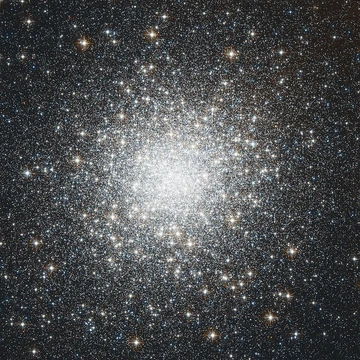
Messier 9
Globular cluster near the Galactic Center in Ophiuchus.

Messier 9 (NGC 6333) is a globular cluster found in the constellation Ophiuchus, in its southern part southwest of the star Eta Ophiuchi. It sits on top of a dark dust cloud known as Barnard 64. French astronomer Charles Messier discovered it on June 3, 1764, calling it a "nebula without stars." Later, in 1783, English astronomer William Herschel used his reflector telescope to pick out individual stars in the cluster, estimating its diameter at 7–8 arcminutes and noting that the stars were packed tightly toward the center.
The cluster has an apparent magnitude of 7.9 and an angular size of 9.3 arcminutes, making it visible with a small telescope. It lies about 5,500 light-years from the Galactic Center, making it one of the globular clusters closest to the Milky Way's core, and its distance from Earth is 25,800 light-years. Its total luminosity is roughly 120,000 times that of the Sun, giving it an absolute magnitude of −8.04. The brightest individual stars in M9 shine at an apparent magnitude of 13.5, observable in moderately sized telescopes. Astronomers have identified 24 variable stars in the cluster: 21 RR Lyrae variables, along with one long-period variable, one Type II Cepheid, and one eclipsing binary. No blue stragglers or SX Phoenicis variables have been found. Based on the periods of its RR Lyrae stars, M9 is classified as an Oosterhoff type II globular cluster, which rules out an extragalactic origin.
About 80 arcminutes (1.33 degrees) northeast of M9 lies the fainter globular cluster NGC 6356, and roughly the same distance to the southeast is the globular cluster NGC 6342.
Quick Facts
- Epoch
- J2000
- Class
- VIII
- Constellation
- Ophiuchus
- Ra
- 17 · 19 · 11.78
- Dec
- –18 · 30 · 58.5
- Dist Ly
- 25.8 kly
- Appmag V
- 7.7
- Radius Ly
- 45 ly
- Metal Fe
- –1.77
- Age
- 12.0 Gyr
- Names
- HD 156587, NGC 6333
Facts from the source article.
Lore & Background
Messier 9 was discovered by French astronomer Charles Messier on June 3, 1764, who described it as a 'nebula without stars'. In 1783, English astronomer William Herschel used his reflector to resolve individual stars within the cluster, estimating its diameter to be 7–8′ with stars densely packed near the center. The cluster is positioned in the southern part of Ophiuchus, southwest of Eta Ophiuchi, and lies atop a dark cloud of dust designated Barnard 64.
The cluster has an apparent magnitude of 7.9 and an angular size of 9.3′, viewable with a small telescope. Its total luminosity is about 120,000 times that of the Sun, with an absolute magnitude of −8.04. The brightest individual stars in M9 have an apparent magnitude of 13.5, visible in moderately sized telescopes. Among its 24 known variable stars are 21 RR Lyrae variables, a long-period variable, a Type II Cepheid, and an eclipsing binary; no blue stragglers or SX Phoenicis variables have been discovered.
Based on the periods of its RR Lyrae variables, M9 is classified as an Oosterhoff type II globular, which precludes an extra-galactic origin. About 80′ to the northeast lies the dimmer globular cluster NGC 6356, and about the same distance to the southeast is NGC 6342.
Reader's Guide
Messier 9 holds significance as one of the nearer globular clusters to the Galactic Center, offering insights into the structure and stellar populations of the Milky Way's inner halo. Its classification as an Oosterhoff type II globular, based on the periods of its RR Lyrae variables, is a key characteristic that distinguishes it from other clusters and indicates its origin within the Galaxy. The cluster's 24 variable stars, including 21 RR Lyrae variables, provide valuable data for studying stellar evolution and distance measurements. The presence of a long-period variable, a Type II Cepheid, and an eclipsing binary adds to its astrophysical interest, while the absence of blue stragglers and SX Phoenicis variables sets it apart from some other globulars. Its discovery by Charles Messier in 1764 and subsequent resolution by William Herschel in 1783 mark important milestones in the history of deep-sky observation. The cluster's location atop the dark nebula Barnard 64 and its proximity to other globulars like NGC 6356 and NGC 6342 make it a notable target for both amateur and professional astronomers.
More in Globular Clusters 1-24
Spotted an error? Know more?
Reader corrections go straight into our review queue. Suggest an edit · How this site is sourced