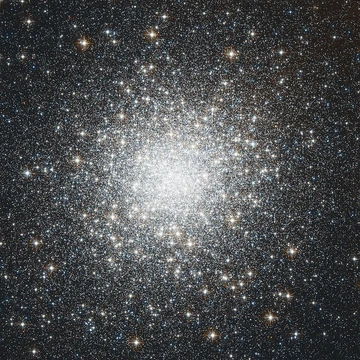
Messier 4
The closest globular cluster to Earth, first resolved into stars.

Messier 4 (M4, NGC 6121, or the Spider Globular Cluster) sits in the constellation Scorpius. Discovered by Philippe Loys de Chéseaux in 1745 and cataloged by Charles Messier in 1764, it holds the distinction of being the first globular cluster where individual stars could be seen separately.
Even in the smallest telescopes, M4 appears as a fuzzy patch of light roughly the size of the Moon. It is one of the easiest globular clusters to locate, lying just 1.3 degrees west of the bright star Antares—both fit in a wide-field telescope. With a modest telescope, individual stars begin to resolve; the brightest in the cluster shine at magnitude 10.8.
The cluster is loosely concentrated (class IX) and spans 75 light-years. A distinctive bar of 11th-magnitude stars, about 2.5 arcminutes long, runs across its core; William Herschel first noted this feature in 1783. At least 43 variable stars have been identified within M4. Its distance of roughly 6,000 light-years makes it the nearest globular cluster to our solar system, and its estimated age is 12.2 billion years.
The iron abundance in M4 is [Fe/H] = −1.07 ± 0.1, meaning it has only about 8.5% of the Sun’s iron content. This low metallicity, along with other evidence, strongly suggests the cluster contains two distinct stellar populations of different ages, indicating it underwent two major cycles of star formation.
The cluster’s space velocity components are (U, V, W) = (−57 ± 3, −193 ± 22, −8 ± 5) km/s. Its orbit around the Milky Way has a period of 116 ± 3 million years and an eccentricity of 0.80 ± 0.03. At periapsis, it comes within 0.6 ± 0.1 kiloparsecs of the galactic core; at apoapsis, it reaches 5.9 ± 0.3 kiloparsecs. The orbit is inclined 23° ± 6° to the galactic plane, carrying it up to 1.5 ± 0.4 kiloparsecs above the disk. Each time it passes through the disk (within 5 kiloparsecs of the nucleus), it experiences a tidal shock that can strip away stars, suggesting the cluster may once have been much more massive.
Notable stars in M4 include some of the oldest known white dwarfs in the galaxy, aged about 13 billion years, imaged by the Hubble Space Telescope in 1995. One of these is part of a binary system with the pulsar PSR B1620−26, which hosts a planet with 2.5 times Jupiter’s mass. Another star in M4 contains an unexpectedly high amount of the rare light element lithium.
Quick Facts
- Epoch
- J2000
- Class
- IX
- Constellation
- Scorpius
- Ra
- 16 · 23 · 35.22
- Dec
- −26 · 31 · 32.7
- Dist Ly
- 6.033 kly
- Appmag V
- 5.6
- Age
- (12.2 ± 0.2) Gyr
- Metal Fe
- −1.07
- Notes
- Closest globular cluster
- Names
- NGC 6121
Facts from the source article.
Lore & Background
M4 was discovered by Philippe Loys de Chéseaux in 1745 and catalogued by Charles Messier in 1764. It was the first globular cluster in which individual stars were resolved. It is conspicuous in even the smallest telescopes as a fuzzy ball of light, appearing about the same size as the Moon in the sky. It is one of the easiest globular clusters to find, located only 1.3 degrees west of the bright star Antares. Modestly sized telescopes will begin to resolve individual stars, the brightest of which are of apparent magnitude 10.8.
M4 is a rather loosely concentrated cluster of class IX and measures 75 light-years across. It features a characteristic 'bar' structure across its core, visible to moderate sized telescopes, consisting of 11th-magnitude stars approximately 2.5′ long, first noted by William Herschel in 1783. At least 43 variable stars have been observed within M4. The cluster has an estimated age of 12.2 billion years. Its measured iron abundance is [Fe/H] = −1.07±0.1, which is 8.5% of the Sun's iron abundance, suggesting it hosts two distinct stellar populations differing by age, indicating two main cycles of star formation.
The space velocity components confirm an orbit around the Milky Way with a period of 116 million years and eccentricity 0.80. During periapsis it comes within 0.6 kpc of the galactic core, and at apoapsis it travels out to 5.9 kpc. The inclination is 23 degrees from the galactic plane, reaching up to 1.5 kpc above the disk. The cluster undergoes tidal shock during each passage through the disk, which can cause repeated shedding of stars, so it may have been much more massive.
Reader's Guide
Messier 4 holds several notable distinctions. It was the first globular cluster in which individual stars were resolved, marking a milestone in observational astronomy. As the closest globular cluster to the Solar System at 6,000 light-years, it is a key object for studying stellar populations and dynamics. The cluster's metallicity of [Fe/H] = −1.07 indicates it hosts two distinct stellar populations, suggesting two phases of star formation. Its orbit, with a period of 116 million years and high eccentricity of 0.80, brings it close to the galactic core and causes tidal shocks that may have stripped many stars over time, implying it was once much more massive.
Notable objects within M4 include white dwarf stars photographed by the Hubble Space Telescope in 1995, which are among the oldest known stars in the galaxy at 13 billion years. One such white dwarf is part of a binary system with a pulsar, PSR B1620−26, which has a planet of 2.5 Jupiter masses. One star in M4 also has an unusually high abundance of the rare light element lithium. In 2023, analysis of Hubble and Gaia data revealed an excess mass of roughly 800 solar masses at the cluster's center, providing kinematic evidence for an intermediate-mass black hole, though an unusually compact cluster of compact objects cannot be completely discounted. The view of M4 through a good telescope was likened by Robert Burnham Jr. to hyperkinetic luminous alpha particles in a spinthariscope.
Did You Know?
- It is the closest globular cluster to the Solar System, at about 6,000 light-years away.
- The cluster contains a possible intermediate-mass black hole of roughly 800 solar masses, identified in 2023.
- One star in M4 has a planet of 2.5 Jupiter masses orbiting a pulsar companion.
Pioneering Discovery & Early Observations
Long before modern instruments could peel apart the smudge of distant starlight, Messier 4 earned a place of singular importance in the history of astronomy. Philippe Loys de Chéseaux first identified this object in 1745, and Charles Messier formally catalogued it a decade later in 1764, assigning it the designation M4. What set this cluster apart from its contemporaries was a remarkable achievement: it became the very first globular cluster in which astronomers could distinguish and resolve individual member stars, transforming it from an amorphous glow into a resolvable population of suns. The cluster sits in the constellation Scorpius and carries the alternate designations NGC 6121 and the evocative nickname Spider Globular Cluster. Decades after Messier's entry, William Herschel turned his attention to M4 in 1783 and identified a distinctive bar-like feature threading through the cluster's core, a structure composed of roughly eleventh-magnitude stars stretching about two and a half arcminutes across. That early structural insight demonstrated how much detail even eighteenth-century optics could coax from a nearby star system, and it established M4 as a benchmark target for generations of observers who would follow.
Structure, Age & Stellar Populations
Among all globular clusters, M4 stands out for its unusually open architecture. Classified as a class IX system, it is loosely concentrated and spans roughly 75 light-years in diameter, making individual stars far easier to pick out than in denser counterparts. At a distance of approximately 6,000 light-years, it is the nearest globular cluster to our Solar System, and its apparent size in the sky rivals that of the full Moon. The cluster's estimated age of 12.2 billion years places it among the oldest stellar systems known. Perhaps most intriguing is what its chemical fingerprint reveals: the measured iron-to-hydrogen ratio of [Fe/H] = −1.07±0.1 means M4 contains only about 8.5 percent of the iron abundance found in the Sun. This low metallicity, combined with other evidence, strongly suggests the cluster harbors two distinct stellar populations born in separate episodes of star formation. At least 43 variable stars have been catalogued within its boundaries, and the brightest resolvable members shine at apparent magnitude 10.8. Robert Burnham Jr. once compared the telescopic view to watching hyperkinetic luminous alpha particles flicker in a spinthariscope, a fitting image for such a sparse, ancient gathering of suns.
Extraordinary Stellar Residents
Though M4 is a loose and ancient gathering, it hides some of the most remarkable individual objects in our galaxy. In 1995, Hubble Space Telescope imaging revealed white dwarf stars within the cluster that are among the oldest known stellar remnants, with ages approaching 13 billion years. One particularly extraordinary system pairs a white dwarf with a pulsar companion designated PSR B1620−26, and orbiting that pulsar is a planet with a mass roughly 2.5 times that of Jupiter, an exoplanet nestled inside a globular cluster, a discovery that reshaped assumptions about where planetary systems can form. Another member star was found to carry a lithium abundance far exceeding what standard stellar evolution models predict for a population of that age, hinting at unusual internal processes. The object CX-1, also located in M4, is identified as a possible millisecond pulsar or neutron star in a binary configuration, completing its orbit in just 6.31 hours. Together, these residents make M4 a laboratory for studying the end stages of stellar life and the formation of exotic compact systems in dense environments.
Orbital Journey & the Central Mystery
M4 does not sit still in the Milky Way; it traces a highly elliptical path around the galactic center with a period of roughly 116 million years and an eccentricity of 0.80. Its velocity components (U, V, W) of (−57, −193, −8) km/s confirm this dramatic orbit, which swings the cluster to within about 0.6 kiloparsecs of the galactic core at periapsis before flinging it out to nearly 6 kiloparsecs at apoapsis. The orbital plane is inclined roughly 23 degrees relative to the galactic disk, carrying M4 up to about 1.5 kiloparsecs above the plane. Each time the cluster plunges through the disk, it encounters tidal shocks that can strip stars from its outer reaches, suggesting M4 may once have been considerably more massive than it is today. In 2023, a combined analysis of Hubble and Gaia spacecraft data uncovered an excess of approximately 800 solar masses concentrated at the cluster's center in a compact, non-extended configuration. This kinematic signature is consistent with an intermediate-mass black hole, though the possibility of a tightly packed group of compact objects, white dwarfs, neutron stars, or stellar-mass black holes, cannot be entirely ruled out.
More in Globular Clusters 1-24
Spotted an error? Know more?
Reader corrections go straight into our review queue. Suggest an edit · How this site is sourced