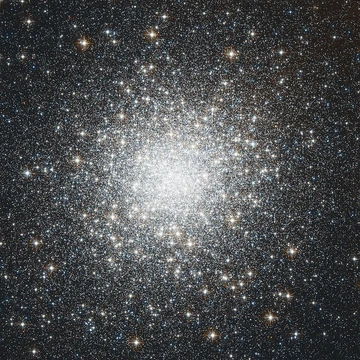
Messier 2
One of the largest and oldest globular clusters in the Milky Way.

Messier 2 (also cataloged as NGC 7089) is a globular cluster located in the constellation Aquarius, about five degrees north of the star Beta Aquarii. It ranks among the largest globular clusters known, standing out for its dense, rich structure and noticeably elliptical shape.
Discovered in 1746 by French astronomer Jean-Dominique Maraldi while he and Jacques Cassini were tracking a comet, the object was later spotted again by Charles Messier in 1760, who mistook it for a nebula with no stars. William Herschel became the first to pick out individual stars within the cluster in 1783. Under exceptionally clear skies, M2 can barely be glimpsed without aid; binoculars or a small telescope reveal it as a non-stellar patch, while larger instruments resolve its stars, the brightest of which shines at magnitude 12.
M2 lies roughly 37,500 light-years from Earth and spans about 175 light-years across. It contains around 150,000 stars, including 21 known variable stars, and its brightest members are red and yellow giants. The cluster’s overall spectral type is F4. At an age of 12.5 billion years, it is one of the older globular clusters associated with the Milky Way. M2 belongs to the Gaia Sausage, the remnant of a dwarf galaxy that merged with our own. Data from the Gaia spacecraft has also revealed an extended tidal stream, roughly 45 degrees long and 300 light-years wide, likely linked to M2 and possibly disturbed by the Large Magellanic Cloud. Like most globular clusters, M2 resides in the galactic halo, specifically in the southern galactic cap, placing it just below the Milky Way’s southern pole.
In terms of Oosterhoff classification, M2 is a type II cluster. This system, devised by Pieter Oosterhoff, separates globular clusters based on metallicity, age, and the average pulsation period of their type ab RR Lyrae variable stars. A type II cluster typically has a metallicity below −1.6, an age above 13 billion years, and an average RRab pulsation period around 0.64 days. M2 meets the metallicity (−1.65) and period (0.64 days) conditions, placing it in the Oosterhoff Gap—a clear separation between type I and type II clusters on a metallicity-versus-period plot. However, its age of 12.5 billion years falls below the 13-billion-year cutoff typical for type II clusters, an anomaly explained by Marín-Franch. A more recent study by Botev et al.
Quick Facts
- Epoch
- J2000
- Class
- II
- Constellation
- Aquarius
- Ra
- 21 · 33 · 27.02
- Dec
- –00 · 49 · 23.7
- Dist Ly
- 11.693 kpc
- Appmag V
- 6.5
- Radius Ly
- 87.3 ly
- Metal Fe
- –1.65
- Age
- 12.5 Gyr
- Names
- NGC 7089
Facts from the source article.
Lore & Background
M2 was discovered by the French astronomer Jean-Dominique Maraldi in 1746 while observing a comet with Jacques Cassini. Charles Messier rediscovered it in 1760, but thought it was a nebula without any stars. William Herschel, in 1783, was the first to resolve individual stars in the cluster. Under extremely good conditions, M2 is just visible to the naked eye; binoculars or a small telescope show it as non-stellar, while larger telescopes resolve individual stars, the brightest of apparent magnitude 12.
The cluster is about 37,500 light-years distant from Earth and 175 light-years in diameter. It contains about 150,000 stars, including 21 known variable stars, with its brightest stars being red and yellow giants. Its overall spectral type is F4. M2 is part of the Gaia Sausage, the hypothesized remains of a merged dwarf galaxy. Data from Gaia has led to the discovery of an extended tidal stellar stream, about 45 degrees long and 300 light-years wide, likely associated with M2, possibly perturbed by the Large Magellanic Cloud. M2 is located within the Milky Way's galactic halo, specifically in the southern galactic cap.
M2 is defined as an Oosterhoff type II globular cluster, determined by metallicity, age, and average pulsation period of type ab RR Lyrae variable stars. It satisfies the metallicity (−1.65) and RRab Lyrae pulsation period (around 0.64 days) conditions, but its age of 12.5 Gyr is below the typical cutoff of 13 Gyr for type II. This anomaly is explained in an article by Marín-Franch. A recent study by Botev et al. proposed a new lower limit of 13.2 Gyr for the age of M2.
Reader's Guide
Messier 2 holds significance as one of the largest and oldest globular clusters known, with an age of 12.5 billion years. Its discovery by Jean-Dominique Maraldi in 1746, and later independent rediscovery by Charles Messier and resolution by William Herschel, mark key steps in the history of deep-sky observation. The cluster's membership in the Gaia Sausage—the hypothesized remains of a merged dwarf galaxy—and the detection of an extended tidal stellar stream via Gaia data provide insights into the Milky Way's formation and accretion history. M2's Oosterhoff type II classification is notable for its anomaly: while its metallicity and RR Lyrae pulsation period fit type II, its age is younger than the typical cutoff, a discrepancy addressed by Marín-Franch and later challenged by Botev et al.'s proposed higher age limit. This cluster thus serves as a test case for understanding the relationship between age, metallicity, and pulsation properties in globular clusters.
Discovery and the Long Road to Resolution
M2 was first identified by the French astronomer Jean-Dominique Maraldi in 1746, spotted while he and Jacques Cassini were tracking a comet. Fourteen years later, Charles Messier independently located the same object but, lacking the resolving power to see its stellar content, catalogued it as a nebula devoid of associated stars. It would take another twenty-three years before William Herschel, working in 1783, became the first observer to break the fuzzy patch into individual stars. Even today, M2 remains a challenging naked-eye target, visible only under exceptionally dark skies. A pair of binoculars or a small telescope will confirm its non-stellar, diffuse nature, while larger apertures are needed to separate the constituent stars, the brightest of which measures apparent magnitude 12. The cluster occupies the constellation Aquarius, positioned roughly five degrees north of the star Beta Aquarii, and carries the alternate catalogue designation NGC 7089.
Structure, Age, and Stellar Census
At a distance of approximately 37,500 light-years, M2 spans roughly 175 light-years across, earning its place among the larger globular clusters known. Its structure is dense, tightly bound, and noticeably elliptical rather than spherical. The cluster's estimated age of 12.5 billion years places it among the oldest stellar groupings tied to the Milky Way. Within its volume reside around 150,000 stars, of which 21 are catalogued as variable. The most luminous members are red and yellow giants, and the cluster's overall spectral type is classified as F4. M2 occupies the galactic halo, specifically in the southern galactic cap, a position that places it just below the Milky Way's southern pole. It is also considered a member of the Gaia Sausage, a structure thought to represent the surviving debris of a dwarf galaxy that merged with the Milky Way in the deep past.
The Oosterhoff Type II Paradox
M2 is designated an Oosterhoff type II globular cluster, a two-category scheme originally formulated by Pieter Oosterhoff that sorts clusters by metallicity, age, and the mean pulsation period of RR Lyrae type ab variable stars. Type II membership requires a metallicity below −1.6, an age exceeding 13 billion years, and an average RRab period near 0.64 days. M2 meets the metallicity criterion at −1.65 and matches the expected pulsation period, anchoring it within the Oosterhoff Gap—the observed divide between type I and type II populations on a metallicity-versus-period diagram. The complication is its measured age of 12.5 billion years, which falls short of the 13-billion-year floor. This is surprising because a cluster's age is normally inferred from its metallicity. Marín-Franch examined the anomaly in a dedicated paper, and more recently Botev and co-workers proposed a revised lower age bound of 13.2 billion years for M2, potentially reconciling the discrepancy.
Tidal Streams and Galactic Interactions
Observations from the Gaia space mission have uncovered an extended tidal stellar stream linked to M2, stretching roughly 45 degrees across the sky and spanning about 300 light-years, or 100 parsecs, in width. This faint ribbon of stars is interpreted as material gradually stripped from the cluster's outer halo as it orbits through the Milky Way. The gravitational perturbation that may have helped dislodge these stars is tentatively attributed to the presence of the Large Magellanic Cloud. The discovery adds a dynamic, ongoing dimension to M2's story, demonstrating that even a 12.5-billion-year-old cluster continues to exchange stars with its galactic environment. Together with M2's membership in the Gaia Sausage structure, the tidal stream illustrates how ancient merger events and present-day gravitational encounters with satellite galaxies continue to sculpt the distribution of stars throughout the Milky Way's halo.
More in Globular Clusters 1-24
Spotted an error? Know more?
Reader corrections go straight into our review queue. Suggest an edit · How this site is sourced