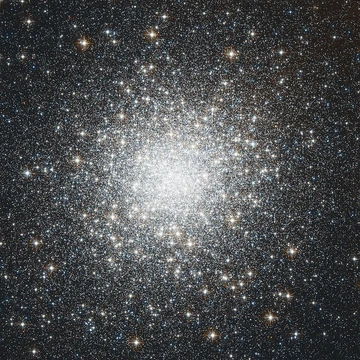
Messier 3
One of the largest and brightest globular clusters, with 500,000 stars.

Messier 3 (M3, also known as NGC 5272) is a globular cluster in the northern constellation Canes Venatici, about 33,900 light-years from Earth. It ranks among the largest and brightest globular clusters known, containing roughly 500,000 stars.
Charles Messier first spotted it on May 3, 1764, making it the first object he personally discovered for his catalog. He initially thought it was a starless nebula, but William Herschel resolved its individual stars around 1784, correcting the error. Since then, M3 has become one of the most thoroughly studied globular clusters. American astronomer Solon Irving Bailey began cataloging its unusually rich population of variable stars in 1913, and new variable members have continued to be identified as recently as 2025.
Many amateur astronomers regard M3 as one of the finest northern globular clusters, second only to Messier 13. Its apparent magnitude of 6.2 makes it a tough naked-eye target even under dark skies with averted vision. However, a moderate-sized telescope reveals it as a cloudy smudge even in heavily light-polluted areas, and darker conditions bring out more detail. To find it, look roughly halfway along the northwest line connecting Arcturus (α Boötis) to Cor Caroli (α Canum Venaticorum). Through a 25 cm (9.8 in) telescope, the cluster shows a bright core about 6 arcminutes across, with the whole cluster spanning twice that.
M3 is estimated to be 11.4 billion years old. It lies 32,600 light-years from Earth, but is quite isolated: it sits 31,600 light-years above the Galactic plane and about 38,800 light-years from the Milky Way’s center. The cluster holds 274 known variable stars—by far the most of any globular cluster—including 133 RR Lyrae variables, about a third of which show the Blazhko effect of long-period modulation. Its metallicity (the abundance of elements heavier than hydrogen and helium) ranges from −1.34 to −1.50 dex, meaning it has about 3.2 to 4.6 percent of the Sun’s heavy-element content. Despite this, M3 is the prototype of the Oosterhoff type I cluster, considered “metal-rich” for a globular cluster.
Quick Facts
- Epoch
- J2000
- Class
- VI
- Constellation
- Canes Venatici
- Ra
- 13 · 42 · 11.62
- Dec
- +28 · 22 · 38.2
- Dist Ly
- 33.9 kly
- Appmag V
- 6.39
- Radius Ly
- 103.0 pc
- Radius Tidal Ly
- 113 pc / [mean]
- Metal Fe
- –1.34
- Age
- 11.39 Gyr
- Absmag V
- −8.93
Facts from the source article.
Lore & Background
Messier 3 was discovered on May 3, 1764, and was the first Messier object to be discovered by Charles Messier himself. Messier originally mistook the object for a nebula without stars, a mistake corrected after the stars were resolved by William Herschel around 1784. Since then, it has become one of the best-studied globular clusters. Identification of the cluster's unusually large variable star population was begun in 1913 by American astronomer Solon Irving Bailey, and new variable members continue to be identified up through 2025.
Many amateur astronomers consider it one of the finest northern globular clusters, following only Messier 13. M3 has an apparent magnitude of 6.2, making it a difficult naked eye target even with dark conditions with averted vision. However, with a moderate-sized telescope, the cluster can be seen as a cloudy smudge even in severely light-polluted skies, and can be further defined in darker conditions. It can be found by looking almost exactly halfway along the north-west line that would join Arcturus to Cor Caroli.
This cluster is one of the largest and brightest, and is made up of around 500,000 stars. It is estimated to be 11.4 billion years old. It is centered at 32,600 light-years away from Earth. Messier 3 is quite isolated as it is 31.6 kly above the Galactic plane and roughly 38.8 kly from the center of the Milky Way. It contains 274 known variable stars, by far the most found in any globular cluster. These include 133 RR Lyrae variables, of which about a third display the Blazhko effect of long-period modulation. The overall abundance of elements other than hydrogen and helium is in the range of −1.34 to −1.50 dex, corresponding to 3.2–4.6% of the solar abundance. Messier 3 is the prototype for the Oosterhoff type I cluster, which is considered 'metal-rich' for a globular cluster.
Reader's Guide
Messier 3 holds a significant place in astronomical history as the first Messier object discovered by Charles Messier himself, and its initial misidentification as a nebula highlights the observational challenges of the 18th century. Its resolution into stars by William Herschel around 1784 marked a key step in understanding the true nature of such objects. The cluster's unusually large variable star population, first systematically studied by Solon Irving Bailey in 1913 and still being expanded through 2025, makes it a crucial laboratory for stellar variability and the Blazhko effect. As the prototype for the Oosterhoff type I cluster, it provides a benchmark for understanding metallicity in globular clusters, being relatively 'metal-rich' despite its low overall abundance of heavier elements. Its isolation far above the Galactic plane and its age of 11.4 billion years offer insights into the early history of the Milky Way. For amateur astronomers, it remains a premier target, visible as a cloudy smudge in light-polluted skies with a moderate telescope and considered one of the finest northern globular clusters after Messier 13.
Did You Know?
- Messier 3 was the first Messier object discovered by Charles Messier himself, on May 3, 1764.
- It contains 274 known variable stars, the most found in any globular cluster.
- About a third of its 133 RR Lyrae variables display the Blazhko effect of long-period modulation.
Discovery & Early History
First catalogued on the night of May 3, 1764, Messier 3 holds a special place in astronomical history as the very first object Charles Messier added to his catalogue of deep-sky targets. At the time of his initial observation, Messier could not resolve individual stars within the object and recorded it as a nebula lacking any stellar structure. That misidentification persisted for roughly two decades until William Herschel, working around 1784, successfully resolved the constituent stars and confirmed the object's true nature as a star cluster. The cluster's scientific study took another major leap in 1913, when American astronomer Solon Irving Bailey initiated the first systematic survey of its remarkably large variable-star population. Remarkably, this line of investigation has never truly ended; new variable members are still being catalogued as late as 2025. Over the more than two centuries since Messier's first sketch, M3 has evolved into one of the most thoroughly studied globular clusters known to astronomy, a testament to the depth of secrets still hidden within its ancient stellar swarm.
Stellar Population & Chemical Makeup
Containing roughly half a million stars, Messier 3 stands among the most massive and luminous globular clusters ever catalogued. Its estimated age of 11.4 billion years places it among the oldest stellar systems in the Milky Way, a relic from the galaxy's earliest epochs. Perhaps its most celebrated feature is its extraordinary variable-star population: 274 known variables, a record that dwarfs any other globular cluster. Among these, 133 are RR Lyrae pulsators, and approximately one-third of those exhibit the Blazhko effect, a long-period modulation superimposed on their primary pulsation cycle. Chemically, M3's metallicity falls in the range of −1.34 to −1.50 dex, meaning its abundance of elements heavier than hydrogen and helium amounts to only 3.2 to 4.6 percent of what the Sun contains. Yet for a globular cluster, that figure is considered relatively generous, earning M3 the designation of prototype for the Oosterhoff type I class, a grouping astronomers describe as metal-rich compared to its peers.
Galactic Position & Isolation
Although it appears in the familiar northern constellation of Canes Venatici, Messier 3 occupies a rather lonely position in galactic three-dimensional space. The cluster sits approximately 31.6 kilolight-years (9.7 kiloparsecs) above the plane of the Milky Way, placing it well above the dense disk where most of our galaxy's stars reside. Its distance from the Galactic centre is roughly 38.8 kilolight-years (11.9 kiloparsecs), and its overall distance from Earth is estimated at about 32,600 to 33,900 light-years depending on the measurement. This combination of high vertical offset and moderate radial distance makes M3 a genuinely isolated object, far removed from the crowded stellar environments that typify the galactic plane. It drifts through the halo of the Milky Way in relative solitude, a dense ball of ancient stars suspended in the vast emptiness above the disk, a vivid reminder that the galaxy's structure extends far beyond the bright band we see on a clear night.
Observability & the Amateur's View
For the backyard astronomer, Messier 3 occupies a special niche as one of the finest northern-sky globular clusters, second only to Messier 13 in the eyes of many observers. At an apparent magnitude of 6.2, it remains a challenging naked-eye target; even under pristine dark skies, averted vision is required to coax its faint glow into perception. A moderate-aperture telescope changes the picture dramatically: the cluster takes on the appearance of a soft, diffuse patch even under heavily light-polluted skies, and under truly dark conditions the structure sharpens considerably. With a 25-centimetre (9.8-inch) instrument, the observer sees a brilliant core spanning roughly six arcminutes, with the full cluster extending to about twice that diameter. Locating it is straightforward—aim almost exactly halfway along the line connecting Arcturus in Boötes to Cor Caroli in Canes Venatici, heading in a north-westerly direction. The reward is a dense, glittering sphere of ancient stars that has captivated observers from Messier's eighteenth-century garden to modern backyards.
More in Globular Clusters 1-24
Spotted an error? Know more?
Reader corrections go straight into our review queue. Suggest an edit · How this site is sourced