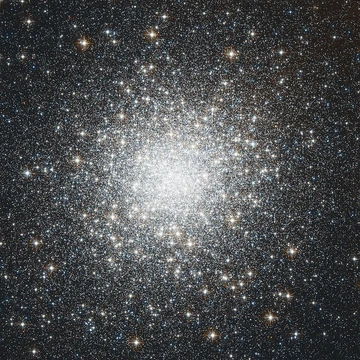
Messier 5
A globular cluster in Serpens with many variable stars.

Messier 5 (NGC 5904) is a globular cluster located in the constellation Serpens. German astronomer Gottfried Kirch first spotted it in 1702 while observing a comet. Under exceptionally clear skies, it can be glimpsed with the naked eye as a faint point of light about 0.37 degrees northwest of the star 5 Serpentis. Binoculars or a small telescope reveal it as a non-stellar object, while larger instruments show individual stars, the brightest of which shine at magnitude 10.6.
Charles Messier added the cluster to his catalog of nebulae in 1764, and William Herschel became the first to resolve its individual stars in 1791, counting roughly 200. The cluster is moving away from the Solar System at a speed exceeding 50 km/s.
M5 hosts 105 known variable stars, 97 of which are RR Lyrae types. These "cluster variables" behave similarly to Cepheid variables and serve as distance indicators because their luminosity and period are closely linked. The brightest variable in M5 fluctuates between magnitudes 10.6 and 12.1 over a period just under 26.5 days.
The cluster contains two millisecond pulsars; one is part of a binary system, which has allowed astronomers to measure the cluster’s proper motion. This binary may also help constrain models of neutron degenerate matter—if its median mass holds, it would rule out any "soft" equation of state for such material. M5 has also been used to search for magnetic dipole moments in neutrinos, a line of inquiry that could inform the study of hypothetical particles like the axion. Additionally, a dwarf nova has been observed within the cluster.
Quick Facts
- Epoch
- J2000
- Class
- V
- Constellation
- Serpens
- Ra
- 15 · 18 · 33.22
- Dec
- +02 · 04 · 51.7
- Dist Ly
- 24.5 kly
- Appmag V
- 5.6
- Radius Ly
- 80 ly
- Metal Fe
- –1.12
- Age
- 10.62 Gyr
- Names
- NGC 5904, GCl 34
Facts from the source article.
Lore & Background
Messier 5 was discovered by German astronomer Gottfried Kirch in 1702 while he was observing a comet. Charles Messier noted it in 1764 and, being a studier of comets, cast it as one of his nebulae. William Herschel was the first to resolve individual stars in the cluster in 1791, counting roughly 200. The cluster is receding from the Solar System at a speed over 50 km/s.
Under extremely good conditions, M5 is just visible to the naked eye as a faint 'star' 0.37 of a degree (22 arcminutes) north-west of star 5 Serpentis. Binoculars and/or small telescopes resolve the object as non-stellar; larger telescopes show some individual stars, some as bright as apparent magnitude 10.6.
Within M5, there are 105 known variable stars, 97 of them belonging to the RR Lyrae type. The brightest and most easily observed variable in M5 varies from magnitude 10.6 to 12.1 in a period of just under 26.5 days. The cluster also contains two millisecond pulsars, one of which is in a binary, allowing the proper motion of the cluster to be measured. A dwarf nova has also been observed in this cluster.
Reader's Guide
Messier 5 holds significance as a globular cluster rich in variable stars, particularly RR Lyrae variables, which are useful for measuring distances in space because the relation between their luminosities and periods is well known. The cluster's two millisecond pulsars, one in a binary system, allow measurement of the cluster's proper motion and may help understand neutron degenerate matter; the current median mass of that binary, if confirmed, would exclude any 'soft' equation of state for such matter. Additionally, the cluster has been used to test for magnetic dipole moments in neutrinos, which could shed light on hypothetical particles such as the axion. The presence of a dwarf nova adds to its observational interest. Discovered in 1702 by Gottfried Kirch and later cataloged by Charles Messier, M5 was the first globular cluster in which William Herschel resolved individual stars, counting roughly 200. Its visibility under good conditions and its varied stellar populations make it a notable object for both amateur and professional astronomers.
Did You Know?
- William Herschel was the first to resolve individual stars in M5 in 1791, counting roughly 200.
- A dwarf nova has been observed in M5.
A Comet Chaser's Accidental Gift
In 1702, German astronomer Gottfried Kirch was tracking a comet when his attention drifted to a faint smudge in the constellation Serpens. That casual glance produced what we now catalog as Messier 5, also known by its New General Catalogue designation NGC 5904. For over six decades the object sat quietly in the astronomical record until Charles Messier, himself a devoted comet hunter, logged it in 1764 and filed it among his list of nebulae—essentially flagging it so future comet seekers would not mistake it for a wandering star. The cluster's true structure, however, remained hidden for another generation. It was not until 1791 that William Herschel turned his powerful reflector toward M5 and became the first observer to break the hazy glow into individual points of light, tallying roughly two hundred distinct stars within the cluster's core. That single act transformed M5 from a vague nebulous patch into a genuine stellar system and opened the door to the rich population of stars we study today.
Seeing the Unseen: M5 from Earth
Under the darkest, steadiest skies, a patient observer can pick out Messier 5 with the unaided eye, though it appears no brighter than a dim star. It sits roughly 0.37 degrees—about 22 arcminutes—northwest of the star 5 Serpentis, a position that makes it a natural companion target for anyone already scanning that stretch of Serpens. Step up to a pair of binoculars or a modest telescope and the object immediately betrays its non-stellar nature, resolving into a soft, extended glow rather than a pinpoint. With a larger aperture, the cluster's individual members begin to emerge, and the brightest of these reach an apparent magnitude of about 10.6, a level that rewards patient averted vision on a transparent night. Beyond its visual appeal, M5 is also on the move: it is receding from our Solar System at a velocity exceeding 50 kilometres per second, a reminder that even the most ancient stellar systems are participants in the grand cosmic expansion.
A Laboratory of Pulsing Stars
Messier 5 harbours a remarkable population of variable stars: 105 have been identified, and a striking 97 of those belong to the RR Lyrae class. These pulsating giants, often nicknamed Cluster Variables, share a kinship with the better-known Cepheid variables, and like their cousins they obey a well-characterised relationship between luminosity and pulsation period. That relationship makes them invaluable cosmic yardsticks, letting astronomers gauge distances to far-off regions of the galaxy. Within M5, the most luminous and readily observable of these variables swings between apparent magnitudes 10.6 and 12.1 over a cycle of just under 26.5 days, a rhythm that has been tracked by observers for generations. The sheer density of RR Lyrae members in this single cluster has made M5 a natural testing ground for refining the period-luminosity calibration, reinforcing its role as a cornerstone in the extragalactic distance ladder.
Pulsars, Neutrinos, and the Edge of Physics
Messier 5 is home to two millisecond pulsars, and one of them is locked in a binary orbit. That pairing is no mere curiosity: it provides a means to measure the cluster's proper motion with precision, anchoring M5's trajectory through the Milky Way. The binary system also offers a window into the behaviour of neutron degenerate matter. If the current median mass estimate holds up under further scrutiny, it would rule out any soft equation of state for that ultra-dense material, narrowing the range of viable nuclear-physics models. M5 has additionally served as a stage for probing the magnetic dipole moments of neutrinos, a line of inquiry that could illuminate the existence of hypothetical particles such as the axion. Even a dwarf nova has been catalogued within the cluster, reminding us that this ancient stellar city is still a site of active, if rare, stellar evolution.
More in Globular Clusters 1-24
Spotted an error? Know more?
Reader corrections go straight into our review queue. Suggest an edit · How this site is sourced