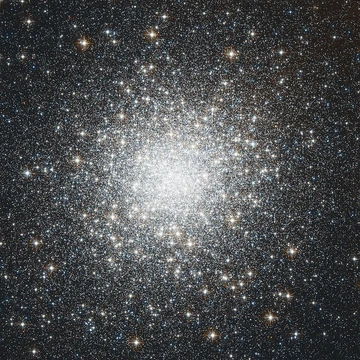
Liller 1
Massive, gamma-ray-bright globular cluster near the Milky Way's center.

Liller 1 is a globular cluster in the constellation Scorpius, discovered by the American astronomer William Liller in 1977. It is notable for being one of the most massive globular clusters in the Milky Way, with a mass of around 2.3 million solar masses, and for having the highest level of gamma-ray emission of any globular cluster. It is located close to the center of the Milky Way in its galactic bulge, only 2,600 light-years from the center, and is heavily obscured by dust.
Quick Facts
- Epoch
- J2000
- Dist Ly
- 26.4 ± 3.3 kly
- Dist Pc
- 8.1 ± 1.0 kpc
- Constellation
- Scorpius
- Ra
- 17 · 33 · 24.5
- Dec
- −33 · 23 · 20
- Mass Msol
- ~2.3e6
- Metal Fe
- −0.36
- Names
- C1730-333, MXB1730-333, J173324.56-332319.8
Facts from the source article.
Lore & Background
Liller 1 is located within the galactic bulge and is heavily obscured by dust, being close to the galactic plane. Studies of this object have mostly been conducted in wavelengths other than the optical range. The absorbing clouds of dust are not uniform, and the extinction coefficient RV is 2.5, less than the typically assumed value of 3.1. After Terzan 5, it has the highest rate of stellar collisions of any Milky Way globular cluster. It also has the highest level of emission of gamma rays of any globular cluster, which may be due to a large number of stellar collisions and pulsars, but it may also be an unrelated background gamma ray source. Liller 1 and Terzan 5 are remarkably similar. Although globular clusters are typically metal-poor, both have a relatively high metallicity; the abundance of metals for Liller 1 is estimated to be half that of the Sun. In 2021, Liller 1 was found to have two different stellar populations, like Terzan 5. One is about 12 billion years old, but the other is relatively young, at 1 to 3 billion years. This suggests that it may not be a true globular cluster, but a class of star cluster that coalesced to form galactic bulges, known as 'bulge fossil fragments'. The globular cluster contains the rapid burster called MXB 1730-335.
Reader's Guide
Liller 1's significance lies in its extreme properties and its challenge to traditional views of globular clusters. As one of the most massive clusters, with a mass of around 2.3 million solar masses, it rivals ω Centauri and Terzan 5. Its highest rate of stellar collisions among Milky Way globular clusters (after Terzan 5) and its highest gamma-ray emission make it a unique laboratory for studying stellar dynamics and high-energy astrophysics. The discovery of two distinct stellar populations—one ancient at 12 billion years and one young at 1 to 3 billion years—suggests that Liller 1 may not be a true globular cluster but a 'bulge fossil fragment,' a relic of the formation of the galactic bulge. This has implications for understanding how galaxies build their central regions. Its high metallicity, half that of the Sun, further sets it apart from typical metal-poor globular clusters. The presence of the rapid burster MXB 1730-335 adds to its astrophysical interest. The uncertainty regarding the source of its gamma rays—whether from internal collisions and pulsars or an unrelated background source—underscores the ongoing research needed to fully understand this object.
Did You Know?
- Liller 1 was discovered by American astronomer William Liller in 1977.
- It contains the rapid burster MXB 1730-335.
Classification as a Globular Cluster
Liller 1 is catalogued as a globular cluster, a dense, gravitationally bound assembly of stars that distinguishes it from the looser open clusters or solitary stellar objects found elsewhere in the sky. The designation "1" appended to the name Liller indicates it holds a primary or first position within a naming series, suggesting that additional objects may share the Liller identifier in subsequent numerical order. As a globular cluster, Liller 1 represents a long-lived stellar community whose constituent stars are held together by mutual gravitational attraction, forming a roughly spherical configuration. Its recognition as a distinct astronomical entity places it among the many deep-sky objects that populate the night firmament, and its inclusion in reference materials confirms its established place in the catalogued inventory of known celestial groupings. The cluster's identity as a globular formation, rather than a nebula, galaxy, or individual star, defines the fundamental nature of what an observer would encounter when directing an instrument toward its coordinates.
Residence in the Scorpius Constellation
The globular cluster known as Liller 1 occupies a position within the constellation Scorpius, one of the most recognizable and ancient figures mapped across the night sky. Scorpius is a zodiac constellation whose distinctive curved shape has been traced by stargazers for millennia, and Liller 1's placement within its boundaries means the cluster shares its apparent celestial neighborhood with the constellation's principal stars. This locational detail situates Liller 1 in a specific sector of the sky, making it accessible to observers who know the general region of Scorpius and wish to search for fainter deep-sky objects nestled among the brighter stellar markers. The association with Scorpius also ties the cluster to a rich tradition of astronomical observation, as this constellation has long served as a reference point for navigating the southern sky. For a globular cluster, being catalogued within a well-known constellation lends a degree of observational accessibility, as the surrounding bright stars provide familiar landmarks for locating the fainter, more diffuse cluster glow that defines a globular formation to the unaided eye or through modest optical instruments.
The Liller Name and Astronomical Heritage
The designation Liller 1 carries a personal name that connects it to a broader constellation of Liller-associated figures and objects. Among the most notable is William Liller, an American astronomer who lived from 1927 to 2021, whose professional work in the field of astronomy lends a scholarly dimension to the name borne by this globular cluster. The naming convention of pairing a surname with a numerical suffix, as seen in Liller 1, is characteristic of cataloguing systems used to organize and identify celestial objects discovered or studied by particular researchers. This cluster is not the only astronomical body to carry the Liller identifier; the minor planet 3222 Liller also shares this nomenclature, indicating that the name has been applied across different categories of celestial objects. The presence of the numeral "1" specifically designates this globular cluster as the first entry in its particular naming sequence, a convention that helps astronomers distinguish it from any subsequent objects that might receive the Liller designation in their own class. Together, these naming threads weave a heritage of astronomical scholarship into the identity of what is, at its core, a dense sphere of ancient stars.
A Name Shared Across Disciplines
Beyond the purely astronomical realm, the name Liller spans an eclectic range of human endeavor, and Liller 1 sits at the intersection of this broader cultural footprint. The Danish jazz musician and singer-songwriter Bjarne Liller, who lived from 1935 to 1993, brought the name into the world of performance and composition, creating a striking contrast with the silent, ancient stellar assembly that shares the same identifier. The minor planet 3222 Liller extends the name into the domain of small solar-system bodies, while the reference to Lillers points toward a geographical or toponymic usage entirely separate from astronomy or music. This scattering of the Liller name across jazz performance, planetary science, stellar astronomy, and place-naming illustrates how a single surname can anchor disparate fields of human knowledge and creativity. For Liller 1 specifically, its position within this wider family of references means that a search for the name yields not only a globular cluster in Scorpius but also a legacy of artistic and scientific contribution, making the cluster one thread in a larger tapestry of human nomenclature and discovery.
More in Globular Clusters 1-24
Spotted an error? Know more?
Reader corrections go straight into our review queue. Suggest an edit · How this site is sourced