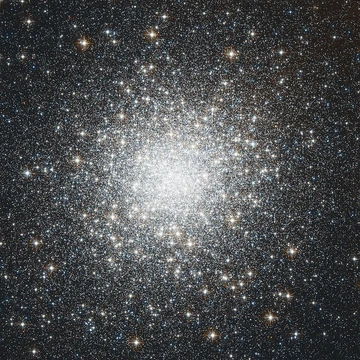
Laevens 1
Most distant Milky Way globular cluster, discovered in 2014.

Laevens 1, discovered in 2014, is a dim globular cluster found in the constellation Crater. It goes by several other names, including Crater, the Crater cluster, and PSO J174.0675-10.8774. Situated 145 kiloparsecs (470,000 light-years) away in the Milky Way's galactic halo, it holds the record as the most distant globular cluster known to belong to our galaxy.
With an estimated age of just 7.5 billion years, Laevens 1 was likely pulled into the Milky Way long after the galaxy's formation, probably during an encounter with the Small Magellanic Cloud. Early studies initially classified it as a satellite galaxy due to the presence of a few blue loop stars and a sparse red clump—features that would suggest star formation within the last 400 million years, which is highly unusual for a globular cluster. However, more recent analysis indicates that some of those stars were mistakenly assigned to the cluster, skewing the results. After removing them, researchers reclassified Laevens 1 as a faint, intermediate-age globular cluster.
This cluster orbits the galaxy at roughly the same distance as the ultrafaint dwarf galaxies Leo IV and Leo V. This proximity hints that all three objects may have once been closely linked before falling together into the Milky Way's halo.
Quick Facts
- Epoch
- J2000
- Ra
- 11 · 36 · 16.2
- Dec
- –10 · 52 · 38.8
- Dist Ly
- 145 kpc
- Constellation
- Crater
- Radius Ly
- 50 pc
- V Hb
- 14.2
- Metal Fe
- –1.65
- Age
- 7.5 Gyr
- Notes
- Unusually young and distant Milky way cluster.
- Names
- Crater cluster, PSO J174.0675-10.8774
- Absmag V
- −5.3
Facts from the source article.
Lore & Background
Laevens 1 was discovered in 2014 in the constellation Crater. With an age of only 7.5 Gyr, it is likely to have been incorporated into our galaxy long after the formation of the Milky Way, probably during an interaction with the Small Magellanic Cloud. Some analyses initially categorized it as a satellite galaxy, because of the presence of a handful of blue loop stars and a sparsely populated red clump; the existence of some of these types of stars in Laevens 1 would imply relatively recent star formation (within 400 Myr). Such recent formation would be very atypical for a globular cluster. More recent work suggests that some of these stars were erroneously assigned membership of the cluster, distorting the overall result. After removing these, the subsequent reanalysis concluded that Laevens 1 is a faint, intermediate-age globular cluster. Laevens 1 is orbiting the galaxy at approximately the same distance as the ultrafaint dwarf galaxies Leo IV and Leo V, hinting that all three satellites may once have been closely associated before falling together into the Milky Way halo.
Reader's Guide
Laevens 1 is notable as the most distant Milky Way globular cluster known, located 145 kiloparsecs away in the galactic halo. Its relatively young age of 7.5 Gyr suggests it was not formed with the Milky Way but was later incorporated, likely during an interaction with the Small Magellanic Cloud. The cluster's initial misclassification as a satellite galaxy, due to stars that implied recent star formation, was later corrected after those stars were found to be erroneously assigned members. This reanalysis confirmed its status as a faint, intermediate-age globular cluster. Its orbital distance matches that of the ultrafaint dwarf galaxies Leo IV and Leo V, indicating a possible common origin before all three fell into the Milky Way halo. The cluster thus provides insight into the accretion history of the Milky Way and the nature of faint stellar systems at the boundary between globular clusters and dwarf galaxies.
Did You Know?
- Laevens 1 is the most distant Milky Way globular cluster known, at 145 kiloparsecs.
- It was initially misclassified as a satellite galaxy due to blue loop stars and a red clump.
- Its age of 7.5 Gyr suggests it was incorporated into the Milky Way long after the galaxy formed.
Discovery and Naming
Laevens 1 first entered the astronomical record in 2014, when it was identified as a faint globular cluster nestled within the constellation Crater. Because of its low surface brightness, it had eluded earlier surveys, making its 2014 detection a meaningful addition to the catalog of known stellar systems. The object carries several alternative designations that reflect both its positional location and its catalog entry: it is sometimes simply called Crater or the Crater cluster after the constellation in which it resides, and it also appears under the identifier PSO J174.0675-10.8774, a designation tied to its sky coordinates. Its entry in the SIMBAD astronomical database, maintained by the Centre de données astronomiques de Strasbourg, confirms its standing as a recognized stellar object. Despite its modest appearance through telescopes, Laevens 1 would go on to claim a remarkable distinction in terms of distance, reshaping what astronomers understood about the outermost reaches of our galaxy's globular cluster population.
The Most Distant Globular Cluster
At a distance of approximately 145 kiloparsecs, equivalent to roughly 470 kilolight-years, Laevens 1 holds the distinction of being the most distant globular cluster yet confirmed as a member of the Milky Way. This places it far beyond the familiar ring of clusters that orbit closer to the galactic disk, deep within the vast, diffuse halo that envelops our entire galaxy. The halo is a sparse, spherical region of ancient stars and dark matter, and finding a globular cluster so far out underscores just how extended the Milky Way's gravitational domain truly is. For astronomers studying the structure and evolution of our galaxy, Laevens 1 serves as a valuable probe of the outer halo environment. Its faintness and remoteness made it a challenging target for observation, and its identification in 2014 pushed the known boundary of the Milky Way's globular cluster system to a new extreme, reminding researchers that even in the well-studied Local Group, there remain objects waiting to be found at the very edges of galactic territory.
A Younger Cluster with a Borrowed Origin
Unlike the ancient globular clusters that formed in the early epochs of the universe, Laevens 1 carries an estimated age of only 7.5 billion years. This relatively young age for a globular cluster suggests it did not form alongside the first generations of stars in the Milky Way. Instead, the prevailing interpretation is that Laevens 1 was incorporated into our galaxy's halo long after the Milky Way itself had already taken shape. The leading hypothesis points to a gravitational interaction with the Small Magellanic Cloud as the likely event that delivered this cluster into the Milky Way's orbit. In this scenario, Laevens 1 may have been part of the Small Magellanic Cloud's own stellar population or a companion system before being stripped away and captured by the much more massive Milky Way. This origin story paints Laevens 1 not as a native resident but as a cosmic immigrant, a remnant of a close encounter between two galaxies that left its mark on the structure of both.
From Satellite Galaxy to Globular Cluster
The initial analyses of Laevens 1's stellar population raised an unexpected question. A handful of blue loop stars and a sparsely populated red clump were detected, features that would imply relatively recent star formation occurring within the last 400 million years. Such recent activity is highly atypical for a globular cluster, which is generally expected to be a quiescent, old stellar system. These findings led some researchers to tentatively reclassify Laevens 1 as a satellite galaxy rather than a globular cluster. However, subsequent work revealed that some of the stars in question had been erroneously assigned to the cluster's membership, artificially inflating the apparent evidence for young populations. Once these misidentified stars were removed, a reanalysis confirmed that Laevens 1 is best described as a faint, intermediate-age globular cluster. Adding to its intriguing story, Laevens 1 orbits the Milky Way at roughly the same distance as the ultrafaint dwarf galaxies Leo IV and Leo V, a coincidence that hints all three objects may once have been closely associated before collectively plunging into the galactic halo.
More in Globular Clusters 1-24
Spotted an error? Know more?
Reader corrections go straight into our review queue. Suggest an edit · How this site is sourced