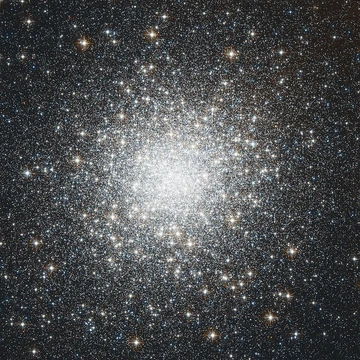
Globular cluster
Spheroidal star clusters bound by gravity, found in galactic halos.

A globular cluster is a roughly spherical swarm of stars, pulled together by gravity, with stars packed more tightly near the center. These clusters can hold anywhere from tens of thousands to millions of stars, all moving in a stable, tight orbit around a common center. This is different from open clusters, whose stars are loosely connected and easily scattered. Globular clusters look a lot like dwarf spheroidal galaxies, and while they were once thought to be brighter than those galaxies, discoveries by the early 2000s blurred the line between the two. The name comes from the Latin *globulus*, meaning "small sphere," and they are sometimes just called "globulars."
One globular cluster, Omega Centauri, was spotted in ancient times and mistaken for a star. It wasn't until telescopes appeared in the 1600s that astronomers began to understand what these objects really were. Early telescope views showed them as fuzzy blobs, which is why Charles Messier added many to his catalog of objects that could be confused with comets. With bigger telescopes in the 1700s, astronomers saw that globular clusters were actually groups of many individual stars. In the early 1900s, the way these clusters were spread across the sky gave some of the first clues that the Sun is not at the center of the Milky Way.
Globular clusters exist in almost every galaxy. In spiral galaxies like the Milky Way, they are mostly found in the outer, spherical halo. They are the biggest and heaviest kind of star cluster, generally older, denser, and with fewer heavy elements than open clusters, which usually sit in the disks of spiral galaxies. The Milky Way has more than 150 known globular clusters, and there could be more.
No one is entirely sure how globular clusters form or what role they play in how galaxies evolve. Some are among the oldest objects in their galaxies—and in the universe—which helps scientists estimate the universe's age. Astronomers used to think all the stars in a globular cluster were born at the same time from a single nebula, but now we know that nearly all clusters contain stars that formed at different times or have different compositions. Some clusters may have gone through multiple rounds of star formation, and some might be the leftover cores of smaller galaxies that were swallowed by bigger ones.
Quick Facts
- Thing
- Star cluster
- Qid
- Q11276
- Commonscat
- Globular Clusters
- Discover
- Abraham Ihle, 1665
- Mass
- 1K · thousand - >1M · million
- Density
- ~2 stars/cubic ly · light year
- Luminosity
- ~25 000
Facts from the source article.
Lore & Background
The first known globular cluster, M 22, was discovered in 1665 by German amateur astronomer Abraham Ihle. Omega Centauri, visible to the naked eye, was known to ancient astronomers like Ptolemy as a star, reclassified as a nebula by Edmond Halley in 1677, and finally as a globular cluster by John Herschel in the early 19th century. Charles Messier included many globular clusters in his catalog of objects that could be mistaken for comets. William Herschel coined the term 'globular cluster' in 1789 after discovering 36 new clusters and resolving virtually all into stars. In 1914, Harlow Shapley began studies using RR Lyrae variables to estimate distances, though he overestimated them because RR Lyrae variables are fainter than Cepheid variables. In 1918, Shapley used the asymmetrical distribution of globular clusters to determine the Sun's position relative to the Galactic Center, correctly concluding the center is in Sagittarius. The Shapley–Sawyer Concentration Class system, developed in 1927–1929, categorizes clusters from Class I (most concentrated) to Class XII (most diffuse). In 2015, astronomers from the Pontifical Catholic University of Chile proposed a new type: dark globular clusters.
Reader's Guide
Globular clusters are significant because they are among the oldest objects in their galaxies and the universe, constraining estimates of the universe's age. Their distribution in the sky provided early evidence that the Sun is far from the center of the Milky Way, contrary to earlier assumptions based on the uniform distribution of ordinary stars. The count of known globular clusters in the Milky Way has steadily increased, reaching 160 by 2011 with discoveries from the VISTA infrared survey. The Andromeda Galaxy may have as many as five hundred globulars, and giant elliptical galaxies like M 87 can have up to 13,000. Their formation is poorly understood; while traditionally thought to consist of stars formed at the same time from one nebula, nearly all globular clusters contain stars that formed at different times or have differing compositions. Some may be remnants of smaller galaxies captured by larger ones. In elliptical and lenticular galaxies, there is a correlation between the mass of the central supermassive black hole and the extent of the globular cluster system. No known globular clusters display active star formation.
Did You Know?
- The name 'globular cluster' comes from Latin globulus (small sphere).
- Omega Centauri was known to ancient astronomers as a star but was reclassified as a globular cluster in the early 19th century.
- Harlow Shapley overestimated distances to globular clusters because he assumed RR Lyrae variables were Cepheid variables.
- In 2015, astronomers proposed a new type called 'dark globular clusters'.
Structure and Stellar Composition
A globular cluster is a tightly packed, roughly spherical collection of stars held together by mutual gravitational attraction. Unlike the loose, easily scattered groupings found in open clusters, these dense assemblies contain anywhere from tens of thousands to several millions of stars, all orbiting within a compact, stable configuration. The stellar density peaks sharply toward the core, giving the cluster its characteristic spheroidal profile. In terms of chemical makeup, globular clusters tend to be older and richer in stellar density than their open-cluster counterparts, while carrying lower abundances of heavy elements. They also resemble dwarf spheroidal galaxies in overall shape, though the boundary between the two categories has blurred considerably since the early 2000s, when outlier discoveries challenged the long-held assumption that globulars were always the more luminous of the pair. The name itself traces back to the Latin word globulus, meaning small sphere, and astronomers often shorten the term to simply "globulars."
From Fuzzy Blobs to Resolved Stars
The journey from misty smudge to resolved stellar system spans centuries. Ancient observers, including Ptolemy, catalogued Omega Centauri as merely a bright star in the southern sky. It was not until the 17th century that telescopes revealed these objects were something other than single points of light. In 1665, German amateur astronomer Abraham Ihle identified M 22, while Edmond Halley reclassified Omega Centauri as a nebula in 1677. Early telescopic views still showed only fuzzy patches, which led Charles Messier to list many of them among objects that might be confused with comets. It was not until 1764 that Messier resolved M 4 into individual stars. William Herschel, working with much larger instruments from 1782 onward, resolved nearly all known clusters into their component stars and formally coined the term "globular cluster" in his 1789 catalogue. By that point, only 34 were known; Herschel added 36 more to the tally.
Mapping the Milky Way's True Shape
The spatial arrangement of globular clusters proved to be one of the earliest and most powerful pieces of evidence that the Sun does not sit at the heart of the Milky Way. In 1918, Harlow Shapley exploited the strongly lopsided distribution of these clusters—concentrated in the outer spheroidal halo rather than the flat disk—to estimate the galaxy's overall dimensions and the Sun's offset position. He correctly identified the galactic center as lying in the direction of Sagittarius, though his distance estimates of 10 to 30 kiloparsecs overshot the modern value of roughly 8.5 kiloparsecs. The reason ordinary star counts had misled earlier astronomers was that most disk stars are hidden behind interstellar gas and dust, while halo globulars sit well above the obscuring plane and remain visible at far greater ranges. Today the Milky Way hosts over 150 confirmed globulars, a number that climbed from 83 in 1915 to 160 by 2011, when the VISTA infrared survey added two new members.
Origins Still Wrapped in Mystery
Despite their ubiquity—found in nearly every galaxy of sufficient mass, with giant ellipticals like M 87 hosting as many as 13,000—globular clusters remain enigmatic in their birth and evolution. They are among the oldest objects in their host galaxies and even in the observable universe, making them crucial anchors for constraining the cosmic age. For decades, the prevailing picture held that all stars within a single cluster formed simultaneously from one parent nebula. Modern observations have shattered that simplicity: nearly every globular cluster examined contains stars of differing ages or chemical compositions, pointing to multiple, sequential episodes of star formation. Some researchers now propose that certain clusters are not native formations at all but rather the stripped cores of smaller galaxies that were gravitationally captured and dismantled by larger hosts. The precise mechanisms governing both their creation and their long-term role in galactic evolution continue to elude a definitive explanation.
More in Globular Clusters 1-24
Spotted an error? Know more?
Reader corrections go straight into our review queue. Suggest an edit · How this site is sourced