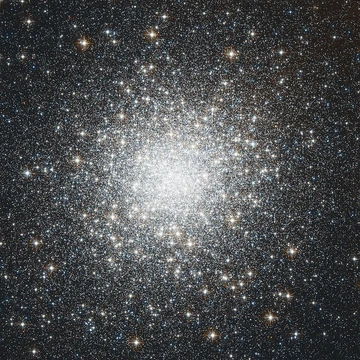
Messier 10
A globular cluster in Ophiuchus with a rich variable star population.

Messier 10 (also known as NGC 6254) is a globular cluster in the equatorial constellation Ophiuchus. French astronomer Charles Messier first spotted it on May 29, 1764, calling it a "nebula without stars" and listing it as number 10 in his catalog. German astronomer Johann Elert Bode described it similarly in 1774 as a "nebulous patch without stars; very pale." Using larger telescopes, William Herschel resolved the cluster into individual stars, calling it a "beautiful cluster of extremely compressed stars." William Parsons, 3rd Earl of Rosse, thought he saw a dark lane running through part of it. Harlow Shapley made the first distance estimate, putting it at 33,000 light-years—much farther than the modern figure.
The cluster's tidal radius spans 19.3 arcminutes, roughly two-thirds the Moon's apparent diameter. Through medium-sized telescopes, it looks about half that size (8–9 arcminutes), as its bright core measures only 35 light-years across. Its core radius is 48 arcseconds, and its half-mass radius is 147 arcseconds (2.5 arcminutes). M10 has a spatial diameter of 83 light-years and lies about 14,300 light-years from Earth. It sits one degree west of 30 Ophiuchi, an orange star at the constellation's center.
In terms of elements heavier than hydrogen and helium—what astronomers call metallicity—M10 is "moderately metal-poor." Its iron abundance ([Fe/H] = –1.45 ± 0.04 dex) is just 3.5% of the Sun's surface iron. The cluster shows enrichment from elements produced by the s-process in massive stars and Type II supernovae, but little evidence of enrichment from Type Ia supernovae.
Binary stars, being on average more massive than normal stars, tend to drift toward the cluster's center. In the core, about 14% of stars are binaries; this fraction drops to roughly 1.5% in the outer regions. The core also holds a concentration of blue straggler stars formed through interactions, most of which originated 2–5 billion years ago. The core's stellar density is about 3.8 solar masses per cubic parsec. Thirty-five variable stars have been found in the cluster, including one RR Lyrae variable, two eclipsing binaries, three W Virginis variables, five semiregular variables, and 16 SX Phoenicis variables. The cluster also contains two known millisecond pulsars.
M10 currently sits about 5 kiloparsecs (16,000 light-years) from the Galactic Center.
Quick Facts
- Epoch
- J2000
- Class
- VII
- Constellation
- Ophiuchus
- Ra
- 16 · 57 · 8.92
- Dec
- -04 · 05 · 58.07
- Dist Ly
- 14.3 kly
- Appmag V
- 6.6
- Mass Msol
- 2.25 × 10 / 5
- Radius Ly
- 41.6 ly
- Metal Fe
- –1.25
- Age
- 11.39 Gyr
- Names
- GCl-49, NGC 6254
Facts from the source article.
Lore & Background
Messier 10 was discovered by French astronomer Charles Messier on May 29, 1764, who cataloged it as number 10 in his catalogue and described it as a 'nebula without stars.' In 1774, German astronomer Johann Elert Bode similarly called it a 'nebulous patch without stars; very pale.' Using larger instrumentation, German-born astronomer William Herschel resolved the cluster into individual stars, describing it as a 'beautiful cluster of extremely compressed stars.' William Parsons, 3rd Earl of Rosse thought he could distinguish a dark lane through part of the cluster. The first to estimate the distance was Harlow Shapley, though his derivation of 33,000 light years was much further than the modern value.
The cluster's tidal radius is 19.3 arcminutes, about two-thirds the apparent diameter of the Moon. Viewed through medium-sized telescopes, its bright core appears about half that size (8–9 arcminutes) and is only 35 light-years across. It has a core radius of 48 arcseconds and a half-mass radius of 147 arcseconds. M10 has a spatial diameter of 83 light-years and is estimated to be 14,300 light-years from Earth. It lies a degree west of 30 Ophiuchi, a center-of-constellation orange star.
In terms of metallicity, M10 is 'moderately metal–poor,' with an iron abundance only 3.5% of that at the Sun's surface. The cluster shows evidence of enrichment by elements from the s-process in massive stars and Type II supernovae, but little evidence of enrichment by Type Ia supernovae. Binary stars, being on average more massive, migrate toward the center, with a binary fraction of about 14% in the core decreasing to about 1.5% in the outskirts. The core region contains a concentration of blue straggler stars, most formed 2–5 billion years ago. The core density is about 3.8 solar masses per cubic parsec. Thirty-five variable stars have been discovered, including one RR Lyrae, two eclipsing binaries, three W Virginis, five semiregular, and 16 SX Phoenicis variables, plus two known millisecond pulsars. The cluster orbits the Milky Way every 140 million years, crossing the galactic disk every 53 million years, with an orbital eccentricity of 0.21.
Reader's Guide
Messier 10's significance lies in its well-documented history of observation and its role in understanding globular cluster dynamics and stellar populations. Discovered by Charles Messier in 1764 as a 'nebula without stars,' it was later resolved by William Herschel, illustrating the progression of telescopic capability. The cluster's moderately metal-poor composition, with iron abundance only 3.5% of the Sun's, provides insight into chemical enrichment processes, showing evidence of s-process and Type II supernova enrichment but not Type Ia supernovae. Its binary star population, concentrated in the core at 14% and decreasing outward, demonstrates mass segregation, a key dynamical process. The presence of 35 variable stars, including RR Lyrae, eclipsing binaries, and SX Phoenicis variables, along with two millisecond pulsars, makes M10 a valuable laboratory for stellar evolution and pulsation studies. The cluster's orbit around the Milky Way, with a period of 140 million years and an eccentricity of 0.21, contributes to understanding the galaxy's gravitational field and the cluster's history of disk crossings every 53 million years.
Did You Know?
- Messier 10 was discovered by Charles Messier on May 29, 1764, who described it as a 'nebula without stars.'
- The cluster's iron abundance is only 3.5% of that found at the surface of the Sun.
- The core region contains about 14% binary stars, decreasing to 1.5% in the outer regions.
Anatomy of a Spheroidal Star City
M10 belongs to a family of stellar systems that defies the casual fuzzy-smudge impression early telescopes once gave them. At its core, this object is a spheroidal congregation of stars held in a stable, compact configuration by mutual gravitational attraction. Rather than scattering loosely across space the way members of an open cluster do, the population here is packed with a noticeably higher density toward the center, producing a rounded, ball-like profile. The total membership can range from tens of thousands up to many millions of individual suns, all sharing a common orbital dance. The very name globular cluster traces back to the Latin word globulus, meaning a small sphere, and in casual astronomical parlance these objects are often shortened to simply globulars. Structurally, they bear a striking resemblance to dwarf spheroidal galaxies, a similarity that has only grown more pronounced in recent decades as astronomers have uncovered outlier systems that blur the boundary between the two categories. What distinguishes M10 and its kin from the more fragile, readily scattered open clusters is this tight gravitational binding and the resulting long-term stability of the entire formation.
From Fuzzy Blob to Resolved Stars
For centuries, objects like M10 were nothing more than faint smudges in the night sky, indistinguishable from a bright star to the unaided eye. The true nature of these spheroidal groupings only became apparent with the arrival of telescopes in the 17th century. In those early peeks through small lenses, the clusters looked like soft, featureless blobs, which is precisely why the French astronomer Charles Messier catalogued many of them alongside comets and other nebulous objects he feared might be confused with passing comets. It was not until the 18th century, when larger instruments became available, that observers began to tease out the individual stars hiding within the haze. William Herschel's ambitious sky survey, launched in 1782, marked a turning point: he resolved virtually every known cluster into its constituent stars and formally introduced the term globular cluster in his 1789 catalogue. Before Herschel, only 34 such objects were known; his work added another 36. The low resolution of earlier telescopes had kept the stars visually inseparable until Messier himself managed to resolve M4 in 1764, a small but important milestone in the long process of understanding what these objects truly were.
A Halo of Ancient Beacons
M10 is not an isolated curiosity but one member of a vast population that surrounds the Milky Way in a great spheroidal shell called the galactic halo. Globular clusters of this type are the largest and most massive star clusters known, and they tend to be older, denser, and poorer in heavy elements than the younger open clusters that populate the flat disk of a spiral galaxy. The Milky Way alone is home to well over 150 confirmed globulars, and astronomers suspect even more remain hidden behind the gas and dust of the galactic plane. In 1918, Harlow Shapley exploited the strongly lopsided distribution of these clusters across the sky to argue that the Sun sits far from the galaxy's true center, which he placed in the direction of Sagittarius. His distance estimates were too large, but the qualitative conclusion was correct and overturned the old assumption that Earth occupied a central position. The confirmed count has climbed steadily over the decades, reaching 83 in 1915, 97 by 1947, and 160 by 2011, while more distant systems like Andromeda may host around five hundred, and giant ellipticals such as M87 can carry as many as 13,000.
A Puzzle of Birth and Age
Despite their apparent uniformity, the origins of clusters like M10 remain one of astrophysics' open questions. For a long time, the prevailing picture was simple: every star in a globular cluster formed simultaneously from a single cloud of collapsing gas. Modern observations have shattered that tidy model. Nearly all known clusters now show evidence that their stars were born at different epochs or carry measurably different chemical compositions, pointing to multiple, staggered episodes of star formation rather than a single burst. Some clusters may even be the surviving cores of small, early galaxies that were swallowed by larger hosts, meaning M10 could carry the fossil record of a primordial system. Because certain members of this family rank among the oldest objects in the universe, they serve as critical anchors for estimating the age of the cosmos itself. Yet their precise role in the broader story of how galaxies assemble and evolve over billions of years is still not fully understood, leaving astronomers with a rich but incomplete picture of where these ancient stellar cities came from.
More in Globular Clusters 1-24
Spotted an error? Know more?
Reader corrections go straight into our review queue. Suggest an edit · How this site is sourced