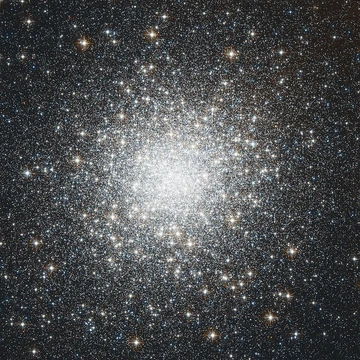
NGC 1818
Young globular cluster in the Large Magellanic Cloud.

NGC 1818 sits in the northwestern region of the Large Magellanic Cloud, roughly 3.2 kiloparsecs from that galaxy’s center. First spotted in 1826 by Scottish astronomer James Dunlop, it has since become a well-studied object. This globular cluster is young—its age is thought to lie between 25 and 40 million years—and has a core radius of about 2.67 parsecs, with a 90% light radius extending to 13.83 parsecs. Its total mass is roughly 13,500 times that of the Sun. Because of the cluster’s youth, most stars with a mass equal to or less than the Sun’s are still in the pre-main-sequence phase. The average metallicity—meaning the abundance of elements heavier than helium—is about −0.4, which corresponds to roughly 40% of the Sun’s metallicity. Within the cluster, two distinct stellar populations exist: the hotter, bluer stars rotate more slowly than the cooler, redder ones. Binary systems become more common farther from the cluster’s core, a pattern opposite to what is typical in globular clusters. This anomaly may arise because interactions in the dense core disrupt binary systems before mass segregation has had time to set in. The cluster contains very few, if any, blue stragglers—stars formed through mergers.
Quick Facts
- Epoch
- J2000
- Constellation
- Dorado
- Ra
- 05 · 04 · 13.300
- Dec
- −66 · 26 · 05.47
- Dist Ly
- ~164 kly
- Appmag V
- 9.7 (B band)
- Absmag V
- −8.8
- Age
- 30 or 40 Myr
- Notes
- Rare young globular
Facts from the source article.
Lore & Background
NGC 1818 was discovered by Scottish astronomer James Dunlop in 1826 and has since been well studied. The cluster has an estimated core radius of 2.67 pc and a 90% light radius of 13.83 pc, with a combined mass of around 13,500 times the mass of the Sun. Its age estimates range from 25 to 40 million years, meaning most stars with a mass equal to the Sun or less are still on the pre-main-sequence. The average stellar metallicity is −0.4, or about 40% of the abundance in the Sun.
There appear to be two distinct stellar populations in the cluster: the more blue (hotter) stars show slower rotation rates than the redder (cooler) stars. The frequency of binary star systems increases with distance from the core, which is the opposite of the normal trend for globular clusters. This may be explained by interactions with other stars in the denser core disrupting binary systems, before mass segregation of the cluster has begun to take effect. The cluster contains few if any blue stragglers, which are the result of stellar mergers.
Reader's Guide
NGC 1818 is significant as a young globular cluster that challenges typical expectations for such systems. Its youth, with an age of only 25 to 40 million years, means that many of its low-mass stars are still in the pre-main-sequence phase, offering a laboratory for studying early stellar evolution. The cluster's unusual binary star distribution—increasing in frequency away from the core—contrasts with the normal trend for globular clusters and suggests that dynamical interactions in the dense core have disrupted binaries before mass segregation could occur. The presence of two distinct stellar populations with different rotation rates adds further complexity, hinting at multiple formation episodes or environmental influences. The low number of blue stragglers, which typically arise from stellar mergers, is consistent with the cluster's youth and the lack of time for such mergers to accumulate. These features make NGC 1818 a valuable object for understanding the early evolution of star clusters and the dynamics of binary systems in dense environments.
Did You Know?
- The cluster's age is estimated between 25 and 40 million years.
- Binary star systems in NGC 1818 become more common farther from the core, opposite to the usual trend.
- The cluster has few if any blue stragglers.
More in Globular Clusters 1-24
Spotted an error? Know more?
Reader corrections go straight into our review queue. Suggest an edit · How this site is sourced