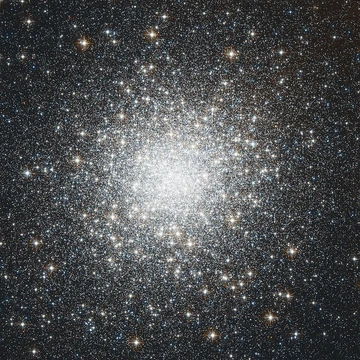
NGC 1466
Old globular cluster in the outskirts of the Large Magellanic Cloud.

NGC 1466 is a globular cluster in the deep southern constellation of Hydrus, located in the outskirts of the Large Magellanic Cloud, a satellite galaxy of the Milky Way. It is notable for its old age of 13.1 billion years and its classification as an Oosterhoff-intermediate cluster based on its RR Lyrae variable stars.
Quick Facts
- Epoch
- J2000
- Constellation
- Hydrus
- Ra
- 03 · 44 · 33
- Dec
- −71 · 40 · 17
- Dist Ly
- 48.5 kpc
- Appmag V
- 11.4
- Mass Msol
- 1.4e5
- Metal Fe
- −1.60
- Age
- 13.1 Gyr
- Names
- SL1, LW1, ESO54SC16, KMHK1, PGC 2802621
Facts from the source article.
Lore & Background
NGC 1466 was discovered on November 26, 1834 by English astronomer John Herschel. John Dreyer described it as 'pF, pS, iR, glbM, *7 f', meaning 'pretty faint, pretty small, irregular round, gradually a little brighter middle, with a 7th magnitude star nearby'. When viewed with a small telescope, it appears as a faint, small, unresolved and difficult target with an angular size of 1.9 arc minutes.
The cluster has a reddening corrected distance modulus of 18.43±0.15, corresponding to a distance of 48.5 kpc. Its mass is about 140,000 times that of the Sun, and it is an old cluster with an estimated age of 13.1 billion years. In photographs, the cluster spans an apparent size of 3.50 arc minutes, with a core radius of 10.7±0.4 arc seconds and a half-light radius of 24.3 arc seconds.
As of 2011, there are 49 known and one candidate RR Lyrae variable stars in the cluster, including eight double-mode RRd variables. The average periods are 0.591 days for RR Lyrae type ab and 0.335 days for RR Lyrae type c, consistent with an Oosterhoff-intermediate classification. Twelve other variables have been identified, including two long-period variables and a Cepheid variable.
Reader's Guide
NGC 1466 holds significance as an old globular cluster in the Large Magellanic Cloud, providing insights into the early history of that satellite galaxy. Its age of 13.1 billion years places it among the oldest known clusters, offering a window into star formation shortly after the Big Bang. The cluster's Oosterhoff-intermediate classification, derived from its RR Lyrae variable stars, is a key characteristic that helps astronomers understand the evolutionary status and metallicity of globular clusters. The presence of 49 known RR Lyrae variables, including double-mode RRd types, along with long-period variables and a Cepheid, makes it a valuable laboratory for studying stellar pulsation and distance measurement techniques. Its location in the outskirts of the Large Magellanic Cloud also aids in mapping the structure and dynamics of this nearby galaxy. The cluster's discovery by John Herschel in 1834 and its description by John Dreyer add historical context to its study, while its faint appearance in small telescopes underscores the challenges of observing such distant objects.
Did You Know?
- It contains 49 known RR Lyrae variable stars as of 2011.
- Its integrated visual magnitude is 11.4.
More in Globular Clusters 1-24
Spotted an error? Know more?
Reader corrections go straight into our review queue. Suggest an edit · How this site is sourced