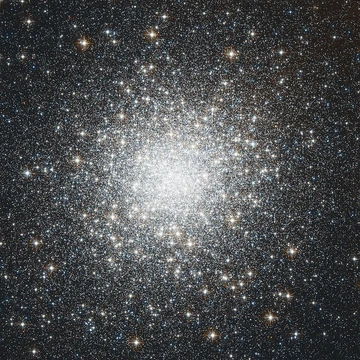
NGC 121
Oldest globular cluster in the Small Magellanic Cloud.

NGC 121 is a globular star cluster located in the southern constellation Tucana. It holds the title of the oldest globular cluster in the Small Magellanic Cloud (SMC), a dwarf galaxy that orbits the Milky Way. Discovered by English astronomer John Herschel on September 20, 1835, it was later described by Danish astronomer John Louis Emil Dreyer, compiler of the New General Catalogue, as "pretty bright, pretty small, little extended, very gradually brighter middle." The cluster lies roughly 200,000 light-years (60 kpc) from the Sun.
NGC 121 belongs to the West Halo region of the SMC, which is moving outward relative to the rest of the galaxy. It sits about 2.3° northwest of the SMC’s galactic center. Its mass is 360,000 times that of the Sun, with an angular half-light radius of 27.1″ and a tidal radius of 143″. The cluster is positioned roughly 32′ from the massive globular cluster 47 Tucanae, which has a tidal radius of 42.86′.
This cluster is the only old globular cluster in the SMC that resembles those in the Milky Way. Its age is estimated between 10.5 and 11.8 billion years, making it 2–3 billion years younger than the oldest comparable Milky Way clusters. Observations of its aging giant stars reveal two distinct stellar populations: a younger one chemically enriched by the first generation. The second generation makes up about 32% of the total population, but this fraction is higher in the cluster’s center, indicating it is more centrally concentrated.
RR Lyrae variable stars were detected in NGC 121 in 1988. In 2008, 20 candidate Dwarf Cepheid variables—including SX Phoenicis types—were reported. Additionally, in 1998, the Hubble Space Telescope identified 42 potential blue stragglers in the cluster.
Quick Facts
- Epoch
- J2000
- Constellation
- Tucana
- Ra
- 00 · 26 · 49.0
- Dec
- −71 · 32 · 10
- Dist Pc
- 60 kpc
- Appmag V
- 11.24
- Radius Ly
- 30.2 pc
- Metal Fe
- −1.280.03
Facts from the source article.
Lore & Background
NGC 121 was first discovered by English astronomer John Herschel on September 20, 1835. The compiler of the New General Catalogue, Danish astronomer John Louis Emil Dreyer, described this object as 'pretty bright, pretty small, little extended, very gradually brighter middle'. The cluster is located at a distance of around 200,000 light-years (60 kpc) from the Sun. It forms part of the West Halo, a region moving outward with respect to the rest of the SMC, and lies about 2.3° northwest of the SMC galactic center. The cluster is positioned about ~32′ from the massive globular cluster 47 Tucanae, which has a tidal radius of 42.86′.
Age estimates for this cluster range from 10.5 to 11.8 billion years old, which is 2-3 billion years younger than the oldest comparable clusters in the Milky Way. The aging giant stars in this cluster demonstrate two distinct stellar populations, with the younger population being chemically enriched from the output of the first generation. The second generation forms a relatively low ~32% of the total population, but this amount is enhanced in the central portion of the cluster, suggesting the later generation is more centrally concentrated.
RR Lyrae variable stars were detected in this cluster in 1988. 20 candidate Dwarf Cepheid candidates were reported in 2008, including SX Phoenicis variables. In 1998, 42 potential blue stragglers were identified via imaging by the Hubble Space Telescope.
Reader's Guide
NGC 121 holds significance as the oldest globular cluster in the Small Magellanic Cloud, providing a unique window into the early star formation history of this dwarf satellite galaxy. Its age, estimated between 10.5 and 11.8 billion years, makes it 2-3 billion years younger than the oldest comparable Milky Way clusters, offering a comparative benchmark for understanding galactic evolution. The cluster's two distinct stellar populations, with the second generation comprising about 32% of the total and being more centrally concentrated, illustrate a process of chemical enrichment and sequential star formation. The detection of RR Lyrae variables in 1988, candidate Dwarf Cepheids in 2008, and blue stragglers in 1998 via the Hubble Space Telescope highlight its ongoing role as a laboratory for stellar astrophysics. Its location in the West Halo, moving outward relative to the SMC, adds a dynamical dimension to its study. As the only old SMC globular cluster similar to Milky Way clusters, NGC 121 serves as a key object for comparing star cluster populations across galaxies.
Did You Know?
- The cluster has two distinct stellar populations, with the younger generation chemically enriched from the first.
- 42 potential blue stragglers were identified in NGC 121 via Hubble Space Telescope imaging in 1998.
More in Globular Clusters 1-24
Spotted an error? Know more?
Reader corrections go straight into our review queue. Suggest an edit · How this site is sourced