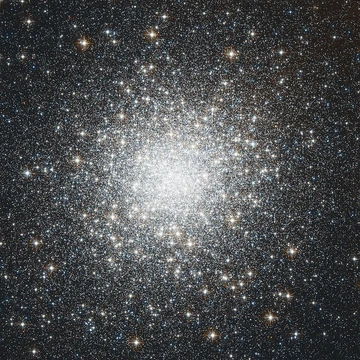
MGC1
Isolated globular cluster likely bound to Andromeda, lacking dark matter.

MGC1 is a globular cluster in the constellation Pisces, located roughly 650,000 light-years (about 200 kpc) from the center of the Andromeda Galaxy (M31). It is considered one of the most isolated globular clusters in the Local Group. Its radial velocity is close to M31’s systemic velocity and likely falls within that galaxy’s escape velocity, so the cluster is probably gravitationally bound to Andromeda. Its absolute magnitude is −8.5.
In 2010, astronomers Charlie Conroy, Abraham Loeb, and David Spergel submitted a paper to *The Astrophysical Journal* presenting evidence that MGC1 and NGC 2419—a globular cluster about 90,000 light-years (30 kpc) from the Milky Way’s center—lack surrounding dark matter halos. A separate article in *Science Magazine* explained that the team used data from other astronomers to build computer models of globular clusters both with and without dark matter halos. Over time, clusters without dark matter slowly lose their gravitational hold on stars at their edges, while those with halos retain them. Both NGC 2419 and MGC1 are missing stars at their fringes, leading the researchers to conclude they formed without dark matter halos. The same may apply to most globular clusters in the local universe. This finding contradicted the prior belief that dark matter helped form all globular clusters.
Quick Facts
- Epoch
- J2000
- Constellation
- Pisces
- Ra
- 00 · 50 · 42.45
- Dec
- +32 · 54 · 58.70
- Dist Ly
- 2.01 Mly
- Dist Pc
- 0.617 Mpc
- Appmag V
- 15.50
- Radius Tidal Ly
- 3900 ly
- Radius Tidal Pc
- 1200 pc
- Metal Fe
- −1.3
Facts from the source article.
Lore & Background
MGC1 lies about 650,000 light-years (about 200 kpc) from the Andromeda Galaxy's galactic center. Its radial velocity is close to the systemic velocity of M 31 and likely within its escape velocity, therefore the cluster is likely gravitationally bound to it. The cluster is considered one of the most isolated globular clusters in the Local Group.
In 2010, three astronomers—Charlie Conroy, Abraham Loeb and David Spergel—submitted an article to The Astrophysical Journal explaining with evidence that MGC1 and NGC 2419 did not have dark matter halos surrounding them. Another article submitted to Science Magazine described computer models showing that clusters without dark matter slowly lose their gravitational grip on stars at their edges, while those with halos hold onto these stars. Both MGC1 and NGC 2419 are missing stars at their fringes, leading researchers to conclude they formed in the absence of dark matter halos.
Reader's Guide
MGC1's significance lies in its use as evidence that dark matter does not form all globular clusters. Before the discovery described in the source article, the belief was that dark matter helped form all globular clusters. Research submitted to The Astrophysical Journal by Charlie Conroy, Abraham Loeb and David Spergel in 2010 provided evidence that MGC1 and NGC 2419 lacked dark matter halos. A subsequent article in Science Magazine explained that computer models, using data from other astronomers, showed that over time clusters without dark matter slowly lose their gravitational grip on stars at their edges, whereas those with halos hold onto these stars. Both MGC1 and NGC 2419 are missing stars at their fringes, leading to the conclusion that they formed without dark matter halos. The article further suggested that the same may be true of most globular clusters in the local universe. This challenges the prior assumption that dark matter was necessary for the formation of all globular clusters.
Did You Know?
- MGC1 is about 650,000 light-years from the Andromeda Galaxy's center.
- Research submitted in 2010 indicated MGC1 lacks a dark matter halo.
More in Globular Clusters 1-24
Spotted an error? Know more?
Reader corrections go straight into our review queue. Suggest an edit · How this site is sourced