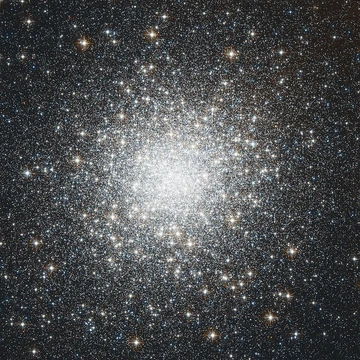
Messier 80
One of the densest globular clusters in the Milky Way.

Messier 80 (M80, NGC 6093) is a globular cluster in the constellation Scorpius, about 32,600 light-years from Earth. Charles Messier first recorded it in 1781. It ranks among the Milky Way’s most tightly packed globular clusters, with several hundred thousand stars crammed into a region roughly 95 light-years across.
The cluster lies in the Galactic halo, more than twice as far from us as the Galactic Center is, and sits halfway between the stars Antares (α Scorpii) and β Scorpii, in an area filled with nebulae. Its apparent diameter spans 10 arcminutes, making it visible from latitudes below the 67th parallel north through modest amateur telescopes; under dark skies, it appears as a mottled, fuzzy ball of light.
M80 is especially known for its many blue stragglers—stars that look younger than the rest of the cluster. Hubble Space Telescope images show these stars clustered in specific zones, hinting at frequent stellar collisions or close encounters in the dense core. On May 21, 1860, the cluster was the site of the nova T Scorpii, which briefly shone brighter than the entire cluster, reaching an absolute magnitude of −8.5 and an apparent magnitude of +7.0, visible through telescopes and binoculars.
Quick Facts
- Epoch
- J2000
- Class
- II
- Ra
- 16 · 17 · 02.41
- Dec
- –22 · 58 · 33.9
- Constellation
- Scorpius
- Dist Ly
- 32.6 kly
- Appmag V
- 7.3
- Radius Ly
- 48 ly
- Metal Fe
- –1.47
- Age
- 13.5 ± 1.0 Gyr
- Names
- M80, NGC 6093, GCl 39
Facts from the source article.
Lore & Background
Messier 80 is situated in the Galactic halo, more than twice as distant as the Galactic Center, and lies midway between the stars α Scorpii (Antares) and β Scorpii in a region rich with nebulæ. With an apparent angular diameter of 10 arcminutes, it can be observed from locations below the 67th parallel north using modest amateur telescopes, where it appears as a mottled ball of light under low light pollution conditions.
The cluster is notable for its high population of blue stragglers, stars that appear younger than the cluster itself. Hubble Space Telescope observations reveal these stars are concentrated in distinct regions, suggesting frequent stellar interactions or collisions in the cluster's dense core.
On May 21, 1860, the cluster hosted the nova T Scorpii, which briefly outshone the entire cluster with an absolute magnitude of −8.5 and reached an apparent magnitude of +7.0, visible through telescopes and binoculars.
Reader's Guide
Messier 80's significance lies in its extreme density and the insights it provides into stellar dynamics. As one of the densest globular clusters in the Milky Way, its core is a laboratory for studying stellar interactions and collisions, evidenced by the high concentration of blue stragglers observed by the Hubble Space Telescope. The cluster also holds historical importance for hosting the nova T Scorpii in 1860, which briefly outshone the entire cluster, demonstrating the violent events that can occur in such crowded environments. Discovered by Charles Messier in 1781, it has been a target for amateur and professional astronomers alike, visible from much of the Northern Hemisphere. Its location in the Galactic halo, more than twice as distant as the Galactic Center, and its position between Antares and Beta Scorpii in a nebula-rich region, add to its observational interest. The cluster's legacy includes its role in advancing understanding of stellar populations and the dynamics of dense star systems.
Did You Know?
- It contains several hundred thousand stars within a diameter of about 95 light-years.
- The cluster hosted the nova T Scorpii on May 21, 1860, which reached an apparent magnitude of +7.0.
- Hubble Space Telescope observations show blue stragglers concentrated in distinct regions, suggesting frequent stellar interactions.
More in Globular Clusters 1-24
Spotted an error? Know more?
Reader corrections go straight into our review queue. Suggest an edit · How this site is sourced