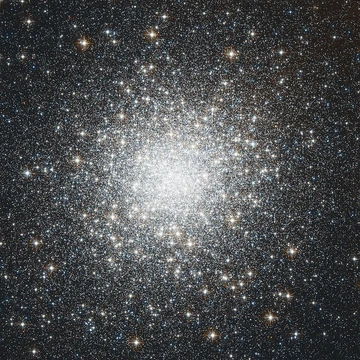
Messier 79
A globular cluster possibly extragalactic, in the constellation Lepus.

Messier 79 (also cataloged as M79 or NGC 1904) is a globular cluster located in the southern constellation Lepus. French astronomer Pierre Méchain first spotted it in 1780. The cluster lies roughly 42,000 light-years from Earth and about 60,000 light-years from the Milky Way’s center.
Like Messier 54—the other extragalactic globular on Messier’s list—M79 is thought to have originated outside the Milky Way. It likely belongs to the suspected Canis Major Dwarf Galaxy, which is currently passing very close to our own galaxy. However, this idea remains debated, as astronomers still disagree on whether the Canis Major Dwarf Galaxy itself is a real structure. Some evidence also suggests M79 might be part of the Gaia Sausage. The cluster is slowly being pulled apart by the Milky Way’s tidal forces, leaving behind a long tidal tail.
A color-magnitude diagram of M79, created from near-infrared images in the J and K bands, shows J-band magnitude on the vertical axis and J–K color on the horizontal axis. This diagram was produced quickly using specialized software designed for crowded-field photometry. It reveals that most of the cluster’s bright stars are red giants, forming an elongated red giant branch. Some stars in the diagram—especially those extending from the red giant branch toward the upper left—are actually foreground stars not part of the cluster.
Three regions of the Hertzsprung–Russell diagram appear here: the low-mass end of the main sequence, the complete red giant branch, and the horizontal branch. Compared to optical bands, the infrared bands make the lower main sequence shallower and the horizontal branch steeper (the blue end is fainter, the red end brighter).
Quick Facts
- Epoch
- J2000
- Class
- V
- Constellation
- Lepus
- Ra
- 05 · 24 · 10.59
- Dec
- -24 · 31 · 27.3
- Dist Ly
- 12.9 kpc
- Appmag V
- 7.7
- Radius Ly
- 53 ly
- Age
- 11.7 Gyr
- Metal Fe
- –1.55
- Names
- M79, NGC 1904, GCl 10, Melotte 34
Facts from the source article.
Lore & Background
Messier 79 was discovered by Pierre Méchain in 1780. It lies in the southern constellation Lepus, about 42,000 light-years from Earth and 60,000 light-years from the Galactic Center. Like Messier 54, it is believed to not be native to the Milky Way but instead to the putative Canis Major Dwarf Galaxy, which is currently experiencing a very close encounter with our galaxy. However, this is a contentious subject as astronomers are still debating the nature of the Canis Major dwarf galaxy itself; Messier 79 may also be part of the Gaia Sausage. The cluster is being disrupted by the galactic tide, trailing a long tidal tail.
Reader's Guide
Messier 79's significance lies in its debated extragalactic origin, making it a key object for studying galaxy interactions and accretion events. The cluster is being disrupted by the galactic tide, trailing a long tidal tail, which provides evidence of its ongoing merger with the Milky Way. Its color-magnitude diagram, made using near-infrared images in J and K bands, reveals that most bright stars are red giants, with the red giant branch clearly visible. The diagram also shows the low-mass end of the main sequence, the complete red giant branch, and the horizontal branch. In infrared bands, the lower main sequence is shallower and the horizontal branch is steeper compared to optical bands. Foreground stars not belonging to the cluster are also present in the diagram. As one of only two extragalactic globulars on Messier's list, M79 offers a window into the history of the Milky Way's growth through dwarf galaxy cannibalism.
More in Globular Clusters 1-24
Spotted an error? Know more?
Reader corrections go straight into our review queue. Suggest an edit · How this site is sourced