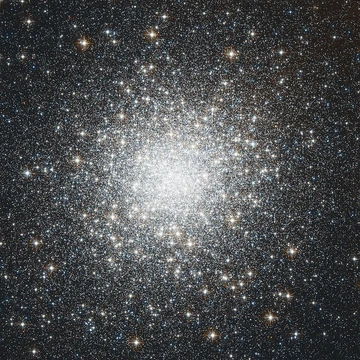
Messier 75
A dense globular cluster in Sagittarius, part of the Gaia Sausage.

Messier 75 (M75, NGC 6864) is a globular star cluster located in the southern constellation Sagittarius. First spotted by Pierre Méchain in 1780, it was added to Charles Messier’s catalog of comet-like objects later that same year.
This cluster lies about 67,500 light-years from Earth and sits roughly 14,700 light-years from the Galactic Center, on the opposite side of it. Its apparent size on the sky corresponds to a true radius of 67 light-years. With a classification of class I, M75 ranks among the most densely packed globular clusters known. It rotates slowly around an axis tilted at a position angle of −15°±30°. The cluster’s absolute magnitude is about −8.5, making it 180,000 times more luminous than the Sun.
M75 has a half-light radius of 9.1 light-years (2.80 parsecs) and a core radius of roughly 1.6 light-years (0.5 parsecs). It does not appear to have undergone core collapse. The mass density at its core is 7.9×10⁴ solar masses per cubic parsec. Within the cluster, 38 RR Lyrae variable stars have been identified, and its metallicity places it in the Oosterhoff-intermediate category. Sixty-two candidate blue stragglers have been found in the cluster field, with 60% of them concentrated in the core region.
This cluster is part of the Gaia Sausage, the remnant of a dwarf galaxy thought to have merged with the Milky Way. As a halo object, M75 follows a highly elliptical orbit (eccentricity 0.87) with an orbital period of 0.4 billion years. Its apocenter, or farthest distance from Earth, is about 57,000 light-years (17,500 parsecs).
Quick Facts
- Epoch
- J2000
- Class
- I
- Constellation
- Sagittarius
- Ra
- 20 · 06 · 04.85
- Dec
- −21 · 55 · 17.85
- Dist Ly
- 20.9 kpc
- Appmag V
- 8.5
- Absmag V
- −8.57
- Radius Ly
- 67 ly
- Metal Fe
- −1.29
- Names
- GCl 116, M75, NGC 6864
Facts from the source article.
Lore & Background
Messier 75 was discovered by Pierre Méchain in 1780 and included in Charles Messier's catalog of comet-like objects that same year. It lies about 67,500 light years from Earth and 14,700 light years from the Galactic Center, on the opposite side of the galaxy. Its apparent size on the sky corresponds to a true radius of 67 light years. The cluster is classified as class I, indicating it is one of the more densely concentrated globular clusters known. It shows a slow rotation around an axis inclined along a position angle of −15°±30°.
The cluster has a half-light radius of 9.1 ly (2.80 pc) and a core radius of about 1.6 ly (0.5 pc), and it appears not to have undergone core collapse yet. Its core mass density is 7.9×10⁴ M☉·pc⁻³. M75 contains 38 RR Lyrae variable stars and is Oosterhoff-intermediate in terms of metallicity. 62 candidate blue stragglers have been identified, with 60% located in the core region.
Messier 75 is part of the Gaia Sausage, the hypothesized remains of a dwarf galaxy that merged with the Milky Way. It is a halo object with an orbital period of 0.4 billion years around the galaxy on a highly elliptical orbit with an eccentricity of 0.87. Its apocenter, or maximal distance from Earth, is about 57,000 ly (17,500 pc).
Reader's Guide
Messier 75's significance lies in its extreme density and its role as a tracer of galactic assembly. As a class I globular cluster, it is among the most centrally concentrated known, with a core mass density of 7.9×10⁴ solar masses per cubic parsec. Its membership in the Gaia Sausage—the hypothesized remains of a dwarf galaxy that merged with the Milky Way—makes it a key object for studying the accretion history of our galaxy. The cluster's highly eccentric orbit (eccentricity 0.87) and orbital period of 0.4 billion years further support its origin as a captured object from a disrupted dwarf galaxy. The presence of 38 RR Lyrae variables and 62 candidate blue stragglers, with a majority in the core, provides insights into stellar evolution and dynamics in dense environments. Its absolute magnitude of −8.5, equating to 180,000 times the Sun's luminosity, underscores its intrinsic brightness despite its great distance of 67,500 light years.
Did You Know?
- M75 is classified as class I, one of the most densely concentrated globular clusters known.
- The cluster has an orbital eccentricity of 0.87, making its orbit highly elliptical.
- 62 candidate blue stragglers have been identified in M75, with 60% in the core region.
More in Globular Clusters 1-24
Spotted an error? Know more?
Reader corrections go straight into our review queue. Suggest an edit · How this site is sourced