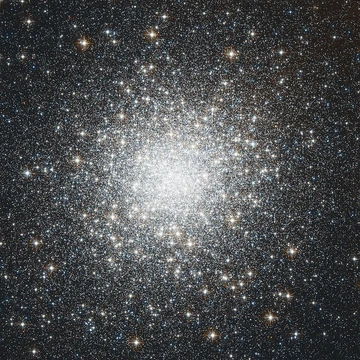
Messier 72
A globular cluster in Aquarius discovered by Pierre Méchain.

Messier 72 (M72, NGC 6981) is a globular cluster found in the southwestern part of the constellation Aquarius. Astronomer Pierre Méchain first spotted it on August 29, 1780; Charles Messier followed up 36 days later and added it to his catalog. Both men classified it as a faint nebula, the prevailing term at the time for such objects. With a larger telescope, John Herschel described it as a bright, round cluster of stars, while Harlow Shapley noted its resemblance to Messier 4 and Messier 12. Under good conditions, a 6-centimeter (2.4-inch) telescope reveals it as a faint nebula. A 2011 census of variable stars placed the cluster 54,500 light-years (16,700 parsecs) from the Sun, with a total mass of about 168,000 times that of the Sun and an age of roughly 9.5 billion years. Within the cluster, 43 variable stars have been identified.
Quick Facts
- Epoch
- J2000
- Class
- IX
- Constellation
- Aquarius
- Ra
- 20 · 53 · 27.70
- Dec
- –12 · 32 · 14.3
- Dist Ly
- 54.57 +/-
- Appmag V
- 9.3
- Metal Fe
- –1.48 ± 0.03
- Age
- 9.5 Gyr
- Names
- NGC 6981, GCl 118
Facts from the source article.
Lore & Background
Messier 72 was discovered by astronomer Pierre Méchain on August 29, 1780. Charles Messier looked for it 36 days later and included it in his catalog. Both astronomers opted for the then-dominant term for such objects, considering it a faint nebula rather than a cluster. With a larger instrument, astronomer John Herschel called it a bright 'cluster of stars of a round figure.' Astronomer Harlow Shapley noted a similarity to Messier 4 and 12. The cluster is visible in a good night sky as a faint nebula in a telescope with a 6 cm (2.4 in) aperture. Based upon a 2011 census of variable stars, the cluster is 54,500 light-years (16,700 pc) away from the Sun. It has an estimated combined mass of 168,000 solar masses (M☉), and is around 9.5 billion years old. There are 43 identified variable stars in the cluster.
Reader's Guide
Messier 72 holds significance as one of the many globular clusters cataloged by Charles Messier, though its discovery is credited to Pierre Méchain. Its initial classification as a faint nebula reflects the observational limitations and terminology of the late 18th century, later corrected by John Herschel who identified it as a cluster of stars. The cluster's distance of 54,500 light-years, mass of 168,000 solar masses, and age of 9.5 billion years, as determined from a 2011 census of variable stars, provide key physical parameters. The presence of 43 identified variable stars adds to its scientific interest. Harlow Shapley's comparison to Messier 4 and 12 places it within a broader context of similar globular clusters. Its visibility through a 6 cm aperture telescope makes it accessible to amateur astronomers under good conditions.
Did You Know?
- Messier 72 was discovered by Pierre Méchain on August 29, 1780.
- Charles Messier looked for it 36 days after its discovery and included it in his catalog.
- The cluster contains 43 identified variable stars as of a 2011 census.
More in Globular Clusters 1-24
Spotted an error? Know more?
Reader corrections go straight into our review queue. Suggest an edit · How this site is sourced