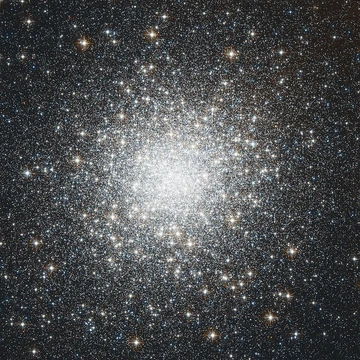
Messier 71
A globular cluster long mistaken for an open cluster.

Messier 71 (M71, NGC 6838, also called the Angelfish Cluster) lies in the small northern constellation Sagitta. Discovered by Philippe Loys de Chéseaux in 1745, it was later added to Charles Messier’s catalog of non-comet objects in 1780; Koehler in Dresden also noted it around 1775. The cluster is sometimes referred to as NGC 6839, though that identification is highly uncertain. It sits about 13,000 light-years from Earth and spans 27 light-years (8 parsecs). The irregular variable star Z Sagittae belongs to this cluster. For decades until the 1970s, astronomers considered M71 a dense open cluster. It lacked a strong central compression, its stars contained more metals than typical for ancient globular clusters, and it showed none of the RR Lyrae variable stars common in most globulars. However, modern photometric measurements revealed a short horizontal branch in its Hertzsprung–Russell diagram—a hallmark of a globular cluster. The branch’s shortness explains the absence of RR Lyrae variables and stems from the cluster’s relatively young age of 9–10 billion years. Taking in many or only late series (Population I) stars explains relatively its stars. Today M71 is classified as a very loosely concentrated globular cluster, similar to M68 in Hydra. Its mass is about 53,000 solar masses, and its luminosity roughly 19,000 times that of the Sun.
Quick Facts
- Epoch
- J2000
- Class
- X–XI
- Constellation
- Sagitta
- Ra
- 19 · 53 · 46.49
- Dec
- +18 · 46 · 45.1
- Dist Ly
- 13.0 kly
- Appmag V
- 8.2
- Radius Ly
- 13 ly
- Metal Fe
- –0.78
- Age
- 9–10 Gyr
- Names
- M71, NGC 6838, Cr 409, GCl 115
Facts from the source article.
Lore & Background
Messier 71 was discovered by Philippe Loys de Chéseaux in 1745 and included by Charles Messier in his catalog of non-comet-like objects in 1780. It was also noted by Koehler at Dresden around 1775. The cluster is also known as NGC 6839, though this identification is very uncertain. The irregular variable star Z Sagittae is a member of the cluster. For many decades until the 1970s, leading astronomers classified M71 as a densely packed open cluster because it lacks a dense central compression, its stars have more 'metals' than is usual for an ancient globular cluster, and it lacks the RR Lyrae 'cluster' variable stars common in most globular clusters. However, modern photometric photometry detected a short horizontal branch in its H–R diagram, characteristic of a globular cluster. The shortness of the branch explains the lack of RR Lyrae variables and is due to the cluster's relatively young age of 9–10 billion years. Today M71 is designated as a very loosely concentrated globular cluster, much like M68 in Hydra.
Reader's Guide
Messier 71's significance lies in its reclassification history, which illustrates how improved observational techniques can overturn long-held classifications. For decades, its lack of dense central compression, high metallicity, and absence of RR Lyrae variables led astronomers to consider it an open cluster. Only in the 1970s did modern photometric photometry reveal a short horizontal branch in its H–R diagram, a hallmark of globular clusters. The shortness of this branch, due to the cluster's relatively young age of 9–10 billion years, also explains the missing RR Lyrae variables. This cluster thus serves as a case study in stellar population analysis and the importance of photometric methods. Its mass of about 53,000 solar masses and luminosity of around 19,000 solar luminosities place it among the less massive globular clusters. The presence of the irregular variable star Z Sagittae as a member adds to its observational interest. The uncertain identification with NGC 6839 underscores the challenges in historical astronomical cataloging.
Did You Know?
- It was long misclassified as a densely packed open cluster until the 1970s.
- The cluster lacks RR Lyrae variable stars due to its short horizontal branch, a result of its relatively young age of 9–10 billion years.
More in Globular Clusters 1-24
Spotted an error? Know more?
Reader corrections go straight into our review queue. Suggest an edit · How this site is sourced