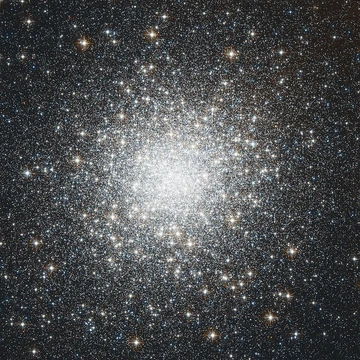
Messier 68
A metal-poor globular cluster with a highly eccentric orbit.

Messier 68 (cataloged as M68 or NGC 4590) is a globular cluster situated in the constellation Hydra, to the east-southeast of its equatorial region. Charles Messier first spotted it in 1780. William Herschel called it a beautiful, extremely rich cluster of stars so tightly packed that most appear blended together, while his son John noted that its stars, all of 12th magnitude, were clearly resolved and looked loose and ragged at the edges. The cluster lies roughly 33,600 light-years from Earth and follows a highly eccentric orbit (eccentricity 0.5) around the Milky Way’s galactic bulge, carrying it as far as 100,000 light-years from the center. It ranks among the most metal-poor globular clusters, meaning it contains very few elements beyond hydrogen and helium. M68 may be undergoing core collapse and shows signs of rotation; it might have been pulled into the Milky Way’s gravitational grip by merging with a satellite galaxy. As of 2015, astronomers have identified 50 variable stars in the cluster, with the first 28 discovered in 1919–20 by Harlow Shapley. Most of these variables are RR Lyrae stars (periodic variables), while six belong to the SX Phoenicis type, which exhibit short pulsations.
Quick Facts
- Epoch
- J2000
- Class
- X
- Constellation
- Hydra
- Ra
- 12 · 39 · 27.98
- Dec
- –26 · 44 · 38.6
- Dist Ly
- 33.6 kly
- Appmag V
- 7.8
- Metal Fe
- –2.23
- Radius Ly
- 53.5 ly
- Age
- 11.2 Gyr
- Notes
- Relatively metal poor.
- Names
- M68, NGC 4590, GCl 20
Facts from the source article.
Lore & Background
Messier 68 was discovered by Charles Messier in 1780. William Herschel described it as 'a beautiful cluster of stars, extremely rich, and so compressed that most of the stars are blended together'. His son John Herschel later noted that it was 'all clearly resolved into stars of 12th magnitude, very loose and ragged at the borders'.
The cluster is centered about 33,600 light-years from Earth and orbits the Milky Way's galactic bulge with a great eccentricity of 0.5, taking it to 100,000 light-years from the center. It is one of the most metal-poor globular clusters, meaning it has a paucity of elements other than hydrogen and helium. The cluster may be undergoing core-collapse and displays signs of being in rotation. It may have been acquired by the Milky Way through accretion from a satellite galaxy.
As of 2015, 50 variable stars have been identified in this cluster, with the first 28 identified as early as 1919–20 by American astronomer Harlow Shapley. Most of these variables are of type RR Lyrae, or periodic variables, while six are of the SX Phoenicis variety, which display short pulsating behavior.
Reader's Guide
Messier 68's significance lies in its status as one of the most metal-poor globular clusters, offering insights into early chemical enrichment in the universe. Its highly eccentric orbit (eccentricity 0.5) and possible origin through accretion from a satellite galaxy suggest it may not have formed within the Milky Way but was captured later. The cluster may be undergoing core-collapse, a stage in the dynamical evolution of globular clusters, and it shows signs of rotation, which is relatively uncommon. The identification of 50 variable stars, including RR Lyrae and SX Phoenicis types, provides valuable data for stellar pulsation studies and distance measurements. The early work by Harlow Shapley in 1919–20, who identified the first 28 variables, underscores the cluster's long history of astronomical observation. Its legacy includes contributing to our understanding of globular cluster dynamics, stellar populations, and the assembly history of the Milky Way.
More in Globular Clusters 1-24
Spotted an error? Know more?
Reader corrections go straight into our review queue. Suggest an edit · How this site is sourced