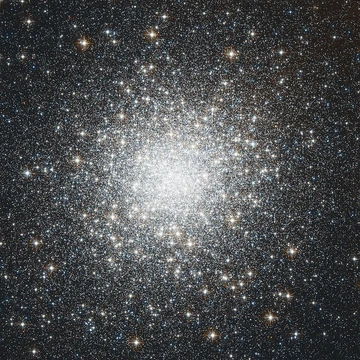
Messier 62
A massive, luminous globular cluster with multiple star populations.

Messier 62 (M62), also cataloged as NGC 6266 and nicknamed the Flickering Globular Cluster, lies in the southern part of the constellation Ophiuchus. Charles Messier discovered it on June 7, 1771, and added it as the 62nd object in his catalog eight years later.
This cluster sits about 21,500 light-years from Earth and roughly 5,500 light-years from the Milky Way’s center. It ranks among the galaxy’s heaviest and brightest globular clusters, with an estimated mass of 1.22 million times that of the Sun and an integrated absolute magnitude in the V band of -9.18, giving a mass-to-light ratio of 2.05 ± 0.04. Its projected shape is nearly perfectly spherical, with an ellipticity of just 0.01. The density profile of its stars indicates the cluster has not yet undergone core collapse. The core radius measures 1.3 light-years (0.39 parsecs), the half-mass radius is 9.6 light-years (2.95 parsecs), and the half-light radius is 6.0 light-years (1.83 parsecs). Stellar density at the core reaches 5.13 solar masses per cubic parsec, and the tidal radius extends to 59 light-years (18.0 parsecs).
The cluster contains at least two distinct stellar populations, likely from two separate bursts of star formation. About 79% ± 1% of its main-sequence stars belong to the first generation, while 21% ± 1% come from the second, which is enriched by elements from the first. Specifically, abundances of helium, carbon, magnesium, aluminum, and sodium differ between the two groups.
M62 is classified as an Oosterhoff type I, or "metal-rich," system. A 2010 survey found 245 variable stars within the cluster’s field: 209 are RR Lyrae variables, four are Type II Cepheids, 25 are long-period variables, and one is an eclipsing binary. It may be the Milky Way’s richest globular cluster in RR Lyrae variables. The cluster also hosts ten binary millisecond pulsars, including one (M62B) that shows eclipsing behavior due to gas streaming off its companion, and another (M62H) with an orbiting exoplanet roughly three times Jupiter’s mass. Multiple X-ray sources exist, with 50 lying within the half-mass radius. Forty-seven blue straggler candidates—formed from the merger of two stars in a binary system—have been identified, and they are preferentially concentrated near the core.
Quick Facts
- Epoch
- J2000
- Class
- IV
- Constellation
- Ophiuchus
- Ra
- 17 · 01 · 12.60
- Dec
- –30 · 06 · 44.5
- Dist Ly
- 6.6 ±
- Appmag V
- 6.5
- Absmag V
- −9.18
- Radius Ly
- 48 ly
- Radius Tidal Ly
- 18.0 pc.
- Metal Fe
- –1.02
- Age
- 11.78 Gyr
Facts from the source article.
Lore & Background
Messier 62 was discovered on 7 June 1771 by Charles Messier, who listed it as the 62nd entry in his catalogue published eight years later. The cluster is about 21.5 kly from Earth and 5.5 kly from the Galactic Center. It is among the most massive and luminous globular clusters in the Milky Way, with an estimated mass of 1.22×10^6 M☉ and an integrated absolute magnitude in the V band of −9.18. Its projected ellipticity of 0.01 indicates it is essentially spherical, and its density profile suggests it has not yet undergone core collapse.
The cluster shows at least two distinct populations of stars, representing two separate episodes of star formation. Of the main sequence stars, 79%±1% are from the first generation and 21%±1% from the second, with the second enriched by elements released by the first. Indications are this is an Oosterhoff type I, or 'metal-rich' system. A 2010 study identified 245 variable stars in the cluster's field, including 209 RR Lyrae variables, four Type II Cepheids, 25 long period variables, and one eclipsing binary. The cluster may prove to be the galaxy's richest in terms of RR Lyrae variables. It has ten binary millisecond pulsars, including one (M62B) displaying eclipsing behavior from gas streaming off its companion, and one (M62H) with an orbiting exoplanet about three times the mass of Jupiter. There are multiple X-ray sources, including 50 within the half-mass radius, and 47 blue straggler candidates have been identified, preferentially concentrated near the core region.
Reader's Guide
Messier 62's significance lies in its status as one of the most massive and luminous globular clusters in the Milky Way, making it a key object for studying stellar populations and cluster dynamics. The article notes that it shows at least two distinct populations of stars, which most likely represent two separate episodes of star formation, with the second generation enriched by elements from the first. This provides insight into the chemical evolution and star formation history of globular clusters. The cluster is also notable for its rich variable star population, particularly RR Lyrae variables, and may be the galaxy's richest in that regard. Its ten binary millisecond pulsars, including one with an exoplanet, offer opportunities for studying binary evolution and planetary systems in dense stellar environments. The article discusses the hypothesis that M62 may host an intermediate mass black hole (IMBH), noting it is considered well-suited for searching for such an object. A brief study before 2013 of proper motion of stars within 17″ of the core did not require an IMBH to explain, but simulations cannot rule out one with a mass of a few thousand M☉ in the core. This uncertainty underscores the cluster's value for ongoing astrophysical research into black hole formation and the dynamics of dense star clusters.
More in Globular Clusters 1-24
Spotted an error? Know more?
Reader corrections go straight into our review queue. Suggest an edit · How this site is sourced