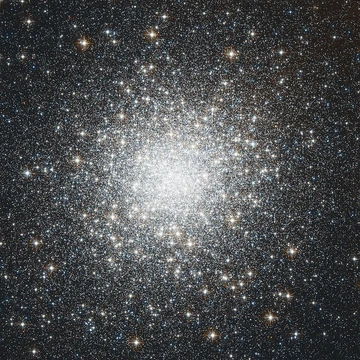
Messier 55
A low-metallicity globular cluster in southern Sagittarius.

Messier 55, also cataloged as NGC 6809 and called the Specter Cluster, is a globular cluster located in the southern part of the constellation Sagittarius. It was first spotted by Nicolas Louis de Lacaille in 1752 during observations in what is now South Africa. Charles Messier tried several times starting in 1754 to find it from Paris, but because the cluster’s low declination keeps it very close to the horizon there, he could not observe it properly until 1778, when he finally cataloged it. The cluster is visible through 50 mm binoculars, but resolving its individual stars requires a medium-sized telescope.
Situated about 17,600 light-years from Earth, Messier 55 contains roughly 269,000 times the mass of the Sun. Like most Milky Way globular clusters, it has far fewer heavy elements than the Sun—a property called low metallicity. Its iron abundance relative to hydrogen and helium is given as [Fe/H] = −1.94 dex, meaning it has only about 1.1 percent of the Sun’s iron proportion. Only around 55 variable stars have been identified in the cluster’s central region.
Quick Facts
- Epoch
- J2000
- Class
- XI
- Constellation
- Sagittarius
- Ra
- 19 · 39 · 59.71
- Dec
- −30 · 57 · 53.1
- Dist Ly
- 17.6 kly
- Appmag V
- 6.3
- Radius Ly
- 48 ly
- Metal Fe
- –1.94
- Age
- 12.3 Gyr
- Names
- M55, NGC 6809, GCl 113, C 1936-310
Facts from the source article.
Lore & Background
Messier 55 was discovered by Nicolas Louis de Lacaille in 1752 while observing from what today is South Africa. Starting in 1754, Charles Messier made several attempts to find this object from Paris, but its low declination meant from there it rises daily very little above the horizon, hampering observation. He observed and catalogued it in 1778. The cluster can be seen with 50 mm binoculars; resolving individual stars needs a medium-sized telescope.
The cluster is about 17,600 light-years away from Earth and contains about 269,000 solar masses. As with other Milky Way globular clusters, it has few elements other than hydrogen and helium compared to the Sun, giving it low metallicity. This quantity is listed as [Fe/H] = −1.94 dex, meaning the cluster has 1.1% of the proportion of the Sun's iron compared to hydrogen and helium. Only about 55 variable stars have been found in the central part of M55.
Reader's Guide
Messier 55 is significant as a globular cluster discovered from the Southern Hemisphere by Nicolas Louis de Lacaille in 1752, and later catalogued by Charles Messier in 1778 after repeated attempts from Paris were hampered by its low declination. Its low metallicity of [Fe/H] = −1.94 dex, meaning it has 1.1% of the Sun's iron proportion, places it among the metal-poor globular clusters of the Milky Way. The cluster's distance of about 17,600 light-years and mass of about 269,000 solar masses are key to understanding its structure and evolution. The presence of about 55 variable stars in its central region provides data for stellar population studies. Its visibility with 50 mm binoculars makes it accessible to amateur astronomers, while resolving individual stars requires a medium-sized telescope. The cluster's legacy includes its inclusion in the Messier catalog and ongoing study of its low-metallicity stellar population.
More in Globular Clusters 1-24
Spotted an error? Know more?
Reader corrections go straight into our review queue. Suggest an edit · How this site is sourced