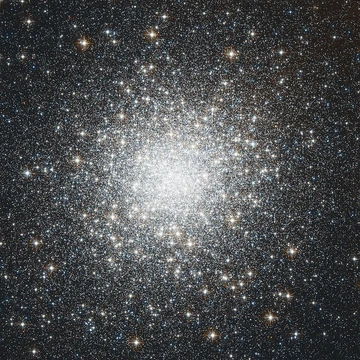
Messier 54
Globular cluster in Sagittarius, possibly the core of SagDEG.

Messier 54, also cataloged as NGC 6715, is a globular cluster located in the constellation Sagittarius. Charles Messier first spotted it in 1778 and added it to his list of objects that could be confused with comets. Though it sits near the star ζ Sagittarii and is easy to locate in the sky, even larger amateur telescopes cannot break it into individual stars.
For a long time, astronomers assumed M54 was part of the Milky Way, roughly 50,000 light-years away. That changed in 1994, when it was found to most likely belong to the Sagittarius Dwarf Elliptical Galaxy (SagDEG), making it the first globular cluster once thought to be in our own galaxy to be reclassified as extragalactic—a status that went unrecognized for over two centuries. Because M54 sits at SagDEG’s center, some researchers think it might actually be that galaxy’s core, while others argue it is a genuine globular cluster that sank to the center after its orbit decayed due to dynamical friction.
Modern distance estimates place M54 about 79,750 light-years away. It is one of the denser globular clusters, classified as class III (where I is the densest and XII the least). Its total luminosity is roughly 850,000 times that of the Sun, and it has an absolute magnitude of −10.0.
In July 2009, a team of astronomers reported evidence for an intermediate-mass black hole at M54’s core.
Quick Facts
- Epoch
- J2000
- Class
- III
- Constellation
- Sagittarius
- Ra
- 18 · 55 · 03.33
- Dec
- −30 · 28 · 47.5
- Appmag V
- 7.6
- Age
- 13 Gyr
- Notes
- Probably extragalactic
- Names
- M54, NGC 6715, GCl 104, C 1851-305
Facts from the source article.
Lore & Background
Messier 54 was discovered by Charles Messier in 1778 and added to his catalog of objects that could be mistaken for comets. It is easily found in the sky, being close to the star ζ Sagittarii, but it is not resolvable into individual stars even with larger amateur telescopes. In July 2009, a team of astronomers reported evidence of an intermediate-mass black hole in its core. Previously thought to belong to the Milky Way at a distance of about 50,000 light-years, it was discovered in 1994 that M54 most likely belongs to the Sagittarius Dwarf Elliptical Galaxy (SagDEG), making it the first globular cluster reassigned to extragalactic status, even if not recognized as such for more than two centuries. As it is located in SagDEG's center, some authors think it may actually be its core; however others propose it is a real globular cluster that fell to the center due to decay of its orbit caused by dynamical friction. Modern estimates place M54 at a distance of some 79,750 light-years. It is one of the denser globulars, being of class III, and shines with the luminosity of roughly 850,000 times that of the Sun, with an absolute magnitude of −10.0.
Reader's Guide
Messier 54 holds a unique place in astronomy as the first globular cluster once thought to be part of the Milky Way that was later recognized as extragalactic. Its reassignment in 1994 to the Sagittarius Dwarf Elliptical Galaxy (SagDEG) changed the understanding of its nature and distance. The cluster's location at the center of SagDEG has led to debate: some consider it the actual core of that dwarf galaxy, while others argue it is a genuine globular cluster that migrated inward due to dynamical friction. The discovery in 2009 of evidence for an intermediate-mass black hole in its core adds further significance, making it a key object for studying black hole formation in dense stellar systems. Its high density (class III) and luminosity (850,000 times the Sun) underscore its prominence. For over two centuries, M54 was misclassified as a Milky Way cluster, highlighting how improved observations can overturn long-held assumptions. Its visibility near ζ Sagittarii makes it easy to locate, though it remains unresolved in amateur telescopes.
Did You Know?
- In 1994, it was discovered that M54 most likely belongs to the Sagittarius Dwarf Elliptical Galaxy, not the Milky Way.
- M54 is one of the denser globular clusters, being of class III on a scale where I is densest and XII is least dense.
More in Globular Clusters 1-24
Spotted an error? Know more?
Reader corrections go straight into our review queue. Suggest an edit · How this site is sourced