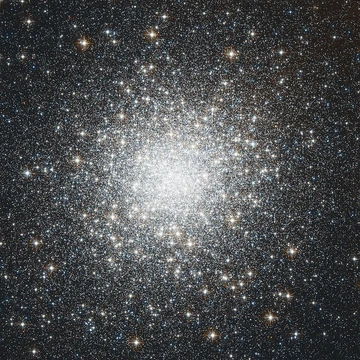
Messier 53
A metal-poor globular cluster with unique tidal interactions.

Messier 53 (M53, also cataloged as NGC 5024) is a globular cluster located in the constellation Coma Berenices. Discovered by Johann Elert Bode in 1775, it lies about 58,000 light-years from the Solar System and roughly 60,000 light-years from the Galactic Center, with a diameter of around 12 parsecs.
The cluster is metal-poor and was once considered the most metal-poor globular cluster in the Milky Way. Its red giant branch consists mostly of first-generation stars—those not formed from recycled gas from earlier stellar generations—unlike most globular clusters, which are dominated by second-generation stars. In M53, second-generation stars are more concentrated toward the core. The overall stellar composition resembles that of the Milky Way’s halo.
M53 shows tidal features such as clumps, ripples, and tails along its east–west orbital path. A bridge-like tidal structure appears to connect it to the neighboring globular cluster NGC 5053, with an envelope surrounding both clusters. This suggests a dynamic tidal interaction between them, a situation possibly unique within the Milky Way. M53 is also a candidate member of the Sagittarius dwarf galaxy tidal stream.
The cluster’s variable star population includes 55 RR Lyrae variables, at least three SX Phoenicis variables, and a semi-regular red giant.
Quick Facts
- Epoch
- J2000
- Class
- V
- Constellation
- Coma Berenices
- Ra
- 13 · 12 · 55.25
- Dec
- +18 · 10 · 05.4
- Dist Ly
- 5.8e4 ly
- Appmag V
- 7.6
- Metal Fe
- –1.86
- Age
- 12.67 Gyr
- Names
- M53, NGC 5024, GCl 22, C 1310+184
Facts from the source article.
Lore & Background
Messier 53 was discovered by Johann Elert Bode in 1775. It lies about 60,000 light-years from the Galactic Center and roughly 58,000 light-years from the Solar System, with a diameter of about 12 parsecs. The cluster is metal-poor and at one time was thought to be the most metal-poor cluster in the Milky Way. Most of its red giant branch stars are first-generation stars, meaning they did not form from recycled gas from previous stellar generations, unlike the majority of globular clusters which are more dominated by second-generation stars. The second-generation stars in NGC 5024 tend to be more concentrated in the core region. Overall, the stellar composition of cluster members is similar to members of the Milky Way halo.
The cluster displays tidal features including clumps and ripples, and tails along its orbit in an east–west direction. A tidal bridge-like structure appears to connect M53 with the globular cluster NGC 5053, and an envelope surrounds both clusters. These may indicate that a dynamic tidal interaction has occurred between the two clusters, a situation that may be unique within the Milky Way. In addition, M53 is a candidate member of the Sagittarius dwarf galaxy tidal stream. Among its variable stars, there are 55 RR Lyrae variables, at least three variables of type SX Phe, and a semi-regular red giant.
Reader's Guide
Messier 53 holds significance as a metal-poor globular cluster that was once considered the most metal-poor in the Milky Way, highlighting its role in studies of stellar populations and chemical evolution. Its unusual stellar composition—dominated by first-generation red giant branch stars rather than second-generation stars—sets it apart from most globular clusters, offering insight into the formation and evolution of cluster generations. The cluster's tidal features, including clumps, ripples, and a bridge-like structure connecting it to NGC 5053, suggest a dynamic tidal interaction that may be unique within the Milky Way, providing a rare case study of cluster interactions. Additionally, its candidacy as a member of the Sagittarius dwarf galaxy tidal stream links it to broader galactic structure and accretion events. The presence of 55 RR Lyrae variables and other variable stars makes it a valuable target for stellar variability research.
More in Globular Clusters 1-24
Spotted an error? Know more?
Reader corrections go straight into our review queue. Suggest an edit · How this site is sourced