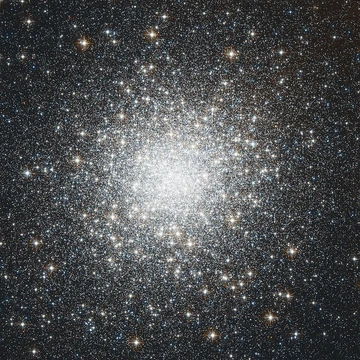
Messier 30
A globular cluster in Capricornus with a retrograde orbit.

Messier 30 (also known as M30, NGC 7099, or the Jellyfish Cluster) is a globular cluster of stars in the southeast of the southern constellation of Capricornus. It was discovered by the French astronomer Charles Messier in 1764, who described it as a circular nebula without a star. The cluster is notable for its retrograde orbit through the inner galactic halo, suggesting it was acquired from a satellite galaxy rather than forming within the Milky Way, and for having undergone core collapse, making it one of the highest density regions in the Milky Way galaxy.
Quick Facts
- Epoch
- J2000
- Class
- V
- Ra
- 21 · 40 · 22.12
- Dec
- –23 · 10 · 47.5
- Dist Ly
- 27.14 +/-
- Appmag V
- 7.2
- Constellation
- Capricornus
- Age
- 12.93 Gyr
- Metal Fe
- –2.27
- Names
- M30, NGC 7099, GCl 122
Facts from the source article.
Lore & Background
Messier 30 was discovered by Charles Messier in 1764, who described it as a circular nebula without a star. In the New General Catalogue, compiled during the 1880s, it was described as a 'remarkable globular, bright, large, slightly oval.' It can be easily viewed with a pair of 10×50 binoculars, forming a patch of hazy light some 4 arcminutes wide that is slightly elongated along the east–west axis. With a larger instrument, individual stars can be resolved and the cluster will cover an angle of up to 12 arcminutes across graduating into a compressed core about one arcminute wide that has further star density within. It is longest observable (opposed to the Sun) in the first half of August.
The cluster is centered 27,100 light-years away from Earth with a roughly 2.5% margin of error, and is about 93 light-years across. Its estimated age is roughly 12.9 billion years and it forms a mass of about 160,000 times the mass of the Sun. The cluster is following a retrograde orbit (against the general flow) through the inner galactic halo, suggesting that it was acquired from a satellite galaxy rather than forming within the Milky Way. It is in this epoch 22.2 kly (6.8 kpc) from the center of the galaxy, compared to an estimated 26 kly (8.0 kpc) for the Sun.
The cluster has passed through a dynamic process called core collapse and now has a concentration of mass at its core of about a million times the Sun's mass per cubic parsec. This makes it one of the highest density regions in the Milky Way galaxy. Stars in such close proximity will experience a high rate of interactions that can create binary star systems, as well as a type of star called a blue straggler that is formed by mass transfer. A process of mass segregation may have caused the central region to gain a greater proportion of higher mass stars, creating a color gradient with increasing blueness toward the middle of the cluster.
Reader's Guide
Messier 30 is significant as a globular cluster that has undergone core collapse, resulting in one of the highest density regions in the Milky Way galaxy, with a core density of about a million solar masses per cubic parsec. Its retrograde orbit through the inner galactic halo suggests it was acquired from a satellite galaxy, providing insight into the formation history of the Milky Way. The cluster's high stellar density leads to frequent interactions, creating binary star systems and blue straggler stars through mass transfer. Mass segregation may have concentrated higher-mass stars in the core, producing a color gradient with increasing blueness toward the center. Discovered by Charles Messier in 1764, it is observable with binoculars and larger telescopes, and its age of roughly 12.9 billion years makes it one of the older globular clusters. Its legacy lies in its role as a natural laboratory for studying stellar dynamics, core collapse, and the accretion history of the Milky Way.
More in Globular Clusters 1-24
Spotted an error? Know more?
Reader corrections go straight into our review queue. Suggest an edit · How this site is sourced