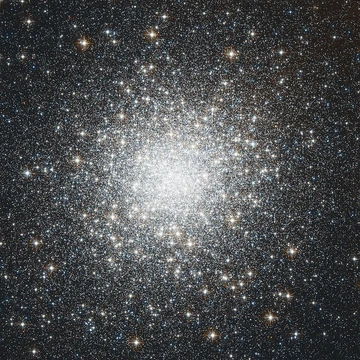
Messier 28
Globular cluster in Sagittarius, first to host a millisecond pulsar.

Messier 28 (M28), also known as NGC 6626, is a globular cluster of stars located in the center-west of the constellation Sagittarius. It was discovered by French astronomer Charles Messier in 1764, who described it as a round nebula containing no star, seen with difficulty in a 3½-foot telescope. The cluster is notable for being the first globular cluster in which a millisecond pulsar was discovered.
Quick Facts
- Epoch
- J2000
- Class
- IV
- Constellation
- Sagittarius
- Ra
- 18 · 24 · 32.89
- Dec
- –24 · 52 · 11.4
- Dist Ly
- 5.6 ±
- Appmag V
- 6.8
- Radius Ly
- 30 ly
- Metal Fe
- –1.32
- V Hb
- 15.55 ± 0.10
- Age
- 12.0 Gyr
- Notes
- Contains first pulsar discovered in a globular
Facts from the source article.
Lore & Background
Messier 28 lies less than a degree to the northwest of the 3rd magnitude star Kaus Borealis (Lambda Sgr). It is faintly visible as a hazy patch with binoculars and can be readily found in a small telescope with an 8 cm (3.1 in) aperture, showing as a nebulous feature spanning 11.2 arcminutes. With a 15 cm (5.9 in) aperture, the core becomes visible and a few distinct stars can be resolved along the periphery. Larger telescopes provide greater resolution; a 25 cm (9.8 in) aperture reveals a dense 2′ core with more density within.
The cluster is about 18,300 light-years from Earth and has a mass of about 551,000 M☉. Its metallicity averages −1.32, meaning it contains more than 10 times less metal than our own star. Its coherency and preponderance of older stellar evolution objects support an estimated age of very roughly 12 billion years. Eighteen RR Lyrae-type variable stars have been found within the cluster.
Reader's Guide
Messier 28 holds a significant place in astronomical history as the first globular cluster in which a millisecond pulsar was discovered. This pulsar, designated PSR B1821–24, was found using the Lovell Telescope at Jodrell Bank Observatory in England. Since then, a total of 11 further millisecond pulsars have been detected in the cluster using the telescope at Green Bank Observatory in West Virginia. As of 2011, these 12 pulsars number the third-most in a cluster tied to the Milky Way, following Terzan 5 and 47 Tucanae. The cluster's discovery by Charles Messier in 1764, who described it as a round nebula containing no star, marks it as one of the early cataloged deep-sky objects. Its relatively high age of about 12 billion years and low metallicity make it a valuable target for studying the early chemical evolution of the Milky Way and the dynamics of old stellar populations.
Did You Know?
- It was the first globular cluster in which a millisecond pulsar (PSR B1821–24) was discovered.
- The cluster contains 18 RR Lyrae-type variable stars.
- As of 2011, it hosts the third-most millisecond pulsars in a Milky Way cluster, after Terzan 5 and 47 Tucanae.
More in Globular Clusters 1-24
Spotted an error? Know more?
Reader corrections go straight into our review queue. Suggest an edit · How this site is sourced