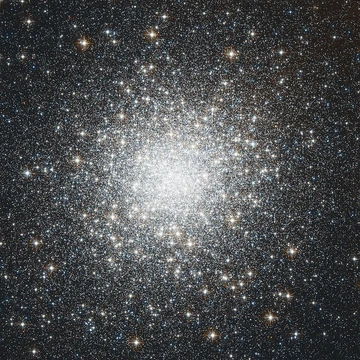
Messier 22
A bright globular cluster near the Galactic bulge.

Messier 22 (M22), also known as NGC 6656 or the Great Sagittarius Cluster, is an elliptical globular cluster of stars in the constellation Sagittarius, near the Galactic bulge region. It is one of the brightest globulars visible in the night sky, with the brightest stars at 11th magnitude and hundreds resolvable with an 8-inch telescope. It is one of the nearer globular clusters to Earth, at about 10,600 light-years away, and is notable for being one of only four globulars in our galaxy known to contain a planetary nebula.
Quick Facts
- Epoch
- J2000
- Class
- VII
- Ra
- 18 · 36 · 23.94
- Dec
- –23 · 54 · 17.1
- Dist Ly
- 10.6 +/-
- Appmag V
- 5.1
- Constellation
- Sagittarius
- Radius Ly
- 50 ± 5 ly
- V Hb
- 14.2
- Metal Fe
- –1.49
- Age
- 12 Gyr
- Notes
- One of four globulars known to contain a planetary nebula.
Facts from the source article.
Lore & Background
M22 was one of the first globulars to be discovered, in 1665 by Abraham Ihle, and was included in Charles Messier's catalog of comet-like objects in 1764. It was one of the first globular clusters to be carefully studied, first by Harlow Shapley in 1930, who placed roughly 70,000 stars within it and found it had a dense core. Halton Arp and William G. Melbourne continued studies in 1959. Due to the large color spread of its red giant branch sequence, akin to that in Omega Centauri, it became the object of intense scrutiny starting in 1977 with James E. Hesser et al.
M22 is in front of part of the galactic bulge and is therefore useful for its microlensing effect on those background stars. Despite its relative proximity, its light is limited by dust extinction, giving it an apparent magnitude of 5.5; even so, it is the brightest globular cluster visible from mid-northern latitudes. From those latitudes, due to its declination of nearly 24° south of the celestial equator, its daily path is low in the southern sky, making it appear less impressive than counterparts such as M13 and M5.
M22 is one of only four globulars of our galaxy known to contain a planetary nebula, designated GJJC1, likely about 6,000 years old. Its central star is a blue star. The nebula was first noted as a pointlike light source using the IRAS satellite by Fred Gillett and his associates in 1986, and its nature was found in 1989 by Gillett et al. Two black holes of between 10 and 20 solar masses each were unearthed with the Very Large Array radio telescope and corroborated by the Chandra X-ray telescope in 2012, implying that gravitational ejection of black holes from clusters is not as efficient as previously thought, leading to estimates of 5 to 100 black holes within M22.
Reader's Guide
M22 holds significance as one of the nearest and brightest globular clusters, making it a key object for study despite dust extinction. Its early discovery in 1665 and inclusion in Messier's catalog mark it as historically important. The cluster's large color spread in its red giant branch sequence, similar to Omega Centauri, has driven intense scrutiny since 1977. Its position in front of the Galactic bulge allows it to serve as a microlensing lens on background stars. The discovery of a planetary nebula within M22—one of only four known in Galactic globulars—adds to its uniqueness, as does the detection of two black holes in 2012, which challenged previous assumptions about black hole ejection efficiency and suggested a population of 5 to 100 black holes. This finding may explain the cluster's unusually large core. For observers at mid-northern latitudes, M22 is the brightest globular visible, though its low southern declination reduces its visual impact compared to other summer globulars.
Did You Know?
- M22 was one of the first globular clusters discovered, in 1665 by Abraham Ihle.
- It is one of only four globular clusters in the Milky Way known to contain a planetary nebula.
- Two black holes between 10 and 20 solar masses were detected in M22 in 2012.
- The cluster's diameter is 99 ± 9 light-years at an estimated distance of about 10,600 light-years.
More in Globular Clusters 1-24
Spotted an error? Know more?
Reader corrections go straight into our review queue. Suggest an edit · How this site is sourced