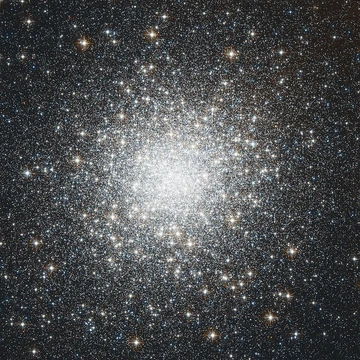
Messier 19
One of the most oblate globular clusters, possibly distorted by dust.

Messier 19 (also cataloged as NGC 6273) is a globular cluster found in the constellation Ophiuchus. Charles Messier first spotted it on June 5, 1764, and later that year included it in his catalog of objects that resemble comets. William Herschel was the first to resolve the cluster into individual stars in 1784. His son, John Herschel, called it "a superb cluster resolvable into countless stars." From Earth, the cluster sits 4.5° west-southwest of Theta Ophiuchi. With 50 mm binoculars, it appears as a faint, fuzzy point of light. Through a 25.4 cm telescope, the cluster takes on an oval shape, with a core measuring 3′ by 4′ and a halo spanning 5′ by 7′.
Among known globular clusters, M19 stands out as one of the most flattened. However, this oblate appearance might not reflect its actual shape. Strong absorption of light along the eastern edge—caused by intervening gas and dust—likely produces the flattening. When observed in infrared, the cluster shows almost no flattening at all. It lies about 28.7 thousand light-years (8.8 kiloparsecs) from the Solar System and is quite close to the Galactic Center, at roughly 6.5 thousand light-years (2.0 kiloparsecs) away.
The cluster holds an estimated 1.1 million times the mass of the Sun and is about 11.9 billion years old. Its stellar population includes four Cepheid variables, some RV Tauri variables, and at least one RR Lyrae variable with a known period. Observations from the ROSAT mission did not detect any low-intensity X-ray sources within the cluster.
Quick Facts
- Epoch
- J2000
- Class
- VIII
- Constellation
- Ophiuchus
- Ra
- 17 · 02 · 37.69
- Dec
- -26 · 16 · 04.6
- Dist Ly
- 28.7 kly
- Appmag V
- 6.8
- Radius Ly
- 70 ly
- Metal Fe
- –1.53
- Age
- 11.90 Gyr
- Names
- NGC 6273, GCl 52
Facts from the source article.
Lore & Background
Messier 19 was discovered by Charles Messier on June 5, 1764 and added to his catalogue of comet-like objects that same year. It was resolved into individual stars by William Herschel in 1784. His son, John Herschel, described it as 'a superb cluster resolvable into countless stars'. The cluster is located 4.5° WSW of Theta Ophiuchi and is just visible as a fuzzy point of light using 50 mm binoculars. Using a telescope with a 25.4 cm aperture, the cluster shows an oval appearance with a 3′ × 4′ core and a 5′ × 7′ halo.
M19 is one of the most oblate of the known globular clusters. This flattening may not accurately reflect the physical shape of the cluster because the emitted light is being strongly absorbed along the eastern edge, the result of extinction caused by intervening gas and dust. When viewed in the infrared, the cluster shows almost no flattening. It lies at a distance of about 28.7 kly from the Solar System and is quite near to the Galactic Center at only about 6.5 kly away.
The cluster contains an estimated 1,100,000 times the mass of the Sun and is around 11.9 billion years old. Its stellar population includes four Cepheids and RV Tauri variables, plus at least one RR Lyrae variable for which a period is known. Observations made during the ROSAT mission failed to reveal any low-intensity X-ray sources.
Reader's Guide
Messier 19 holds significance as one of the most oblate globular clusters known, a characteristic that may be partly an observational artifact due to strong absorption of light along its eastern edge by intervening gas and dust. This extinction effect is so pronounced that when viewed in the infrared, the cluster shows almost no flattening, highlighting the importance of multi-wavelength observations in understanding true cluster morphology. Its proximity to the Galactic Center—only about 6.5 kly away—makes it a valuable object for studying the effects of the Galactic environment on cluster structure. The cluster's age of 11.9 billion years and mass of 1.1 million solar masses place it among the older, massive globular clusters. The presence of variable stars, including Cepheids, RV Tauri variables, and at least one RR Lyrae variable, provides opportunities for distance calibration and stellar evolution studies. The lack of low-intensity X-ray sources detected by ROSAT suggests a relative absence of certain binary systems or other X-ray-emitting phenomena. Its discovery by Charles Messier in 1764 and subsequent resolution by William Herschel in 1784, along with John Herschel's descriptive praise, anchor it in the history of astronomical observation.
Did You Know?
- M19 is one of the most oblate globular clusters known, but this flattening may be due to dust absorption rather than its true shape.
- It lies only about 6.5 kly from the Galactic Center.
More in Globular Clusters 1-24
Spotted an error? Know more?
Reader corrections go straight into our review queue. Suggest an edit · How this site is sourced