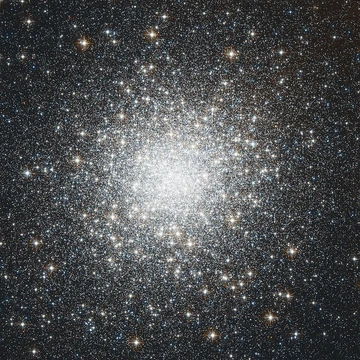
Messier 15
One of the oldest and most densely packed globular clusters in the Milky Way.

Messier 15 (also cataloged as NGC 7078 and called the Great Pegasus Cluster) is a globular cluster located in the constellation Pegasus. Jean-Dominique Maraldi found it in 1746, and Charles Messier added it to his catalog of comet-like objects in 1764. With an age of roughly 12.5 billion years (give or take 1.3 billion), it ranks among the oldest globular clusters known.
The cluster lies about 35,700 light-years from Earth and spans 175 light-years across. Its absolute magnitude is −9.2, making it 360,000 times as luminous as the Sun. M15 is one of the most tightly packed globular clusters in the Milky Way. Its core has experienced a process called core collapse, resulting in a dense central cusp packed with stars, possibly surrounding a black hole.
M15 contains over 100,000 stars, including 112 variable stars and 8 pulsars. One of these pulsars, M15-C, is a double neutron star system. The cluster also hosts Pease 1, the first planetary nebula ever found inside a globular cluster (discovered in 1928). Only three other such nebulae have been identified in globular clusters since.
At magnitude 6.2, M15 is nearly visible to the naked eye under good conditions. Binoculars or a small telescope show it as a fuzzy star. A telescope with at least a 6-inch (150 mm) aperture begins to resolve individual stars, the brightest of which shine at magnitude +12.6. The cluster appears 18 arc minutes across (about three-tenths of a degree). It lies roughly 4° west-northwest of Epsilon Pegasi, the brightest star in Pegasus.
Two bright X-ray sources have been detected in M15 by the Uhuru and Chandra X-ray Observatory satellites: Messier 15 X-1 (also known as 4U 2129+12) and Messier 15 X-2. The former is thought to be the first X-ray source ever detected in the constellation Pegasus.
Quick Facts
- Epoch
- J2000
- Class
- IV
- Constellation
- Pegasus
- Ra
- 21 · 29 · 58.33
- Dec
- +12 · 10 · 01.2
- Dist Ly
- 10.944 ±
- Appmag V
- 6.2
- Radius Ly
- ~88 ly
- Metal Fe
- –2.37
- V Hb
- 15.83
- Age
- 12.0 Gyr
- Notes
- steep central cusp
Facts from the source article.
Lore & Background
Messier 15 was discovered by Jean-Dominique Maraldi in 1746 and later included in Charles Messier's catalogue of comet-like objects in 1764. It lies about 35,700 light-years from Earth and spans 175 light-years in diameter. With an absolute magnitude of −9.2, its total luminosity is 360,000 times that of the Sun. The cluster is one of the most densely packed globulars known in the Milky Way, and its core has undergone a contraction known as 'core collapse,' featuring a central density cusp with an enormous number of stars surrounding what may be a central black hole.
The cluster is home to over 100,000 stars and is notable for containing a large number of variable stars (112) and pulsars (8), including one double neutron star system, M15-C. It also contains Pease 1, the first planetary nebula discovered within a globular cluster, found in 1928; only three others have been found in globular clusters since then. At magnitude 6.2, M15 approaches naked eye visibility under good conditions and can be observed with binoculars or a small telescope, appearing as a fuzzy star. Larger telescopes (at least 6 inches aperture) reveal individual stars, the brightest of which are magnitude +12.6. The cluster appears 18 arc minutes in size and is located about 4° west-northwest of the brightest star of Pegasus, Epsilon Pegasi.
Reader's Guide
Messier 15 holds significance as one of the oldest known globular clusters, with an estimated age of 12.5±1.3 billion years, placing it among the earliest structures formed in the Milky Way. Its extreme density and core collapse make it a key object for studying stellar dynamics and the possible presence of intermediate-mass black holes. The cluster's rich population of variable stars and pulsars, including the double neutron star system M15-C, provides valuable data for stellar evolution and binary system research. The discovery of Pease 1, the first planetary nebula found in a globular cluster, marked a milestone in understanding late-stage stellar evolution within dense stellar environments. Additionally, Earth-orbiting satellites Uhuru and Chandra X-ray Observatory have detected two bright X-ray sources in the cluster—Messier 15 X-1 and Messier 15 X-2—with the former being the first astronomical X-ray source detected in the constellation Pegasus. For amateur astronomers, M15 is a rewarding target, approaching naked-eye visibility at magnitude 6.2 and revealing its dense core and individual stars through modest telescopes.
Did You Know?
- The cluster has a double neutron star system called M15-C.
- Two bright X-ray sources, Messier 15 X-1 and Messier 15 X-2, have been detected in the cluster by the Uhuru and Chandra X-ray Observatory satellites.
More in Globular Clusters 1-24
Spotted an error? Know more?
Reader corrections go straight into our review queue. Suggest an edit · How this site is sourced