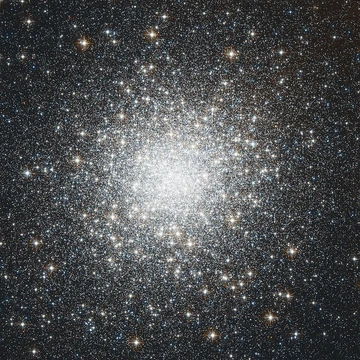
Messier 14
Globular cluster in Ophiuchus with a historic nova.

Messier 14, also cataloged as NGC 6402, is a globular cluster located in the constellation Ophiuchus. Charles Messier first recorded it in 1764. This cluster is home to several hundred thousand stars and lies roughly 30,000 light-years from Earth. With an apparent magnitude of +7.6, it is easily visible through binoculars, while medium-sized telescopes reveal hints of its individual stars, the brightest of which shines at magnitude +14.
The cluster’s total luminosity is about 400,000 times that of the Sun, giving it an absolute magnitude of −9.12. Its shape is distinctly elongated, and it spans roughly 100 light-years across. Within M14, astronomers have identified 70 variable stars, many of the W Virginis type common in globular clusters. In 1938, a nova erupted in the cluster, though it went unnoticed until 1964, when photographic plates from that year were examined. This nova is estimated to have peaked at magnitude +9.2, making it over five times brighter than the cluster’s brightest normal star.
About 3° southwest of M14 lies the fainter globular cluster NGC 6366.
Quick Facts
- Epoch
- J2000
- Class
- VIII
- Constellation
- Ophiuchus
- Ra
- 17 · 37 · 36.15
- Dec
- –03 · 14 · 45.3
- Dist Ly
- 30.3 kly
- Appmag V
- 7.6
- Radius Ly
- 50 ly
- Metal Fe
- –1.28
- Names
- NGC 6402
Facts from the source article.
Lore & Background
Messier 14 was discovered by Charles Messier in 1764. At a distance of about 30,000 light-years, it contains several hundred thousand stars. Its shape is decidedly elongated, and it is about 100 light-years across. The total luminosity of M14 is in the order of 400,000 times that of the Sun, corresponding to an absolute magnitude of −9.12. A total of 70 variable stars are known in M14, many of the W Virginis variety common in globular clusters. In 1938, a nova appeared, although this was not discovered until photographic plates from that time were studied in 1964. It is estimated that the nova reached a maximum brightness of magnitude +9.2, over five times brighter than the brightest 'normal' star in the cluster. Slightly over 3° southwest of M14 lies the faint globular cluster NGC 6366.
Reader's Guide
Messier 14 is significant as a globular cluster discovered by Charles Messier in 1764, adding to the catalog of deep-sky objects. Its elongated shape distinguishes it from many other globular clusters. The cluster's large number of variable stars, particularly of the W Virginis type, makes it a subject of study for stellar evolution. The most notable event in its history is a nova that occurred in 1938 but was not identified until 1964 from archival photographic plates. This nova reached a magnitude of +9.2, far outshining the cluster's brightest normal star. The cluster is easily observed with binoculars due to its apparent magnitude of +7.6, while medium-sized telescopes can resolve some of its individual stars, the brightest of which is magnitude +14. Its legacy includes being a target for amateur astronomers and a subject in astronomical databases and images, such as the NASA Astronomy Picture of the Day featuring the cluster alongside a comet.
Did You Know?
- A nova in M14 occurred in 1938 but was not discovered until 1964.
- The cluster contains 70 known variable stars, many of the W Virginis type.
- The brightest normal star in M14 has a magnitude of +14.
More in Globular Clusters 1-24
Spotted an error? Know more?
Reader corrections go straight into our review queue. Suggest an edit · How this site is sourced