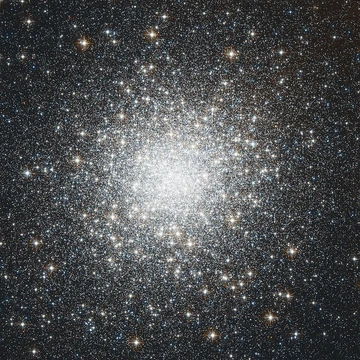
Messier 13
A magnificent globular cluster in Hercules, discovered by Halley in 1714.

Messier 13 (also known as NGC 6205, the Great Globular Cluster in Hercules, the Hercules Globular Cluster, or the Great Hercules Cluster) is a globular cluster containing several hundred thousand stars, located in the constellation Hercules.
Edmond Halley first spotted it in 1714, and Charles Messier added it to his catalog on June 1, 1764, so astronomers would not confuse it with a comet. That catalog later became known as the Messier catalog. Its coordinates are right ascension 16h 41.7m and declination +36° 28'. Many astronomers call M13 the finest globular cluster visible from the Northern Hemisphere.
To find it, look about one-third of the way from Vega to Arcturus. Four bright stars in Hercules form a shape called the Keystone asterism, which represents the hero’s broad torso. Within that asterism, M13 sits two-thirds of the way north (by west) from Zeta to Eta Herculis. On very dark nights, people with good averted vision can sometimes see it with the naked eye, since its apparent magnitude is 5.8. Through standard binoculars, it appears as a bright, round patch of light about 23 arcminutes across. Small telescopes show it easily, and a four-inch aperture begins to resolve individual stars at the cluster’s outer edge as tiny points of light. Only larger telescopes can resolve stars deeper into the center. From latitudes above 36° north, the cluster is visible all year, but it is easiest to see during spring and summer in the Northern Hemisphere.
Nearby, 28 arcminutes directly northeast, lies NGC 6207, a 12th-magnitude edge-on galaxy. Halfway between NGC 6207 and M13, north-northeast of the cluster’s center, is the small galaxy IC 4617. At low magnification, two seventh-magnitude stars bracket the cluster.
M13 spans about 145 light-years across and holds somewhere between 300,000 and over half a million stars. Its brightest star is a red giant variable named V11 (also called V1554 Hercules), with an apparent visual magnitude of 11.95. The cluster lies between 22,200 and 25,000 light-years from Earth, and it is one of more than a hundred globular clusters orbiting the center of the Milky Way.
All its stars belong to Population II, meaning they have far fewer heavy elements than Population I stars like the Sun. Overall, M13 contains only about 4.6% as much iron as the Sun does.
Individual stars in this cluster were first resolved in 1779.
Quick Facts
- Epoch
- J2000
- Class
- V
- Constellation
- Hercules
- Ra
- 16 · 41 · 41.24
- Dec
- +36 · 27 · 35.5
- Dist Ly
- 24.1 kly
- Appmag V
- 5.8
- Radius Ly
- 84 ly
- Metal Fe
- –1.33
- Absmag V
- –8.5
- Age
- 11.65 Gyr
- Notes
- One of the best-known clusters of the Northern Hemisphere
Facts from the source article.
Lore & Background
Messier 13 was discovered by Edmond Halley in 1714, and cataloged by Charles Messier on June 1, 1764, into his list of objects not to mistake for comets; Messier's list, including Messier 13, eventually became known as the Messier catalog. It is located at right ascension 16h 41.7m, declination +36° 28'. About one third of the way from Vega to Arcturus, four bright stars in Hercules form the Keystone asterism, the broad torso of the hero. M13 can be seen in this asterism 2⁄3 of the way north (by west) from Zeta to Eta Herculis. With an apparent magnitude of 5.8, Messier 13 may be visible to the naked eye with averted vision on dark nights. It is prominent in traditional binoculars as a bright, round patch of light. Its diameter is about 23 arcminutes and it is readily viewable in small telescopes. At least four inches of telescope aperture resolves stars in Messier 13's outer extent as small pinpoints of light, but only larger telescopes resolve stars further into the center. The cluster is visible throughout the year from latitudes greater than 36 degrees north, with the longest visibility during Northern Hemisphere spring and summer.
About 145 light-years in diameter, M13 is composed of several hundred thousand stars, with estimates varying from around 300,000 to over half a million. The brightest star in the cluster is a red giant, the variable star V11, also known as V1554 Hercules, with an apparent visual magnitude of 11.95. M13 is 22,200 to 25,000 light-years away from Earth, and the globular cluster is one of over one hundred that orbit the center of the Milky Way. The stars in this cluster are firmly in the Population II category, markedly lower in metals than Population I stars like the Sun and most other stars in the Sun's close proximity. M13 as a whole has only about 4.6% as much iron as the Sun does. Single stars in this globular cluster were first resolved in 1779. Compared to the stars in the neighborhood of the Sun, the stars of the M13 population are more than a hundred times more densely packed. They are so close together that they sometimes collide and produce new stars, known as 'blue stragglers'. In 2007, a paper was published suggesting the possibility of an intermediate-mass black hole of up to 13,000 solar masses at the centre of the cluster, but this is heavily disputed.
Reader's Guide
Messier 13's significance extends beyond its visual splendor. It was one of the objects Charles Messier cataloged to help astronomers avoid mistaking it for a comet, and his list became the famous Messier catalog. The cluster was the target of the 1974 Arecibo message, which contained encoded information about the human race, DNA, atomic numbers, Earth's position and other information, beamed from the Arecibo Observatory radio telescope towards Messier 13. It was meant as a demonstration of human technological achievement, rather than a real attempt to enter into a conversation with extraterrestrials. M13 was chosen because it was a large, relatively close star cluster that was available at the time and place of the ceremony. It will take around 25,000 years for the message to reach the cluster, though it will move through space during the transit time; opinions differ as to whether or not the cluster will be in a position to receive the message by the time that it arrives. The cluster has also appeared in numerous literary and artistic works, including science fiction novellas by Isaac Asimov and Poul Anderson, the German series Perry Rhodan, novels by James Blish, Dan Simmons, and Kurt Vonnegut, the 1977 space opera The War in Space, and the 1968 Doctor Who story The Wheel in Space. Messier 13 is also featured as part of the interior of the dome of St Anne's Church, Kew in London, based on a photograph by NASA.
Did You Know?
- The cluster is about 145 light-years in diameter and contains several hundred thousand stars.
- The 1974 Arecibo message was beamed towards Messier 13 as a demonstration of human technology.
- The brightest star in M13 is a red giant variable star with an apparent magnitude of 11.95.
More in Globular Clusters 1-24
Spotted an error? Know more?
Reader corrections go straight into our review queue. Suggest an edit · How this site is sourced