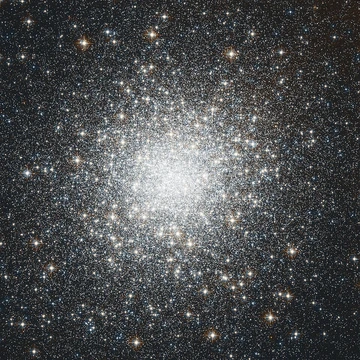
Whiting 1
A faint, young globular cluster associated with the Sagittarius Dwarf Spheroidal Galaxy.

Whiting 1 is a faint and unusually young globular cluster in the constellation Cetus, located in the halo of the Milky Way. It is notable for its close similarity to Palomar 1 and for being metal-rich, with many studies indicating it is part of the Sagittarius Dwarf Spheroidal Galaxy.
Quick Facts
- Constellation
- Cetus
- Ra
- 02h 02m 57s
- Dec
- -03° 15' 10"
- Dist Ly
- 95,900
- Dist Pc
- 30600 ± 1200
- Appmag V
- 15.03
- Absmag V
- -2.46
- Radius Ly
- 33
- Age
- 5.7 Billion years old
- Names
- WHI B0200-03; GALEXASC J020257.10-031510.5; [LM2010] 03; 0200-03
Facts from the source article.
Lore & Background
Whiting 1 was discovered in 2002 by Alan B. Whiting, G.K.T. Hau, and Mike Irwin, and was identified as a globular cluster by Giovanni Carraro in 2005. It lies 30.1 kpc from the Sun and 34.9 kpc from the Galactic Center. A study gives its metallicity as [Fe/H] = -0.70 dex and its age as 5.0 Gyr, indicating it is an ancient star cluster from the early universe. Its ellipticity is 0.18 ± 0.07, suggesting it is fairly or almost round. The radial velocity is -130.6 km/s, measured using the Visible Multi Object Spectrograph (VIMOS), but the radial velocity dispersion is not stated, implying the cluster has few bright stars and is challenging to observe.
Gaia data show that the trajectory of Whiting 1 closely matches the orbit of the Sagittarius Dwarf Spheroidal Galaxy, confirming a physical association. Whiting 1 is present in the trailing arm of that galaxy, together with Palomar 12. Other clusters—Terzan 7, Terzan 8, and Arp 2—are in the main body, while Messier 54 lies at the center of the main body. Whiting 1 has been recently accreted or detached from its parent galaxy and is now a member of the galactic halo due to tidal stripping by the Milky Way. The study also suggests that Whiting 1 is losing mass via tidal stripping, as indicated by its luminosity function and surface density.
Reader's Guide
Whiting 1 holds significance as a rare example of a young, metal-rich globular cluster in the Milky Way halo, with properties closely matching Palomar 1. Its association with the Sagittarius Dwarf Spheroidal Galaxy is strongly supported by Gaia trajectory data, placing it in the trailing arm of that system. This connection helps trace the accretion history of the Milky Way, as Whiting 1 appears to have been recently stripped from the Sagittarius Dwarf Spheroidal Galaxy and is now part of the galactic halo. The cluster's ongoing mass loss via tidal stripping, inferred from its luminosity function and surface density, provides insight into the dynamical evolution of accreted clusters. Its legacy lies in confirming that some halo globular clusters originate from dwarf galaxies, and in illustrating the process of tidal disruption. The lack of a measured radial velocity dispersion underscores the observational challenges posed by its faintness and sparse bright stars.
Did You Know?
- Its radial velocity of -130.6 km/s was measured using the Visible Multi Object Spectrograph (VIMOS).
- Whiting 1 is present in the trailing arm of the Sagittarius Dwarf Spheroidal Galaxy, along with Palomar 12.
More in Globular Clusters, Part 2 1-24
Spotted an error? Know more?
Reader corrections go straight into our review queue. Suggest an edit · How this site is sourced