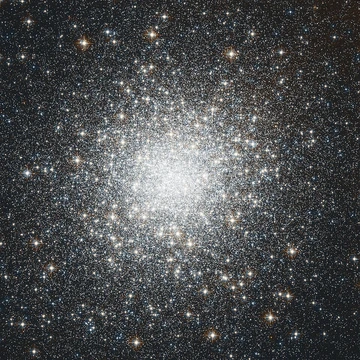
NGC 4147
A small, metal-poor Oosterhoff type I globular cluster.

NGC 4147 is a globular cluster of stars in the northern constellation of Coma Berenices. It is notable for being the lowest-metallicity Oosterhoff type I (OoI) cluster known, and for its possible association with the Sagittarius tidal stream, suggesting it may have been captured by the Milky Way after separation from the Sagittarius Dwarf Spheroidal Galaxy.
Quick Facts
- Epoch
- J2000
- Class
- IX
- Constellation
- Coma Berenices
- Ra
- 12 · 10 · 06.149
- Dec
- +18 · 32 · 31.78
- Dist Ly
- 18.5 kpc
- Appmag V
- 10.74
- Mass Msol
- 37,200
- Radius Tidal Arcminsec
- 6.6′
- Metal Fe
- −1.78
- Age
- 11.0 Gyr
Facts from the source article.
Lore & Background
NGC 4147 was discovered by English astronomer William Herschel on March 14, 1784, who described it as 'very bright, pretty large, gradually brighter in the middle'. With an apparent visual magnitude of 10.7, it is located around 60,000 light years from the Sun at a relatively high galactic latitude of 77.2°. This is a relatively small globular cluster, ranking 112th in luminosity among the Milky Way globular cluster population.
It is considered an Oosterhoff type I cluster (OoI), despite having a relatively low metallicity. Indeed, it has the lowest metallicity of any OoI cluster known. There are 19 RR Lyrae variable star candidates and as many as 23 blue stragglers. A high proportion of the latter are concentrated near the dense core of the cluster, which is consistent with the idea that blue stragglers form through stellar mergers.
The cluster lies some 70.4 ± 7.5 kly from the Galactic Center, and is relatively isolated from other globular clusters in the galaxy. The position of this cluster makes it a candidate for association with the Sagittarius tidal stream, and thus it may have been captured by the Milky Way after separation from the Sagittarius Dwarf Spheroidal Galaxy. A contour map of the cluster appears to show S-shaped tidal arms stretching to the north and south for several tidal radii. Such features are predicted for globular clusters that follow elliptical orbits and are near their apogalacticon.
Reader's Guide
NGC 4147 holds significance as the lowest-metallicity Oosterhoff type I cluster known, challenging typical expectations for such clusters. Its relatively small size and low luminosity (ranking 112th among Milky Way globular clusters) make it a modest but scientifically interesting object. The presence of 19 RR Lyrae variable star candidates and 23 blue stragglers, with a high concentration of the latter near the dense core, supports the stellar merger formation theory for blue stragglers. The cluster's possible association with the Sagittarius tidal stream suggests it may have been captured from the Sagittarius Dwarf Spheroidal Galaxy, offering clues about galactic accretion processes. The observed S-shaped tidal arms in contour maps, stretching north and south for several tidal radii, align with predictions for globular clusters on elliptical orbits near apogalacticon. This cluster thus provides a case study in stellar evolution, cluster dynamics, and galactic interactions.
Did You Know?
- NGC 4147 has the lowest metallicity of any Oosterhoff type I cluster known.
- A contour map shows S-shaped tidal arms stretching north and south for several tidal radii.
Placement Within the Sagittarius Dwarf's Stellar Architecture
NGC 4147 is a globular cluster that occupies a distinctive position within the broader structure of the Sagittarius Dwarf Spheroidal Galaxy. Rather than residing in the compact main body of this satellite galaxy—where clusters such as M 54, Terzan 7, Terzan 8, and Arp 2 are concentrated—NGC 4147 is instead found embedded within the extended stellar streams that trail outward from the dwarf. It shares this outer placement with Palomar 12, Whiting 1, NGC 2419, and NGC 5634, forming a group of clusters scattered along the tidal debris. This positioning is significant because it marks NGC 4147 as part of the material that has already been pulled away from the dwarf's core by the Milky Way's gravitational influence. The main body of Sgr dSph is roughly 10,000 light-years across, but the extended streams stretch far beyond that boundary, wrapping around and through the Milky Way's disc. NGC 4147 thus exists in a transitional state: still identifiable as a coherent cluster, yet already spatially separated from the parent galaxy's central concentration of stars.
Revealing the Extended Streams
The full spatial context in which NGC 4147 resides was not immediately apparent after the Sagittarius Dwarf Spheroidal Galaxy was first identified in 1994 by Rodrigo Ibata, Mike Irwin, and Gerry Gilmore. It was only through subsequent work leveraging the 2MASS Two-Micron All Sky Infrared Survey that researchers from the University of Virginia and the University of Massachusetts Amherst were able to trace the complete loop-shaped structure of the dwarf's stellar debris. In 2003, Steven Majewski, Michael Skrutskie, and Martin Weinberg used infrared telescopes combined with supercomputer analysis to isolate the faint presence of the Sagittarius Dwarf from the overwhelming background of Milky Way stars. Their star map revealed the full extent of the looping, spiraling path and confirmed that the extended streams—where NGC 4147 is situated—stretch at a near right angle to the plane of the Milky Way. This work transformed what had been a partially understood satellite into a fully mapped structure, placing NGC 4147 within a coherent geometric framework of tidal disruption.
Metallicity Context in a Tidally Disrupted System
NGC 4147 exists within a system that displays a complex range of stellar ages and chemical compositions. The Sagittarius Dwarf Spheroidal Galaxy hosts multiple stellar populations spanning from nearly the age of the universe down to trace populations only a few hundred million years old. A clear age-metallicity relationship has been identified: the oldest populations are strongly metal-poor, with iron abundances around [Fe/H] = −1.6 ± 0.1, while the youngest populations exhibit super-solar metal abundances. This gradient provides important context for understanding the chemical environment in which NGC 4147 formed or was captured. Furthermore, analyses drawing on VVV and Gaia EDR3 data have identified at least twenty additional globular clusters associated with the dwarf, and these newly found clusters tend to be more metal-rich than the previously known ones. NGC 4147, as part of the extended stream population rather than the core, may reflect a different formation epoch or accretion history than clusters like M 54 at the dwarf's center, though the specific metallicity of NGC 4147 itself is not detailed in the available records.
A Galaxy in the Process of Dissolution
NGC 4147's location within the extended stellar streams places it at the frontier of an ongoing cosmic event: the gradual dissolution of the Sagittarius Dwarf Spheroidal Galaxy into the Milky Way. The dwarf, currently about 80,380 light-years from Earth, travels in a polar orbit at roughly 50,000 light-years from the galactic core, and has passed through the Milky Way's plane multiple times over its history. Tidal forces have been tearing the dwarf apart over hundreds of millions of years, stretching what may have once been a spherical object into an elongated ellipse. Based on current trajectory, the main cluster is expected to pass through the galactic disc within the next hundred million years, with full dissipation and merger calculated to be complete within roughly a billion years. A 2011 simulation even suggested that repeated passages of the dwarf may have helped generate the Milky Way's spiral structure. NGC 4147, already displaced into the outer streams, represents material that has been shed in this prolonged process of gravitational stripping, making it a fossil record of the dwarf's slow unraveling.
Frequently Asked Questions
Who is NGC 4147?
NGC 4147 is a compact globular cluster of ancient stars sitting in the northern sky constellation Coma Berenices. It was first spotted by William Herschel on March 14, 1784, and sits roughly 60,000 light years from our Sun.
What are NGC 4147's powers/role?
This cluster stands out as the most metal-poor Oosterhoff type I system identified to date, making it a key reference point for studying RR Lyrae variable-star populations. It also carries the intriguing possibility of having once belonged to the Sagittarius Dwarf Spheroidal Galaxy before being stripped away.
Why is NGC 4147 important?
Astronomers value this cluster because its extremely low metal content pushes the boundary of what Oosterhoff type I membership can encompass, offering a test case for theories linking variable-star periods to stellar composition. Its probable Sagittarius origin also makes it a useful tracer of galactic accretion events.
Where can I find NGC 4147?
Look toward the constellation Coma Berenices in the northern sky; the cluster appears as a faint smudge with an apparent visual magnitude of about 10.7, so it requires at least a modest telescope to resolve. At roughly 60,000 light years out, it sits well within the Milky Way's extended halo.
More in Globular Clusters, Part 2 1-24
Spotted an error? Know more?
Reader corrections go straight into our review queue. Suggest an edit · How this site is sourced