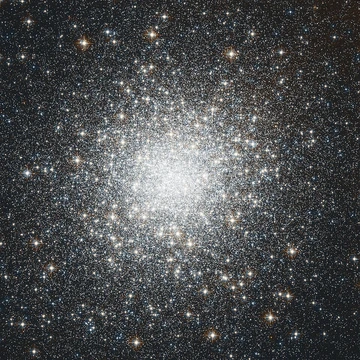
NGC 3201
A low-density globular cluster with an unusually high radial velocity.

NGC 3201, also cataloged as Caldwell 79, is a globular star cluster located in the southern constellation Vela, at a low galactic latitude. Its stars are spread out with very little concentration toward the center. James Dunlop discovered the cluster on May 28, 1826, and included it in his 1827 catalogue, describing it as a fairly large, fairly bright, round nebula about 4 to 5 arcminutes across, gradually brightening toward the center, easily resolved into stars, with an irregular shape and many stars scattered to the south.
The cluster’s radial velocity is exceptionally high—490 km/s, the fastest known for any cluster. Its peculiar velocity is 240 km/s, still below the Milky Way’s escape velocity. NGC 3201 lies about 16,300 light-years from the Sun, has an estimated mass of 157,000 solar masses, and is roughly 10.24 billion years old.
The stellar population is not uniform; it varies with distance from the core. Stars closer to the center tend to be redder and cooler, while those farther out are hotter. As of 2010, NGC 3201 and Messier 4 were the only two clusters known to show a clear inhomogeneous population.
Because NGC 3201 is a relatively sparse globular cluster that has not undergone core collapse, it is thought to contain a substantial number of black holes in its core. Several black holes have already been detected there, orbiting nearby stars. A 2022 study, using data from the Hubble Space Telescope and the Gaia spacecraft, tracked star motions near the core and found evidence of a sub-cluster of stellar-mass black holes with a total mass of about a thousand solar masses. Dynamical simulations from the same study suggested this sub-cluster could contain nearly one hundred black holes.
Quick Facts
- Epoch
- J2000
- Class
- X
- Constellation
- Vela
- Ra
- 10 · 17 · 36.82
- Dec
- –46 · 24 · 44.9
- Dist Ly
- 4.55 kpc
- Appmag V
- +8.24
- Radius Ly
- 40 ly
- V Hb
- 14.77
- Metal Fe
- –1.24
- Age
- 12.20.5 Gyr
- Names
- GCl 15, GC 2068, h 3238, Dun 445, Bennett 44, Caldwell 79, Melotte 99
Facts from the source article.
Lore & Background
NGC 3201 was discovered by James Dunlop on May 28, 1826 and listed in his 1827 catalogue. He described it as 'a pretty large pretty bright round nebula, 4′ or 5′ diameter, very gradually condensed towards the centre, easily resolved into stars; the figure is rather irregular, and the stars are considerably scattered on the south'. The cluster has a very low central concentration of stars and is located at a distance of 16,300 light years from the Sun. Its radial velocity of 490 km/s is larger than any other cluster known, corresponding to a peculiar velocity of 240 km/s, which is lower than the escape velocity of the Milky Way galaxy. The cluster is about 10.24 billion years old and has an estimated mass of 157,000 times the mass of the Sun.
The stellar population of NGC 3201 is inhomogeneous, varying with distance from the core. The effective temperature of the stars increases with greater distance, with redder and cooler stars tending to be located closer to the core. As of 2010, this is one of only two clusters (including Messier 4) that shows a definite inhomogeneous population. Because NGC 3201 is a less dense globular cluster far from undergoing core collapse, it is believed to harbor a substantial black hole population in its core. A few black holes have been detected in this cluster, orbiting nearby stars. In a study from 2022, the movement of stars near the cluster's core derived from data gathered by the Hubble Space Telescope and the European Space Agency's Gaia spacecraft indicated that NGC 3201 has a sub-cluster of stellar mass black holes with a total mass of roughly a thousand solar masses. The same study showed, with dynamical simulations, that this sub-cluster could contain nearly a hundred black holes.
Reader's Guide
NGC 3201 is significant for its extreme radial velocity, the highest known among globular clusters, which provides a unique laboratory for studying cluster dynamics and interactions with the Milky Way. Its low central concentration and inhomogeneous stellar population, with cooler stars concentrated toward the core and hotter stars farther out, offer insights into stellar evolution and mass segregation. The detection of a sub-cluster of stellar mass black holes in its core, with a total mass of roughly a thousand solar masses and potentially nearly a hundred black holes, makes it a key target for understanding black hole populations in globular clusters. As one of only two clusters known to have a definite inhomogeneous population as of 2010, it challenges models of cluster formation and evolution. Its legacy includes advancing knowledge of black hole dynamics and the role of low-density clusters in retaining black holes.
Frequently Asked Questions
What is NGC 3201?
NGC 3201, also catalogued as Caldwell 79, is a low-density globular cluster residing in the southern constellation Vela. Unlike many of its globular counterparts, its stars are loosely spread out with very little crowding toward the core.
Who first spotted NGC 3201 and when?
James Dunlop identified the cluster on May 28, 1826, and later included it in his 1827 catalogue. He noted it as a fairly bright, roundish patch of light roughly four to five arcminutes wide that resolved easily into individual stars.
What makes NGC 3201 stand out among globular clusters?
Its radial velocity of 490 km/s is exceptionally high compared to typical globulars, making it one of the fastest-moving clusters known. Combined with its notably low stellar density, it sets NGC 3201 apart in southern-sky surveys.
How far is NGC 3201 from Earth?
The cluster sits roughly 16,300 light years from the Sun, placing it well beyond the inner galactic disk at a low galactic latitude.
What did Dunlop's original 1827 description of NGC 3201 look like?
Dunlop characterized it as a round, moderately bright nebulous patch that brightened gradually toward its center, with an irregular outline and a scattering of stars trailing off to the south.
More in Globular Clusters, Part 2 1-24
Spotted an error? Know more?
Reader corrections go straight into our review queue. Suggest an edit · How this site is sourced