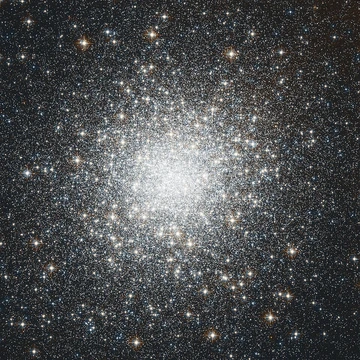
NGC 2808
A massive globular cluster with three generations of stars.

NGC 2808 is a globular cluster of stars in the southern constellation of Carina. It is one of the Milky Way's most massive clusters, containing more than a million stars, and is estimated to be 12.5 billion years old. The cluster is notable for being composed of three generations of stars, a discovery that challenged conventional understanding of globular cluster formation.
Quick Facts
- Epoch
- J2000
- Class
- I
- Constellation
- Carina
- Ra
- 09 · 12 · 03.10
- Dec
- –64 · 51 · 48.6
- Dist Ly
- 31.3 kly
- Appmag V
- 6.2
- Metal Fe
- –1.14
- Age
- 10.2 Gyr
- Names
- GCl 13, Melotte 95
Facts from the source article.
Lore & Background
NGC 2808 currently belongs to the Milky Way, although it was likely stolen from a dwarf galaxy that collided with the Milky Way. The cluster is being disrupted by the galactic tide, trailing a long tidal tail. It had been thought that NGC 2808, like typical globular clusters, contains only one generation of stars formed simultaneously from the same material. In 2007, a team of astronomers led by Giampaolo Piotto of the University of Padua in Italy investigated Hubble Space Telescope images of NGC 2808 taken in 2005 and 2006 with Hubble's Advanced Camera for Surveys. Unexpectedly, they found that this cluster is composed of three generations of stars, all born within 200 million years of the formation of the cluster. Astronomers have argued that globular clusters can produce only one generation of stars, because the radiation from first generation stars would drive the residual gas not consumed in the first star generation phase out of the cluster. However, the great mass of a cluster such as NGC 2808 may suffice to gravitationally counteract the loss of gaseous matter, allowing a second and a third generation of stars to form. An alternative explanation for the three star generations is that NGC 2808 may actually be the remnant core of a dwarf galaxy that collided with the Milky Way, called the Sausage Galaxy.
Reader's Guide
NGC 2808 is significant because its discovery of three generations of stars, announced in 2007 by a team led by Giampaolo Piotto using Hubble Space Telescope images from 2005 and 2006, challenged the long-held assumption that globular clusters contain only a single generation of stars. This finding forced astronomers to reconsider the processes of star formation within dense stellar systems. The article notes that the cluster's great mass may allow it to retain gas for multiple rounds of star formation, counteracting the usual radiation-driven loss. Alternatively, the three generations may be explained by the cluster being the remnant core of a dwarf galaxy—the Sausage Galaxy—that collided with the Milky Way. The cluster is also notable for being one of the Milky Way's most massive clusters, containing more than a million stars, and for being disrupted by the galactic tide, trailing a long tidal tail. Its estimated age of 12.5 billion years places it among the oldest known objects in the galaxy. The legacy of NGC 2808 lies in its role as a case study for multiple stellar populations and for its possible extragalactic origin, linking it to the broader history of galactic mergers.
Did You Know?
- The cluster may be the remnant core of a dwarf galaxy called the Sausage Galaxy that collided with the Milky Way.
- NGC 2808 is being disrupted by the galactic tide and trails a long tidal tail.
Frequently Asked Questions
Where can I find NGC 2808 in the sky?
NGC 2808 sits in the southern constellation Carina, making it a target for observers in the southern hemisphere. It is one of the Milky Way's most massive globular clusters, packing more than a million stars into a single dense grouping.
How old is NGC 2808?
Astronomers estimate the cluster to be roughly 12.5 billion years old, placing its formation very early in the history of the Milky Way. Remarkably, all of its stellar generations were produced within a span of only about 200 million years.
What makes NGC 2808 different from other globular clusters?
NGC 2808 contains three distinct chemical generations of stars rather than the single, uniform population expected in most globular clusters. This discovery forced astronomers to rethink the standard model of how these ancient star systems form and evolve.
How massive is NGC 2808 compared to typical globular clusters?
With over a million member stars, NGC 2808 ranks among the most massive globular clusters in our galaxy. Its sheer stellar count gives it a gravitational dominance that sets it apart from the many smaller, less populous clusters catalogued in the NGC.
Why is NGC 2808 important to the study of star formation?
The three-generation structure revealed in NGC 2808 showed that globular clusters can undergo multiple, rapid bursts of star birth rather than forming all at once. This finding challenged long-held assumptions and opened new questions about the physical conditions that allow successive stellar populations to arise in a single cluster.
More in Globular Clusters, Part 2 1-24
Spotted an error? Know more?
Reader corrections go straight into our review queue. Suggest an edit · How this site is sourced