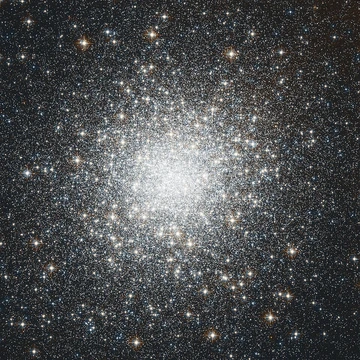
NGC 4833
A massive, metal-poor globular cluster with a highly eccentric orbit.

NGC 4833 is a globular cluster first spotted by Abbe Lacaille during his 1751–1752 expedition to South Africa and added to his catalogue in 1755. Later, James Dunlop and Sir John Herschel observed it with telescopes powerful enough to pick out its individual stars. It lies in the far southern constellation Musca, about 21,500 light-years from Earth, near the Coalsack Nebula, whose dusty region of the galactic plane partly obscures it. After accounting for the reddening caused by that dust, studies suggest the cluster is roughly 2 billion years older than globulars like M5 or M92.
This cluster is massive and poor in metals, with signs of multiple stellar generations. It belongs to the old halo type known as Oosterhoff type II, and its orbit through the galaxy is highly eccentric—an eccentricity of 0.84—bringing it close to the Galactic Center. Interactions with the galactic bulge have likely stripped away a large share of its original mass. A 2012 survey for variable stars turned up six SX Phe variables, two eclipsing binaries (one a W UMa type), and 19 RR Lyrae variables.
Quick Facts
- Epoch
- J2000
- Class
- VIII
- Constellation
- Musca
- Ra
- 12 · 59 · 33.92
- Dec
- –70 · 52 · 35.4
- Dist Ly
- 21.5 kly
- Appmag V
- +7.79
- Absmag V
- −8.16
- Radius Ly
- 42 ly
- Metal Fe
- –2.02
- Age
- 12.54 Gyr
- Names
- NGC 4833, Caldwell 105, GCl 21, Lacaille I.4, Dunlop 164, Bennett 56
Facts from the source article.
Lore & Background
NGC 4833 was discovered by Abbe Lacaille during his 1751–1752 journey to South Africa and catalogued in 1755. It was later observed and catalogued by James Dunlop and Sir John Herschel, whose instruments could resolve it into individual stars. The cluster is situated in the very southerly constellation Musca at a distance of 21,500 light years from Earth, near the Coalsack Nebula, and is partially obscured by this dusty region of the galactic plane.
After corrections for reddening by dust, evidence was obtained that NGC 4833 is in the order of 2 billion years older than globular clusters M5 or M92. It is an old halo cluster of the Oosterhoff type II, and its orbit through the galaxy is very eccentric, with an eccentricity of 0.84 that carries it close to the Galactic Center. The cluster has likely lost a significant portion of its original mass due to interactions with the galactic bulge.
A 2012 survey for variable stars identified six SX Phe, two eclipsing binaries (including a W UMa), and 19 RR Lyr variables in the cluster.
Reader's Guide
NGC 4833 holds significance as a massive, metal-poor globular cluster that shows evidence for multiple generations of stars, indicating a complex star formation history. Its age, estimated to be about 2 billion years older than clusters M5 or M92 after correcting for dust reddening, makes it an important object for studying the early evolution of the Milky Way's halo. The cluster's very eccentric orbit (eccentricity 0.84) and its proximity to the Galactic Center suggest it has undergone significant tidal interactions, likely losing a substantial portion of its original mass. The identification of 27 variable stars in a 2012 survey—including SX Phe, eclipsing binaries, and RR Lyr variables—provides data for understanding stellar pulsation and evolution in a metal-poor environment. Its location near the Coalsack Nebula and partial obscuration by dust highlight the challenges of observing objects in the galactic plane, but also offer opportunities to study interstellar extinction. The cluster's legacy includes its early discovery by Lacaille and subsequent resolution into stars by Dunlop and Herschel, marking it as a key target in southern hemisphere astronomy.
Early Cataloguing and the Fuzzy-Blob Era
NGC 4833 entered the astronomical record in the mid-eighteenth century when the French observer Abbé Lacaille included it in his 1751–1752 catalogue, listing it alongside NGC 104, M 55, M 69, and NGC 6397. At that time, the instruments available to observers were still of modest resolving power, so objects like NGC 4833 presented themselves through the eyepiece not as collections of individual suns but as soft, indistinct smudges of light. This is precisely why earlier cataloguers such as Charles Messier had swept many such fuzzy patches into his list of objects that might be confused with comets. It was not until 1764, when Messier turned his telescope toward M 4, that the low-resolution barrier was finally broken and individual member stars could be visually separated for the first time. The true identity of these spheroidal groupings—vast assemblies of stars held together by mutual gravity—remained a mystery for decades after Lacaille's entry, and it was only with progressively larger telescopes in the latter half of the eighteenth century that astronomers began to appreciate that what had looked like a single nebulous glow was in fact a compact swarm of countless individual stars.
Spheroidal Architecture and Stellar Makeup
A globular cluster is, by definition, a roughly spherical aggregation of stars locked in a stable gravitational dance, with the density of members climbing steeply toward the core. NGC 4833 belongs to this family of objects, which can house anywhere from tens of thousands to many millions of stars all orbiting within a compact volume. Unlike the looser, more easily scattered open clusters that populate the flat disks of spiral galaxies, globulars are the largest and most massive class of star cluster known. They tend to be older, more densely packed, and enriched with lower abundances of heavy elements compared to their open-cluster counterparts. The very name "globular cluster" was coined by William Herschel in his 1789 catalogue, drawing on the Latin word globulus, meaning small sphere, a reference to the rounded silhouette these systems present against the night sky. In casual astronomical parlance they are often shortened simply to "globulars." Though their overall shape resembles that of dwarf spheroidal galaxies, the two populations were long considered distinct in luminosity; however, the discovery of outlier objects in the early twenty-first century has blurred that boundary considerably.
A Resident of the Galactic Halo
In spiral galaxies such as our own Milky Way, globular clusters like NGC 4833 are not scattered through the luminous disk where young, bright stars form. Instead, they are concentrated in the outer spheroidal envelope that surrounds the galactic core—the so-called galactic halo. This placement is significant because it means that, unlike the ordinary disk stars which are hidden behind veils of interstellar gas and dust, globular clusters sit well above and below the plane and can be detected at far greater distances. The Milky Way alone is known to host over 150 globular clusters, a number that has grown steadily over the decades: 83 by 1915, 93 by 1930, 97 by 1947, and 160 by the end of 2011 after the ESO VVV infrared survey added two new members. Astronomers suspect additional clusters remain hidden in the crowded bulge or behind dense dust lanes. The phenomenon is not unique to our galaxy; every sufficiently massive galaxy in the Local Group carries its own retinue of globulars, and giant ellipticals at the hearts of galaxy clusters can harbor as many as 13,000.
Ancient Relics and Unsolved Origins
Globular clusters occupy a special place in cosmology because some members of the class rank among the oldest objects in their host galaxies and possibly in the observable universe, making them vital anchors for constraining the age of the cosmos. For much of the twentieth century, the prevailing view was that every star in a given globular cluster had been born simultaneously from a single star-forming nebula. That tidy picture has since been overturned: nearly all globular clusters now appear to contain stars that formed at different epochs or exhibit differing chemical compositions, suggesting that at least some clusters experienced multiple rounds of star formation. Another tantalizing possibility is that certain globulars are not native to their host galaxy at all but are the stripped-down cores of smaller galaxies that were gravitationally captured and dismantled over billions of years. The precise origin of these systems and their role in the broader story of galactic evolution remain, as of the current understanding, genuinely unresolved questions in astrophysics.
Frequently Asked Questions
Who first spotted NGC 4833 and when did it enter the record?
Abbe Lacaille catalogued it in 1755 after observing it during his 1751–1752 expedition to South Africa. It wasn't until later that James Dunlop and Sir John Herschel used larger telescopes to resolve its individual stars.
Where does NGC 4833 sit in the sky and how far away is it?
It resides in the southern constellation Musca, roughly 21,500 light-years from Earth. Its position near the dusty Coalsack Nebula means interstellar dust along the galactic plane partially veils it from our view.
What is special about NGC 4833's orbit around the Milky Way?
It traces a highly eccentric path with an orbital eccentricity of 0.84, swinging far in and out relative to the galactic center. It is also classified as an Oosterhoff type II cluster, placing it in the group with longer period variable stars.
How old is NGC 4833 compared to other famous globulars?
After correcting for the reddening caused by nearby dust, studies indicate it is roughly two billion years older than well-known clusters like M5 or M92. This makes it one of the more ancient stellar systems we can study.
Why is NGC 4833 considered metal-poor and what does that tell us?
Its low metallicity marks it as a product of the galaxy's early epoch, formed when fewer heavy elements had been scattered by previous generations of stars. Combined with its great age, it serves as a fossil record of the Milky Way's formative era.
More in Globular Clusters, Part 2 1-24
Spotted an error? Know more?
Reader corrections go straight into our review queue. Suggest an edit · How this site is sourced