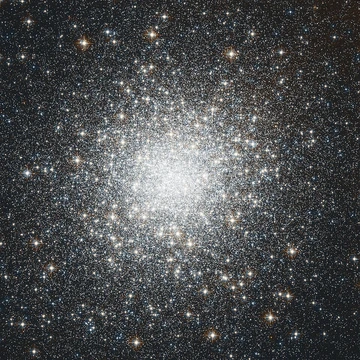
NGC 5466
A loose, dim globular cluster with a long tidal stream.

NGC 5466 is a globular star cluster located in the constellation Boötes. German-British astronomer William Herschel first spotted it on May 17, 1784, and logged it as H VI.9. The cluster is large but faint, with an apparent visual magnitude of 9.2 and an angular size of 9.0 arcminutes. It lies roughly 52,000 light-years (16.0 kiloparsecs) from the Sun and about 53,000 light-years (16.3 kiloparsecs) from the Galactic Center.
Classified as Shapley–Sawyer Concentration Class XII, NGC 5466 is a loose cluster with an unusually sparse central density for its brightness. Because it sits at a high galactic latitude, interstellar dust causes almost no reddening. Its core radius measures 1.43 ± 0.10 arcminutes, and its half-light radius is 2.3 ± 0.07 arcminutes. The King tidal radius extends to 238.0 light-years (72.98 parsecs).
The distribution of stars within the cluster reveals mass segregation, with heavier objects drifting toward the center. This is a dynamically young cluster that has only recently begun to evolve. An isochrone fit gives an age of 12.15 ± 0.11 billion years, though other estimates range from 12.2 ± 0.9 to 13.57 billion years depending on the method. The cluster has extremely low metallicity.
In 2006, astronomers detected a long tidal stream stretching from NGC 5466, possibly spanning 45 to 60 degrees across the sky. The stream’s total mass is estimated at 4.0 × 10³ solar masses, and its width dispersion is 1.31 ± 0.24 degrees, corresponding to a physical width of 1,200 ± 220 light-years (367 ± 67 parsecs) at the cluster’s distance. This tidal tail suggests the cluster has been heavily disrupted by gravitational interactions with the Milky Way, and the stream may have been further disturbed by the Large Magellanic Cloud.
The cluster contains 97 identified blue straggler stars, which show a mild central concentration. In 2019, researchers reported a candidate hot white dwarf orbiting a blue straggler on the cluster’s outskirts—only the second such pair found in a globular cluster. Three short-period eclipsing binaries and six SX Phoenicis variables have also been discovered; NGC 5466 was the first globular cluster where a blue straggler eclipsing variable was found. It also hosts the brightest known anomalous Cepheid variable, designated V19.
Quick Facts
- Epoch
- J2000
- Class
- XII
- Constellation
- Boötes
- Ra
- 14 · 05 · 27.29
- Dec
- +28 · 32 · 04.0
- Dist Pc
- 16.0 ±
- Appmag V
- 9.2
- Absmag V
- −6.98
- Radius Tidal Ly
- 72.98 pc
- V Hb
- 16.47
- Metal Fe
- –1.950.02
- Age
- 12.150.11 Gyr
Facts from the source article.
Lore & Background
NGC 5466 is a Shapley–Sawyer Concentration Class XII cluster, meaning it is very loosely concentrated. It has an unusually low central density compared to other globulars of similar luminosity. Located at a high galactic latitude, it shows negligible reddening from interstellar dust. Its core radius is 1.43′±0.10′, half-light radius 2.3′±0.07′, and King tidal radius 238.0 ly (72.98 pc).
Observation of the star distribution reveals mass segregation, with heavier objects sinking toward the center. The cluster is dynamically young and just starting to evolve. An isochrone fit gives an age of 12.15±0.11 billion years, though other methods yield ages from 12.2±0.9 to 13.57 Gyr. It has extremely low metallicity.
In 2006, a long tidal stream was detected stretching from the cluster, possibly reaching 45° to 60° across the sky, with a combined mass of 4.0×10³ M☉. The stream's width dispersion is 1.31°±0.24°, corresponding to a physical width of 1,200±220 ly (367±67 pc). The tidal tail suggests strong disruption by the Milky Way, and it may have been tidally disrupted by the Large Magellanic Cloud.
Reader's Guide
NGC 5466 is significant as a dynamically young globular cluster that is just beginning to evolve, showing clear mass segregation. Its extremely low metallicity and high galactic latitude make it a valuable object for studying early stellar populations with minimal interstellar interference. The discovery of a long tidal stream in 2006, possibly spanning 45° to 60° across the sky, highlights the cluster's ongoing disruption by the Milky Way and its interaction with the Large Magellanic Cloud. The cluster hosts 97 blue straggler stars, three short period eclipsing binaries, six SX Phoenicis variables, and the brightest-known anomalous Cepheid variable (V19). In 2019, a candidate hot white dwarf was reported orbiting a blue straggler in the cluster's outskirts, the second such pair found in a globular cluster. NGC 5466 was also the first globular where a blue straggler eclipsing variable was discovered. These features make it a key target for studying stellar evolution, binary interactions, and galactic dynamics.
Did You Know?
- NGC 5466 was discovered by William Herschel on May 17, 1784.
- It has an unusually low central density for a globular cluster of its luminosity.
- A long tidal stream stretching up to 60° across the sky was detected from this cluster in 2006.
Frequently Asked Questions
Who discovered NGC 5466 and when?
German-British astronomer William Herschel first identified this cluster on May 17, 1784, recording it in his catalog under the designation H VI.9.
Where does NGC 5466 sit in the night sky?
It appears in the constellation Boötes and orbits at roughly 52,000 light-years from the Sun, placing it about 53,000 light-years from the Milky Way's center.
What makes NGC 5466's structure unusual among globular clusters?
Rated Shapley–Sawyer Concentration Class XII, it is a notably loose system whose core is far less densely packed than you would expect for a cluster of its brightness.
How bright is NGC 5466, and how large does it look through a telescope?
With an apparent visual magnitude of 9.2 it is a faint target, yet it spans a generous 9.0 arcminutes of sky, making it one of the larger globular clusters to observe.
What is notable about NGC 5466's tidal features?
The cluster stretches out a long, visible tidal stream of stars that have been pulled from its outer regions by the Milky Way's gravitational tides.
More in Globular Clusters, Part 2 1-24
Spotted an error? Know more?
Reader corrections go straight into our review queue. Suggest an edit · How this site is sourced