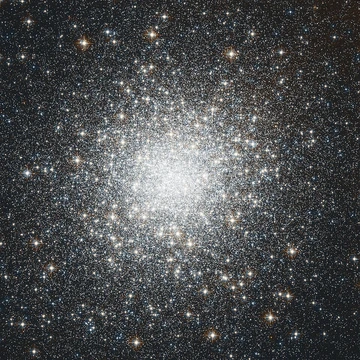
NGC 6256
Ancient globular cluster with two blue straggler sequences.

NGC 6256, a globular cluster in the southern constellation Scorpius, was first spotted by Scottish astronomer James Dunlop on August 2, 1826. In J. L. E. Dreyer's New General Catalogue, it is noted as very faint, very large, and gradually brightening toward the center, with its stars clearly resolved. The cluster lies about 22,000 light-years (6.8 kiloparsecs) from the Sun.
This ancient grouping of stars is roughly 13 billion years old, having formed during the Milky Way's early assembly. It follows a low-eccentricity orbit within the galactic bulge. Interstellar gas and dust heavily redden its light, and its structure is extremely concentrated at the core, displaying a post-core-collapse morphology.
The cluster's Hertzsprung-Russell diagram reveals two sequences of blue straggler stars, products of stellar mergers. The bluer sequence is narrow and well-defined, likely formed over a short period, while the redder sequence is sparser, resulting from ongoing formation. The bluer sequence may have originated around the time of the cluster's core collapse roughly one billion years ago, an event that increased stellar collision rates.
NGC 6256 also hosts a millisecond X-ray pulsar, designated IGR J16597-3704.
Quick Facts
- Epoch
- J2000
- Constellation
- Scorpius
- Ra
- 16 · 59 · 32.68
- Dec
- −37 · 07 · 17.1
- Dist Ly
- 6.8 kpc
- Appmag V
- 11.3
- Names
- NGC 6256, GCL 49.1, ESO 391-SC6 and vdB-Hagen 208
Facts from the source article.
Lore & Background
NGC 6256 was discovered by the Scottish astronomer James Dunlop on Aug 2, 1826. In J. L. E. Dreyer's New General Catalogue annotation it is described as 'very faint, very large, very gradually bright in the middle, well resolved clearly consisting of stars.' The cluster is located at a distance of 22 thousand light-years (6.8 kpc) from the Sun.
This is an ancient cluster with an estimated age of about 13 billion years; it was formed during the very early stages of assembly of the Milky Way galaxy. The cluster is orbiting within the galactic bulge with a low orbital eccentricity. It is heavily reddened by extinction due to interstellar gas and dust. The structure is very concentrated at the center, showing a post core collapse morphology.
The HR diagram for this cluster displays two sequences of blue straggler stars, which are the products of stellar mergers. The bluer sequence is well-defined and narrow, most likely being generated over a short time span. The redder sequence is more sparse, being the result of a continuous process of formation. It is hypothesized that the bluer sequence was formed around the time of the cluster's core collapse about one billion years ago; an event that made stellar collisions more likely.
Reader's Guide
NGC 6256 is significant as an ancient globular cluster formed during the early assembly of the Milky Way, providing a window into the galaxy's formation history. Its post core collapse morphology indicates a highly concentrated center, and its heavy reddening by interstellar dust highlights the challenges of observing objects in the galactic bulge. The cluster is particularly notable for its two distinct sequences of blue straggler stars, which are products of stellar mergers. The well-defined, narrow bluer sequence is hypothesized to have formed around the time of the cluster's core collapse about one billion years ago, when stellar collisions became more likely. The redder, more sparse sequence results from a continuous formation process. This dual sequence offers insights into the dynamics and evolution of globular clusters. Additionally, the cluster contains a millisecond X-ray pulsar, designated IGR J16597-3704, adding to its astrophysical interest as a source of compact object studies.
Did You Know?
- The cluster is about 13 billion years old, formed during the early assembly of the Milky Way.
- It has two sequences of blue straggler stars, with the bluer one hypothesized to have formed around the time of core collapse about one billion years ago.
Frequently Asked Questions
Who found NGC 6256 and when did they spot it?
Scottish astronomer James Dunlop first recorded this cluster on August 2, 1826, making it one of the earlier southern-sky globulars catalogued in the nineteenth century.
Where exactly is NGC 6256 in the sky and how far away is it?
It sits in the southern constellation Scorpius and lies roughly 22,000 light-years (about 6.8 kiloparsecs) from the Sun. Its orbit is a fairly low-eccentricity path that keeps it tied to the Milky Way's central bulge region.
How old is NGC 6256 and what does that tell us?
At approximately 13 billion years, the cluster formed during the very earliest stages of the Milky Way's assembly, making it a fossil from the galaxy's infancy. Its age places it among the oldest stellar groupings we can study.
What does NGC 6256 look like through a telescope?
Dreyer's New General Catalogue describes it as very faint and very large, with light that builds up only gradually toward the center. Individual stars are clearly resolved, and the cluster's appearance is heavily reddened by intervening interstellar gas and dust.
What makes NGC 6256 scientifically interesting to globular-cluster fans?
Astronomers have identified two distinct blue straggler sequences within the cluster, hinting at complex internal dynamical history. Combined with its bulge-anchored orbit and strong interstellar reddening, it offers a rich case study for understanding how old stellar systems evolve.
More in Globular Clusters, Part 2 1-24
Spotted an error? Know more?
Reader corrections go straight into our review queue. Suggest an edit · How this site is sourced