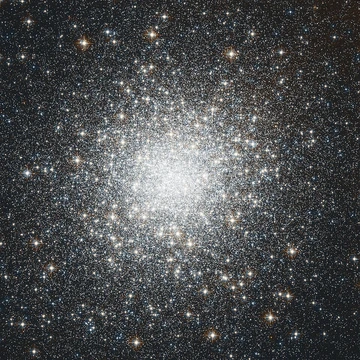
NGC 5286
An ancient globular cluster in Centaurus, possibly linked to dwarf galaxy remnants.

NGC 5286, also cataloged as Caldwell 84, is a globular cluster in the constellation Centaurus, lying about 35,900 light-years from Earth. Its light is reddened by interstellar dust and gas by 0.24 magnitude in the UBV system. The cluster sits 4 arc-minutes north of the naked-eye star M Centauri. Discovered by Scottish astronomer James Dunlop while working in Australia, it was listed in his 1827 catalog.
Roughly 29,000 light-years (8.9 kpc) from the Galactic Center, NGC 5286 orbits in the Milky Way’s halo. It may be linked to the Monoceros Ring, a tidal stream possibly formed from a disrupted dwarf galaxy, and is part of the Gaia Sausage, the remains of another merged dwarf galaxy. With an estimated age of 12.54 billion years, it could be one of the galaxy’s oldest globular clusters. The cluster is slightly elliptical, with a projected ellipticity of 0.12.
At its core, the velocity dispersion of stars is 8.1 ± 1.0 km/s. This motion suggests an intermediate-mass black hole may reside there, with an upper mass limit of 6,000 solar masses and comprising less than 1% of the cluster’s total mass.
Quick Facts
- Class
- V
- Epoch
- J2000
- Ra
- 13 · 46 · 26.81
- Dec
- –51 · 22 · 27.3
- Dist Ly
- 35.9 kly
- Appmag V
- 7.6
- Metal Fe
- –1.41
- Age
- 12.54 Gyr
- Constellation
- Centaurus
- Names
- Caldwell 84
Facts from the source article.
Lore & Background
NGC 5286 was discovered by Scottish astronomer James Dunlop, who was active in Australia, and listed in his 1827 catalog. The cluster lies 4 arc-minutes north of the naked-eye star M Centauri. Its light has undergone reddening from interstellar gas and dust, measured as E(B – V) = 0.24 magnitude in the UBV photometric system. The cluster is about 29 kly (8.9 kpc) from the Galactic Center and currently orbits in the Milky Way halo. It is not perfectly spherical, having a projected ellipticity of 0.12. The velocity dispersion of stars at its center is (8.1 ± 1.0) km/s, and based on stellar motions at the core, it may host an intermediate mass black hole with less than 1% of the cluster's mass; the upper limit for the mass estimate of this object is 6,000 times the mass of the Sun. NGC 5286 may be associated with the Monoceros Ring, a long tidal stream of stars that could have formed from a disrupted dwarf galaxy, and it is part of the Gaia Sausage, the hypothesised remains of a merged dwarf galaxy.
Reader's Guide
NGC 5286 holds significance as one of the oldest known globular clusters in the Milky Way, with an estimated age of 12.54 billion years. Its possible association with the Monoceros Ring and its membership in the Gaia Sausage suggest that the cluster may be a remnant of a merged dwarf galaxy, providing clues about the accretion history of the Milky Way. The presence of a potential intermediate mass black hole at its core, with an upper mass limit of 6,000 solar masses, makes it a target for studying black hole formation and dynamics in dense stellar systems. The cluster's measured velocity dispersion of (8.1 ± 1.0) km/s and its non-spherical shape (ellipticity 0.12) offer insights into its internal structure and evolution. Discovered by James Dunlop in Australia and cataloged in 1827, NGC 5286 continues to be studied for its role in galactic archaeology and the assembly of the Milky Way halo.
Discovery and Celestial Position
NGC 5286, catalogued as Caldwell 84, owes its formal identification to the Scottish astronomer James Dunlop, who was conducting observations from Australia during the early nineteenth century. Dunlop recorded the cluster in his 1827 catalog, adding it to the growing inventory of deep-sky objects visible from the southern hemisphere. The cluster resides in the constellation Centaurus, nestled just four arc-minutes north of the naked-eye star M Centauri, a convenient landmark for observers attempting to locate it with modest telescopes. At a distance of roughly 35,900 light years, NGC 5286 sits far beyond the dense star fields of the galactic plane. Its light, on its long journey to Earth, passes through interstellar gas and dust that impart a measurable reddening of 0.24 magnitudes in the UBV photometric system (E(B–V) = 0.24). This modest but significant dimming and color shift must be accounted for when astronomers derive the cluster's intrinsic brightness and stellar population characteristics.
Ancient Origins and Galactic Context
NGC 5286 is believed to be one of the most ancient globular clusters in the Milky Way, with an estimated age of 12.54 billion years. That places its formation in the very earliest epochs of galactic assembly, long before the Sun or the Earth came into being. The cluster orbits within the Milky Way's extended halo, roughly 29 kilolight-years (8.9 kiloparsecs) from the Galactic Center, a region far sparser than the crowded disk where most young stars form. Its dynamical history may be intertwined with larger structures: NGC 5286 is thought to be part of the so-called Gaia Sausage, the hypothesized remnant of a dwarf galaxy that was accreted and merged into the Milky Way billions of years ago. It may also be associated with the Monoceros Ring, a long tidal stream of stars that could have been sculpted by the gravitational disruption of another dwarf galaxy. These connections suggest that NGC 5286's present orbit is not a random placement but the legacy of a violent cosmic merger that reshaped the outer architecture of our galaxy.
Structure and Stellar Dynamics
Unlike the idealized spherical globular clusters often depicted in textbooks, NGC 5286 exhibits a measurable departure from perfect roundness. Its projected ellipticity is 0.12, meaning the cluster's apparent shape on the sky is slightly elongated rather than circular. This modest flattening could reflect the true three-dimensional geometry of the stellar system or may be a projection effect arising from the cluster's orientation relative to our line of sight. At the dynamical heart of the cluster, the velocity dispersion of stars is measured at 8.1 ± 1.0 km/s. This figure encapsulates the random motions of individual stars as they orbit the cluster's gravitational center, and it provides a key constraint on the total mass enclosed within the core region. The relatively moderate dispersion, combined with the cluster's great age and halo location, paints a picture of a gravitationally relaxed system whose internal kinematics have been shaped over billions of years of stellar interactions and tidal influences from the host galaxy.
The Possible Intermediate-Mass Black Hole
Perhaps the most intriguing aspect of NGC 5286 is the possibility that it harbors an intermediate-mass black hole at its core. This inference is drawn from careful analysis of the motions of stars in the cluster's central region. The observed kinematics suggest that an unseen compact object may be contributing additional gravitational pull beyond what the visible stellar population alone can account for. If such a black hole exists, its mass is constrained to be less than one percent of the total mass of the cluster. The upper limit placed on this object is approximately 6,000 times the mass of the Sun. This range sits in the so-called mass gap between stellar-mass black holes, which typically do not exceed a few hundred solar masses, and the supermassive black holes that anchor the centers of large galaxies. Confirming or ruling out this candidate would provide valuable insight into whether intermediate-mass black holes can form or persist within old stellar systems, a question that remains central to modern astrophysics.
Frequently Asked Questions
Who is NGC 5286?
NGC 5286, also cataloged as Caldwell 84, is an ancient globular cluster sitting in the southern constellation Centaurus about 35,900 light-years from Earth. Scottish astronomer James Dunlop first recorded it in his 1827 catalog while working in Australia.
What are NGC 5286's powers/role?
Clocking in at roughly 12.54 billion years, NGC 5286 is one of the oldest stellar systems known and orbits deep in the Milky Way's halo, about 29,000 light-years from the Galactic Center. Its light suffers 0.24 magnitudes of reddening from interstellar dust, and its shape is only mildly stretched, with an ellipticity of 0.12.
Why is NGC 5286 important?
Its suspected connection to the Monoceros Ring offers a concrete clue about how the Milky Way accreted smaller satellite galaxies to grow. At 12.5 billion years old, the cluster also acts as a preserved snapshot of early galactic chemistry and stellar evolution.
Where can I find NGC 5286 in the sky?
Aim in Centaurus, roughly four arc-minutes north of the bright naked-eye star M Centauri. From mid-northern latitudes it sits extremely low on the southern horizon, making it a tough target for observers above about 40° N.
More in Globular Clusters, Part 2 1-24
Spotted an error? Know more?
Reader corrections go straight into our review queue. Suggest an edit · How this site is sourced