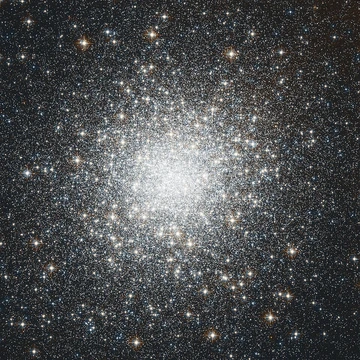
NGC 5986
A massive, metal-rich globular cluster in Lupus with multiple stellar populations.

NGC 5986 is a globular cluster found in the southern constellation Lupus, roughly 34 kilolight-years from Earth. Scottish astronomer James Dunlop first spotted it on May 10, 1826. John L. E. Dreyer later called it a remarkable object—very bright, large, round, with a gradually brighter middle, composed of stars between 13th and 15th magnitude. Its orbit through the Milky Way is unusual: both prograde and retrograde, highly eccentric, and irregular. The cluster has a mean heliocentric radial velocity of +100 km/s. It sits about 17 kilolight-years (5.2 kiloparsecs) from the galactic center, placing it in the galaxy’s inner halo. As of 2017, this relatively massive cluster had received little scientific attention. It is moderately concentrated, with a core radius of 28.2 arcseconds and a projected half-light radius of 58.8 arcseconds; its three-dimensional half-mass radius is roughly 78.16 arcseconds. Compared to most other globular clusters, NGC 5986 has a higher metallicity—meaning it contains more elements heavier than helium. Evidence suggests it hosts at least four or five distinct stellar populations, each with different chemical compositions, and that it may have lost between 60 and 80 percent of its original mass over time.
Quick Facts
- Epoch
- J2000
- Class
- VII
- Constellation
- Lupus
- Ra
- 15 · 46 · 03.00
- Dec
- –37 · 47 · 11.1
- Dist Ly
- 10.4 kpc
- Appmag V
- 8.0
- Absmag V
- −8.44
- Metal Fe
- −1.35
- Age
- 12.16 Gyr
- Names
- ESO 329-SC 018, NGC 5986
Facts from the source article.
Lore & Background
NGC 5986 was discovered by Scottish astronomer James Dunlop on May 10, 1826. John L. E. Dreyer described it as 'a remarkable object, a globular cluster, very bright, large, round, very gradually brighter middle, stars of 13th to 15th magnitude.' Its orbit through the Milky Way is considered irregular and highly eccentric, and its galactocentric distance of 17 kly places it in the galaxy's inner halo. This relatively massive cluster has been poorly studied as of 2017. It is moderately concentrated, with a core radius of 28.2″ and a projected half-light radius of 58.8″. The three-dimensional half-mass radius is approximately 78.16″. The cluster has a higher metallicity than most other globular clusters, and it may contain at least 4–5 different stellar populations with distinct elemental compositions. There is evidence that it has lost about 60–80% of its original mass.
Reader's Guide
NGC 5986 is significant as a relatively massive globular cluster that has been poorly studied, at least as of 2017. Its high metallicity—the abundance of elements heavier than helium—sets it apart from most other globular clusters, suggesting a different chemical enrichment history. The evidence for at least 4–5 distinct stellar populations indicates a complex formation and evolution, possibly involving multiple generations of stars. The cluster's irregular, highly eccentric orbit through the Milky Way's inner halo and its substantial mass loss of 60–80% of its original mass provide clues about dynamical interactions and tidal stripping over its lifetime. Its discovery by James Dunlop in 1826 and Dreyer's detailed description underscore its early recognition as a remarkable object. The cluster's moderate concentration and measured radii (core radius 28.2″, half-light radius 58.8″, half-mass radius ~78.16″) offer structural parameters for comparison with other globular clusters. Despite its notable features, NGC 5986 remains understudied, making it a target for future research into stellar populations and galactic dynamics.
Did You Know?
- The cluster may contain at least 4–5 distinct stellar populations with different elemental compositions.
- It has lost an estimated 60–80% of its original mass.
A Globular Cluster in the Northern Reaches
NGC 5986 is identified as a globular cluster situated towards the northern portion of the constellation Lupus, a region of the mid-Southern Sky. It shares this celestial neighborhood with another globular cluster, NGC 5824, and lies in proximity to the dark nebula B 228. Together, these objects form a small grouping of deep-sky features that mark the upper reaches of the constellation. Lupus itself, whose name derives from the Latin word for wolf, occupies a position in the southern celestial hemisphere that has been recognized since antiquity. The constellation was originally treated not as an independent entity but as an asterism embedded within the larger figure of Centaurus, a status it retained for centuries before being formally separated. The presence of two globular clusters in close proximity to one another, along with a dark nebula, makes this northern sector of Lupus a region of particular interest for observers of deep-sky objects, offering a compact field where different classes of celestial phenomena can be studied in relative proximity.
A Field of Diverse Deep-Sky Objects
The broader constellation of Lupus contains a remarkable variety of deep-sky objects that provide context for NGC 5986's placement. In addition to the two northern globular clusters and the dark nebula B 228, the southern portion of the constellation hosts two open clusters, NGC 5822 and NGC 5749, while the eastern border shared with Norma is marked by yet another globular cluster, NGC 5927. The western edge presents a different set of targets: two spiral galaxies and the Wolf-Rayet planetary nebula IC 4406, also known as the Retina Nebula, which contains some of the hottest stars known to exist and sits at a distance of five thousand light-years. A second planetary nebula, NGC 5882, occupies a position towards the center of the constellation. Additionally, the transiting exoplanet Lupus-TR-3b resides within these borders, and the historic supernova SN 1006, one of the brightest stellar events in recorded history, is described by various sources as having appeared in Lupus around April 30 to May 1 of the year 1006. This diversity of object types makes Lupus a constellation of considerable depth for systematic sky surveys.
Mythological Roots and the Wolf Identity
The constellation that shelters NGC 5986 carries a long and layered mythological heritage. In ancient Greek tradition, the figure was not a wolf at all but rather an arbitrary animal destined to be killed on behalf of the centaur, or alternatively a wineskin held by Centaurus, as attested by Eratosthenes. The Greek constellation likely draws upon the Babylonian Mad Dog, a hybrid creature combining a human head and torso with the legs and tail of a lion, often depicted alongside the sun god and a being called the Bison-man. In Arab folk astronomy, Lupus and Centaurus were collectively referred to as al-Shamareekh, evoking the dense fruit branches of a date palm. Islamic medieval astronomers later designated it al-Sab', a term for any predatory wild beast, and in manuscripts of Al-Sufi's Book of Fixed Stars it was drawn sometimes as a lion and sometimes as a wolf. The specific identification with a wolf did not arrive in Europe until the Latin translation of Ptolemy's catalog, which fixed the name Lupus and the animal association that persists to this day.
Celestial Geography and Observability
Lupus spans 333.7 square degrees of the night sky, accounting for 0.809 percent of the total celestial sphere and ranking 46th among the 88 modern constellations. Its official boundaries, defined by a twelve-sided polygon and adopted under the International Astronomical Union's 1922 three-letter abbreviation Lup, are bounded by six neighboring constellations: Scorpius, Norma, Circinus, Libra, Centaurus, and Hydra, the last touching only at a corner. In equatorial coordinates, the constellation's right ascension extends from 14 hours 17 minutes 48 seconds to 16 hours 8 minutes 37 seconds, while its declination ranges from minus 29.83 degrees to minus 55.58 degrees. Because of this southern declination, the entire constellation is visible to observers located south of latitude 34 degrees north, making it accessible from much of the Southern Hemisphere but largely invisible from northern mid-latitudes. For an observer in the appropriate hemisphere, NGC 5986 and its neighboring deep-sky objects in the northern part of the constellation would appear in a region of sky that also contains the bright star Alpha Lupi, now officially named Uridim, and the blue giant Beta Lupi.
Frequently Asked Questions
What is NGC 5986?
NGC 5986 is a massive, metal-rich globular cluster located in the southern constellation Lupus, sitting roughly 34 kilolight-years from Earth. It contains multiple distinct stellar populations, making it more chemically complex than many of its globular-cluster neighbors.
Who first observed NGC 5986 and when?
Scottish astronomer James Dunlop was the first to spot the cluster on May 10, 1826. John L. E. Dreyer later catalogued it, noting its impressive size, round shape, and a core that brightens gradually toward the center.
What makes NGC 5986's orbit around the Milky Way unusual?
Rather than following a simple circular path, NGC 5986 traces a highly eccentric and irregular trajectory that switches between prograde and retrograde motion. Its mean heliocentric radial velocity sits at about +100 km/s, and it orbits roughly 5.2 kiloparsecs from the galactic center.
Where exactly can I find NGC 5986 in the sky?
Look toward the faint southern constellation Lupus, the Wolf, to locate the cluster. Individual member stars typically fall between 13th and 15th magnitude, so a small telescope or binoculars are needed to resolve them against the background.
Why do fans and astronomers consider NGC 5986 noteworthy?
Its combination of high metallicity, multiple stellar populations, and a chaotic galactic orbit sets it apart from the more uniform, metal-poor globular clusters that dominate the Milky Way halo. Dreyer himself flagged it as a remarkable object, and its irregular path suggests it may have been captured or perturbed by a past interaction.
More in Globular Clusters, Part 2 1-24
Spotted an error? Know more?
Reader corrections go straight into our review queue. Suggest an edit · How this site is sourced