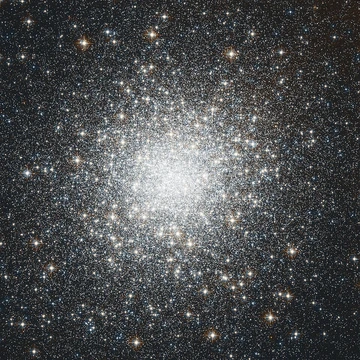
NGC 5053
A metal-poor globular cluster possibly stripped from a dwarf galaxy.

NGC 5053, a globular cluster located in the northern constellation Coma Berenices, was first spotted by German-British astronomer William Herschel on March 14, 1784. He cataloged it as VI-7 and described it in his shorthand as an extremely faint grouping of very small stars, with a resolvable nebula spanning 8 to 10 arcminutes in diameter, confirmed using a magnification of 240. Danish-Irish astronomer John Louis Emil Dreyer later noted in 1888 that the cluster appeared very faint, fairly large, and irregularly round, brightening gradually toward its center.
The cluster is metal-poor, meaning its stars contain low amounts of elements heavier than hydrogen and helium. As recently as 1995, it was regarded as the most metal-poor globular cluster in the Milky Way. The chemical makeup of its stars more closely resembles that of the Sagittarius Dwarf Spheroidal Galaxy than the Milky Way’s halo, and its motion through space suggests NGC 5053 may have been pulled away from that dwarf galaxy.
Ten RR Lyrae variable stars have been identified in the cluster, with masses between 68% and 78% of the Sun’s mass. German astronomer Walter Baade reported nine of these variables in 1928, and American astronomer Helen Sawyer added the tenth in 1946. The cluster also contains 27 known blue stragglers, five of which are short-period SX Phoenicis variable stars.
NGC 5053 is a relatively low-mass cluster, with a core concentration factor of just 1.32. A stream of tidal debris stretches westward from the cluster, with a projected length of 1.7 kiloparsecs, possibly formed through shock-induced processes. The cluster lies less than one degree from Messier 53, and the two have nearly identical distance moduli, placing them about 2 kiloparsecs apart in space. A tidal bridge connects M53 to NGC 5053, hinting at a past interaction between the pair. The cluster follows an orbit around the Milky Way with a perigalacticon of 9 kiloparsecs and an orbital eccentricity of 0.84. Currently, it sits 18.4 kiloparsecs from the Galactic Center and moves with a radial velocity of 42.0 ± 1.4 kilometers per second.
Quick Facts
- Epoch
- J2000
- Class
- XI
- Constellation
- Coma Berenices
- Ra
- 13 · 16 · 27.09
- Dec
- +17 · 42 · 00.9
- Dist Ly
- 17.4 kpc
- Appmag V
- 9.96
- Radius Tidal Pc
- 89.13 pc
- Metal Fe
- −2.30
- Names
- Cr 267, C 1313+179, GCl 23
Facts from the source article.
Lore & Background
NGC 5053 was discovered by German-British astronomer William Herschel on March 14, 1784 and cataloged as VI-7. In his abbreviated notation, he described it as 'an extremely faint cluster of extremely small stars with resolvable nebula 8 or 10′ diameter, verified by a power of 240, beyond doubt'. Danish-Irish astronomer John Louis Emil Dreyer reported in 1888 that the cluster appeared, 'very faint, pretty large, irregular round shape, growing very gradually brighter at the middle'.
This is a metal-poor cluster, meaning the stars have a low abundance of elements other than hydrogen and helium. As recently as 1995, it was considered the most metal-poor globular cluster in the Milky Way. The chemical abundances of the stars in NGC 5053 are more similar to those in the dwarf galaxy Sagittarius Dwarf Spheroidal Galaxy than to the Milky Way halo. Along with the kinematics of the globular cluster, this suggests that NGC 5053 may have been stripped from the dwarf galaxy.
There are ten known RR Lyrae variable stars in this cluster with masses ranging from 68% to 78% of the solar mass. Nine of these variables were reported by German astronomer Walter Baade in 1928, and the tenth by American astronomer Helen Sawyer in 1946. The cluster hosts 27 known blue stragglers, of which five are short period SX Phoenicis variable stars.
Reader's Guide
NGC 5053 is a relatively low mass cluster with a low core concentration factor of 1.32. It sports a stream of tidal debris to the west with a projected length of 1.7 kpc. This stream may have been created through shock-induced processes. The cluster is located less than 1° from Messier 53 and the two have nearly the same distance modulus, which corresponds to a spatial separation of around 2 kpc. There is a tidal bridge joining M53 to NGC 5053, suggesting the pair may have interacted in the past. The cluster is following an orbit through the Milky Way that has a perigalacticon distance of 9 kpc and an orbital eccentricity of 0.84. At present, it is 18.4 kpc from the Galactic Center, with a radial velocity of 42.0±1.4 km/s. Its significance lies in its extreme metal-poor nature and its likely origin as a captured cluster from the Sagittarius Dwarf Spheroidal Galaxy, providing clues to the accretion history of the Milky Way.
Did You Know?
- NGC 5053 was discovered by William Herschel on March 14, 1784.
- It has ten known RR Lyrae variable stars, with masses from 68% to 78% of the solar mass.
- A tidal bridge joins NGC 5053 to Messier 53, suggesting past interaction.
Frequently Asked Questions
Who discovered NGC 5053 and when?
William Herschel first observed the cluster on March 14, 1784, and logged it under his personal catalog number VI-7. He noted it as an extremely faint collection of tiny stars spread over roughly 8 to 10 arcminutes.
What kind of object is NGC 5053?
It is a metal-poor globular cluster situated in the northern constellation Coma Berenices. Its low metal abundance suggests it may have originally belonged to a dwarf galaxy that was later torn apart by the Milky Way's gravity.
How far is NGC 5053 from the center of the Milky Way?
The cluster orbits at a distance of about 18.4 kiloparsecs from the galactic center, with its closest approach (perigalacticon) reaching down to roughly 9 kiloparsecs. Its radial velocity is measured at 42.0 ± 1.4 km/s.
What does NGC 5053 look like through a telescope?
Dreyer described it in 1888 as very faint, fairly large, and somewhat irregularly round, with brightness increasing gently toward the core. Herschel's own shorthand called it a resolvable nebula made up of extremely small, dim stars.
Why do astronomers find NGC 5053 interesting?
Its metal-poor composition and orbital parameters make it a strong candidate for a cluster that was stripped from a disrupted satellite galaxy rather than forming in situ within the Milky Way. That history turns it into a useful fossil for studying how the galaxy assembled over billions of years.
More in Globular Clusters, Part 2 1-24
Spotted an error? Know more?
Reader corrections go straight into our review queue. Suggest an edit · How this site is sourced