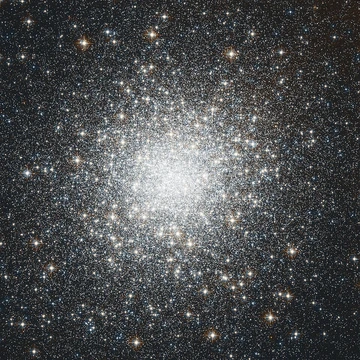
NGC 2419
A distant, massive globular cluster once thought to be an intergalactic wanderer.

NGC 2419, also cataloged as Caldwell 25, is a globular cluster located in the constellation Lynx. It was first observed by William Herschel on the last day of 1788. The cluster sits roughly 300,000 light-years from both the Solar System and the Milky Way’s center. Its nickname, “the Intergalactic Wanderer,” originated from an earlier mistaken belief that it did not orbit the Milky Way. In reality, its orbit carries it farther from the galactic center than the Magellanic Clouds, and it takes about three billion years to complete one circuit around the galaxy. Though it can be considered part of the Milky Way, this classification comes with some qualifications.
Visually, NGC 2419 is dimmer than famous clusters like M13, but it shines at magnitude 9 and can be spotted with a 102mm telescope under good skies. Intrinsically, it is among the Milky Way’s brightest and most massive globular clusters, with an absolute magnitude of −9.42 and a mass 900,000 times that of the Sun. Some astronomers have suggested that, like Omega Centauri, NGC 2419 might be the remnant of a dwarf spheroidal galaxy that was torn apart and absorbed by the Milky Way, though this idea has been challenged.
The cluster contains two distinct stellar populations—one richer in helium than the other—which contradicts the standard model of globular cluster formation, which expects a very uniform composition. This raises new questions about how NGC 2419 came to be. Its high mass-to-light ratio has prompted studies for a central black hole, but that ratio could also be explained by a dense concentration of stellar-mass black holes, a central grouping of faint stars, or even dark matter; a central black hole is not necessary to account for it.
Astronomer Leos Ondra noted that for any hypothetical observers in the Andromeda Galaxy, NGC 2419 would appear as the “best and brightest” globular cluster of the Milky Way, since it lies outside the obscuring dust of the main galactic disk. This is similar to how Earth-based observers see the cluster G1 orbiting Andromeda.
Quick Facts
- Epoch
- J2000
- Class
- VII
- Constellation
- Lynx
- Ra
- 07 · 38 · 08.51
- Dec
- +38 · 52 · 54.9
- Dist Ly
- 275 kly / (from the Sun) · 300 kly / (from the GC)
- Dist Pc
- 84.2 kpc / (Sun) · 91.5 kpc / (GC)
- Appmag V
- 10.3
- Radius Ly
- 260 ly
- V Hb
- 20.45
- Metal Fe
- –2.14
- Age
- 12.3 Gyr
Facts from the source article.
Lore & Background
NGC 2419 was discovered by German-British astronomer William Herschel on December 31, 1788. It bears the nickname 'the Intergalactic Wanderer,' which was bestowed when it was erroneously thought not to be in orbit around the Milky Way. Its orbit takes it farther away from the galactic center than the Magellanic Clouds, but it can (with qualifications) be considered as part of the Milky Way. At this great distance it takes three billion years to make one trip around the galaxy.
The cluster is dim in comparison to more famous globular clusters such as M13, but it is a 9th magnitude object readily viewed in good sky conditions with telescopes as small as 102mm (four inches) in aperture. Intrinsically, it is one of the brightest and most massive globular clusters of our galaxy, having an absolute magnitude of −9.42 and being 900,000 times more massive than the Sun.
It was proposed that NGC 2419 could be, as Omega Centauri, the remnant of a dwarf spheroidal galaxy disrupted and accreted by the Milky Way. However, that hypothesis has been disputed. The cluster was found to be composed of two different populations, one being more helium-rich than the other, which does not fit the current model for globular cluster formation. This raises new questions on how this globular cluster was formed.
Reader's Guide
NGC 2419's significance lies in its extreme distance and intrinsic properties. At about 300,000 light years from both the Solar System and the Galactic Center, it is one of the most remote globular clusters associated with the Milky Way. Its nickname 'the Intergalactic Wanderer' reflects a historical misconception that it was not bound to the galaxy, though its orbit now places it within the Milky Way system. Astronomer Leos Ondra noted that NGC 2419 would be the 'best and brightest' for any observers in the Andromeda Galaxy, looking for globular clusters in our galaxy since it lies outside the obscuring density of the main disk, analogous to how the cluster G1 is seen orbiting outside Andromeda from Earth. The cluster has been studied for a possible central black hole to explain its high mass-to-light ratio, but this could also be caused by a high concentration of stellar-mass black holes, a centrally segregated mass of faint stars, or dark matter, as a central black hole is not required. Its two stellar populations challenge current formation models, making it an important object for understanding globular cluster evolution.
Did You Know?
- NGC 2419 was discovered by William Herschel on December 31, 1788.
- It is nicknamed 'the Intergalactic Wanderer' because it was once erroneously thought not to orbit the Milky Way.
- The cluster takes three billion years to complete one orbit around the galaxy.
Discovery & Galactic Address
NGC 2419 first entered the astronomical record on the final day of 1788, when the German-British astronomer William Herschel turned his instruments toward the constellation Lynx and catalogued a faint smudge of starlight. That single observation, made on December 31, 1788, secured the cluster a permanent place in the New General Catalogue and, later, in the Caldwell catalogue as object number 25. What Herschel could not have known from his observatory in England was just how far away his discovery truly lay. Modern measurements place NGC 2419 at roughly 300,000 light years from the Solar System, and remarkably, at essentially the same distance from the center of the Milky Way. This symmetrical positioning—equidistant from us and from the galactic core—makes the cluster a genuinely peripheral member of our galaxy, hovering at the outermost reaches of its gravitational domain. For a globular cluster, that is an extraordinary address, one that would later earn it a colorful and somewhat misleading nickname.
The Intergalactic Wanderer
The nickname "the Intergalactic Wanderer" was bestowed on NGC 2419 during a period when astronomers erroneously concluded that the cluster was not actually in orbit around the Milky Way at all. The reasoning seemed compelling: the cluster's orbit carries it to a distance from the galactic center that exceeds even that of the Magellanic Clouds, the two well-known satellite galaxies orbiting our own. To many, that placed NGC 2419 in a kind of intergalactic no-man's-land, a rogue object drifting between galaxies. Yet the reality is more nuanced. With certain qualifications, the cluster can still be considered part of the Milky Way's family, bound by gravity even at such extreme range. Its orbital period is staggering: a single trip around the galaxy takes approximately three billion years. In that vast timescale, the cluster has completed only a handful of circuits since the Milky Way took its current form, making it one of the slowest, most distant travelers in our galactic neighborhood.
A Giant Hiding in Plain Sight
To the casual observer, NGC 2419 appears unremarkable. Compared to celebrated globular clusters like M13 in Hercules, it is noticeably dimmer and less photogenic, a modest 9th-magnitude smudge that requires a reasonably dark sky to appreciate. Yet even modest equipment suffices: telescopes with apertures as small as 102 millimeters—just four inches—can reveal the cluster under good observing conditions, making it accessible to backyard astronomers with patient eyes. What is far more impressive is what lies beneath that unassuming appearance. Intrinsically, NGC 2419 ranks among the brightest and most massive globular clusters in the entire Milky Way. Its absolute magnitude reaches −9.42, and its total mass is approximately 900,000 times that of the Sun. The cluster's apparent faintness is therefore almost entirely a matter of distance; up close, it would be a veritable powerhouse of stellar light, dwarfing many of its more famous counterparts.
Formation Puzzles and Dark Secrets
NGC 2419 has generated a remarkable string of formation mysteries. One hypothesis proposed that the cluster might be the surviving core of a dwarf spheroidal galaxy that was disrupted and swallowed by the Milky Way, much as Omega Centauri is sometimes described. That idea, however, has been disputed by other researchers. A separate and perhaps more troubling puzzle emerged when observations revealed that the cluster contains two distinct stellar populations, one measurably richer in helium than the other. This bimodal composition defies the standard model of globular cluster formation, which predicts a remarkably homogeneous stellar population, and has opened fresh questions about the cluster's birth. Meanwhile, its unusually high mass-to-light ratio has prompted searches for a central supermassive black hole. Yet that explanation is not strictly required; the excess mass could instead arise from a dense concentration of stellar-mass black holes, a centrally segregated population of faint stars, or even dark matter. The cluster's true nature remains an open question.
Frequently Asked Questions
What is NGC 2419?
NGC 2419, also listed as Caldwell 25, is a massive globular cluster situated in the constellation Lynx. It is one of the most distant known globular clusters associated with the Milky Way.
Who discovered NGC 2419 and when?
William Herschel first observed the cluster on December 31, 1788, making it a late entry in his extensive cataloging of deep-sky objects.
How far is NGC 2419 from Earth and the galactic center?
The cluster sits roughly 300,000 light-years from both the Solar System and the center of the Milky Way, placing it well beyond the Magellanic Clouds in terms of distance from our galaxy's core.
Why is NGC 2419 nicknamed the Intergalactic Wanderer?
The name came from an earlier, incorrect assumption that the cluster was not gravitationally bound to the Milky Way at all. We now know it does orbit our galaxy, but its path carries it farther out than the Magellanic Clouds, which is why the nickname stuck.
How long does it take NGC 2419 to complete one orbit around the Milky Way?
A single circuit around the galactic center takes approximately three billion years, making it one of the slowest-orbiting known globular clusters in the system.
More in Globular Clusters, Part 2 1-24
Spotted an error? Know more?
Reader corrections go straight into our review queue. Suggest an edit · How this site is sourced