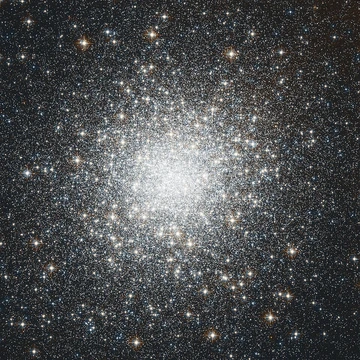
NGC 1851
Massive globular cluster with multiple stellar populations and exotic pulsars.

NGC 1851, also cataloged as Caldwell 73, is a globular cluster in the southern constellation Columba. It is relatively massive and sits about 39.5 kilolight-years from the Sun, with its center roughly 54.1 kilolight-years from the Galactic Center. John Dreyer described it as not very bright but very large, round, well resolved, and clearly composed of stars. The cluster follows a highly eccentric orbit through the galaxy, with an eccentricity near 0.7.
Its Shapley–Sawyer Concentration Class is II, meaning it has a dense central concentration—one of the highest known among Galactic globular clusters. The cluster is estimated to be 9.2 billion years old and holds about 551,000 times the mass of the Sun. Its stellar population includes two distinct groups of subgiant stars, with the brighter branch more concentrated in the outer regions. Two populations of horizontal branch stars have also been observed, separated by roughly two billion years in age. Spectroscopic analysis of red giant branch stars suggests there are actually three different stellar populations in the cluster. Additionally, 43 RR Lyrae variables have been found, classifying it as an Oosterhoff type I cluster, though it displays properties similar to type II.
A diffuse halo of stars extends outward to a radius of 240 parsecs or more. This halo, combined with the lack of a tidal tail or associated stream of stars, suggests NGC 1851 may be a stripped dwarf galaxy nucleus that was accreted by the Milky Way, similar to Omega Centauri—though a tidal tail is still present. Another possibility is that the cluster formed from the merger of two separate clusters, but this scenario is considered less likely because the two would need to have the same metallicity (the abundance of elements other than hydrogen and helium).
The cluster contains several notable pulsar systems. PSR J0514-4002A is a millisecond pulsar orbiting a massive object that may also be a neutron star; the pair has an orbital period of 18.8 days and a high eccentricity of 0.89. A nearby pulsar, PSR J0514−4002E, orbits a massive object that falls in the "mass gap" between the heaviest neutron stars and the lightest black holes, making it an unusual system useful for testing theories of gravity.
Quick Facts
- Epoch
- J2000
- Class
- II
- Ra
- 05 · 14 · 06.76
- Dec
- –40 · 02 · 47.6
- Dist Ly
- 12.1 kpc
- Appmag V
- 7.3
- Absmag V
- −7.80
- Age
- 9.2 Gyr
- Metal Fe
- −1.27
- Constellation
- Columba
- Names
- GCl 9, ESO 305-SC 016, Caldwell 73, Melotte 30
Facts from the source article.
Lore & Background
NGC 1851 was described by astronomer John Dreyer as not very bright but very large, round, well resolved, and clearly consisting of stars. It has a Shapley–Sawyer Concentration Class of II, indicating a dense central concentration, and is one of the most concentrated Galactic globular clusters. The cluster is surrounded by a diffuse halo of stars extending to a radius of 240 pc or more, and its lack of a tidal tail (though a tidal tail is still present) suggests it may be a stripped dwarf galaxy nucleus, similar to Omega Centauri, that has been accreted by the Milky Way. Alternatively, it could be the result of a merger of two separate clusters, but the requirement of identical metallicity makes this scenario less likely.
The stellar components show two separate populations of subgiant stars, with the brighter branch more concentrated in the outer regions. Two populations of horizontal branch stars have been observed, with an age difference of around two billion years. Spectroscopic analysis of red giant branch stars suggests there are actually three different populations in the cluster. The cluster is an Oosterhoff type I cluster but has properties similar to type II.
Reader's Guide
NGC 1851 is significant for its multiple stellar populations, which challenge simple models of globular cluster formation. The presence of two distinct subgiant and horizontal branch populations, along with evidence for three populations from red giant spectroscopy, indicates a complex evolutionary history. The cluster's high concentration and diffuse halo, combined with the lack of a clear tidal tail, support the hypothesis that it may be the stripped nucleus of a dwarf galaxy accreted by the Milky Way. The discovery of thirteen new pulsars by the TRAPUM Large Survey Project using the MeerKAT radio telescope, including the millisecond pulsar PSR J0514-4002A orbiting a massive object that may be a neutron star, and PSR J0514−4002E orbiting an object in the mass gap between neutron stars and black holes, makes the cluster a valuable laboratory for studying gravity and compact object physics. The possible central intermediate-mass black hole of up to 7,500 solar masses, inferred from pulsar eccentricities, further adds to its astrophysical importance.
Did You Know?
- NGC 1851 has an orbital eccentricity of about 0.7, indicating a highly eccentric orbit through the galaxy.
- It has two populations of horizontal branch stars with an age difference of around two billion years.
Frequently Asked Questions
Who is NGC 1851?
NGC 1851, also cataloged as Caldwell 73, is a massive globular cluster located in the southern constellation Columba, roughly 39.5 kilolight-years from the Sun. John Dreyer first described it as a large, round, well-resolved ball of stars that, while not especially bright, clearly showed individual members.
What are NGC 1851's powers and role?
With about 551,000 solar masses and a Shapley–Sawyer Class II core, NGC 1851 packs one of the densest central concentrations known among Milky Way globular clusters. It also harbors multiple distinct stellar populations and exotic pulsars, giving it a uniquely rich cast of characters for studying stellar evolution under extreme crowding.
Why is NGC 1851 important to the fan community?
Its blend of high mass, dense core, multiple stellar populations, and exotic pulsars makes it a premier natural laboratory for testing models of cluster formation and dynamical evolution. The cluster's highly eccentric orbit (e ≈ 0.7) also provides a real-world case study in how tidal interactions sculpt globular clusters over cosmic time.
What is NGC 1851's backstory and home base?
NGC 1851 traces a wildly elliptical path through the Milky Way, with its center sitting about 54.1 kilolight-years from the Galactic Center. Its orbit, with an eccentricity near 0.7, sends it swinging far out into the halo before whipping back in, a journey that has likely driven the multiple generations of star formation seen within it.
More in Globular Clusters, Part 2 1-24
Spotted an error? Know more?
Reader corrections go straight into our review queue. Suggest an edit · How this site is sourced