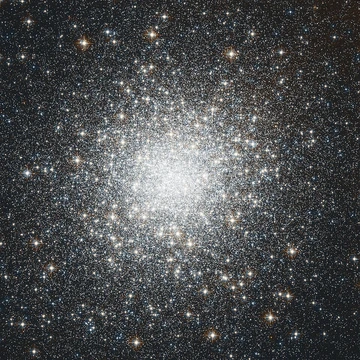
NGC 1866
Young LMC globular cluster with many Cepheid variables.

NGC 1866 is a young globular cluster situated near the northern edge of the Large Magellanic Cloud (LMC), in the southern constellation Dorado. British astronomer James Dunlop first spotted it on August 3, 1826. The LMC itself lies about 161,700 light-years from the Sun, and NGC 1866 orbits roughly 13,000 light-years from the LMC’s core. Based on isochrone fitting, the cluster is around 190 million years old. It may be one of the most massive objects to have formed in the LMC over the past three billion years, with an estimated mass of 135,000 times that of the Sun. Its core radius spans 11.1 light-years, and 90% of its light comes from within a radius of 47.6 light-years.
In 1948, A. D. Thackeray began searching NGC 1866 and identified several Cepheid variables. An independent study by H. Shapley and V. M. Nail in 1951 found 29 variables, 23 of which are Classical Cepheids; notably, no older type II Cepheids were detected. Thackeray also observed both red and blue giants in the cluster, and its overall color index was very blue, indicating youth. The cluster’s wealth of Cepheids, all at the same distance from Earth, has made them a frequent target for research.
Studies of young globular clusters in the Magellanic Clouds often reveal bimodal main sequences on their color-magnitude diagrams. Hubble Space Telescope observations of NGC 1866 show both a similar split main sequence and an extended main sequence turnoff (eMSTO). Spectroscopic analysis of the eMSTO stars reveals two populations: one older and rapidly rotating, the other younger and slower rotating. A study of the cluster’s Cepheid variables supports this dichotomy. NGC 1866 also contains a high number of fast-rotating Be stars.
In 2025, a planetary nebula was discovered near the cluster’s center. Its size and expansion rate suggest an age of about 18,000 years. The nebula’s blue central star is visible, and its progenitor likely had an initial mass of 3.9 times that of the Sun.
Quick Facts
- Epoch
- J2000
- Constellation
- Dorado
- Ra
- 05 · 13 · 38.92
- Dec
- −65 · 27 · 52.75
- Dist Pc
- 49.59 kpc
- Appmag V
- 9.73
- Metal Fe
- −0.430.01
Facts from the source article.
Lore & Background
NGC 1866 was discovered on August 3, 1826 by British astronomer James Dunlop. It orbits the Large Magellanic Cloud at a distance of 13.0 ± 1.7 thousand light-years from the LMC core. An isochrone fit to its members yields an estimated age of approximately 190 million years, and it may be one of the most massive objects formed in the LMC over the last three billion years, with an estimated 135,000 solar masses. The cluster has a core radius of 11.1 light-years and a 90% light radius of 47.6 light-years.
A. D. Thackeray began a search for Cepheid variables in NGC 1866 in 1948. An independent study by H. Shapley and V. M. Nail in 1951 found 29 variables, of which 23 are Classical Cepheids with a notable lack of older type II Cepheids. Thackeray found both red and blue giants, and the integrated color index was very blue, suggesting a young age. The rich abundance of Cepheids at the same distance has made them a frequent subject of study.
Investigations with the Hubble Space Telescope show a split main sequence and an extended main sequence turnoff (eMSTO). Spectroscopic study of eMSTO stars reveals two populations: one older and rapidly rotating, the other younger and rotating more slowly. A study of Cepheid variables supports this dichotomy. The cluster contains a high abundance of fast rotating Be stars. In 2025, a planetary nebula was discovered near the cluster's center, with an age of 18,000 years; its blue central star is visible, and the progenitor likely had an initial mass of 3.9 solar masses.
Reader's Guide
NGC 1866 is significant as a young globular cluster in the Large Magellanic Cloud, providing a laboratory for studying stellar evolution and variable stars. Its rich population of Classical Cepheid variables, all at the same distance from Earth, has made them a frequent subject for study, helping to calibrate distance scales and understand Cepheid behavior. The cluster's bimodal main sequence and extended main sequence turnoff, revealed by Hubble Space Telescope observations, indicate the presence of two distinct stellar populations with different rotation rates and ages. This dichotomy is supported by studies of its Cepheid variables. The discovery of a planetary nebula near the cluster's center in 2025, with a progenitor mass of 3.9 solar masses, adds further insight into the late stages of stellar evolution within the cluster. The high abundance of fast rotating Be stars also contributes to understanding stellar rotation and mass loss. Overall, NGC 1866 serves as a key object for testing models of star formation and evolution in a young, massive cluster environment.
Did You Know?
- It has an estimated mass of 135,000 times the mass of the Sun.
- A study in 1951 found 29 variables in the cluster, of which 23 are Classical Cepheids.
- In 2025, a planetary nebula with an age of 18,000 years was discovered near the cluster's center.
Frequently Asked Questions
Who discovered NGC 1866 and when?
British astronomer James Dunlop first identified this cluster on August 3, 1826, while surveying the southern sky. It sits near the northern rim of the Large Magellanic Cloud in the constellation Dorado.
How old is NGC 1866 compared to typical globular clusters?
At roughly 190 million years, NGC 1866 is extraordinarily young by globular-cluster standards, which often exceed ten billion years. Isochrone fitting of its stellar population is what pins down that age estimate.
How massive is NGC 1866?
The cluster carries an estimated mass of about 135,000 solar masses, making it a heavyweight among LMC objects. It may well be the most massive structure to have assembled in the Large Magellanic Cloud during the last three billion years.
Where exactly does NGC 1866 sit relative to the LMC?
It orbits roughly 13,000 light-years from the LMC's galactic core, placing it close to the cloud's northern periphery. From Earth, the whole system is about 161,700 light-years away, in the direction of Dorado.
Why do astronomers care about NGC 1866?
Beyond its unusual youth and high mass, the cluster hosts a rich population of Cepheid variable stars, which makes it a valuable natural laboratory for studying stellar pulsation and distance calibration. Its properties also help constrain how massive star-forming events can occur in a dwarf galaxy environment.
More in Globular Clusters, Part 2 1-24
Spotted an error? Know more?
Reader corrections go straight into our review queue. Suggest an edit · How this site is sourced