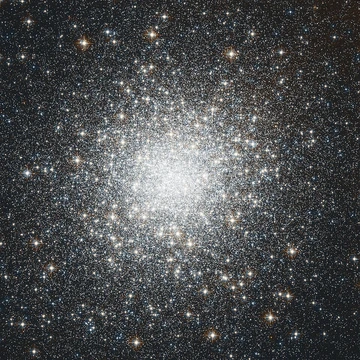
Terzan 7
A young globular cluster associated with the Sagittarius Dwarf Spheroidal Galaxy.

Terzan 7 is a globular cluster that stands out for being both sparse and young. It likely formed within the Sagittarius Dwarf Spheroidal Galaxy (Sag DEG) and remains physically tied to it. The cluster’s relatively high metal content, combined with a low nickel abundance, matches the chemical signature of the Sag DEG system, reinforcing that connection. A dense population of blue stragglers is strongly clustered near its center. The cluster has an average absolute magnitude of Mv = -5.05 and a half-light radius of 6.5 parsecs.
Discovered in 1968 by Turkish-Armenian astronomer Agop Terzan, it was the brightest of six globulars he found that year.
Most globular clusters in the Milky Way’s halo formed between 12 and 15 billion years ago, a pattern that holds even for distant ones like NGC 2419 and those in the Large Magellanic Cloud and Fornax Dwarf. Terzan 7 is one of a handful of exceptions—significantly younger clusters that include Palomar 1, 3, 4, 12, and 14, Ruprecht 106, IC 4499, Arp 2, Eridanus, and Fornax 4. Those linked to the Sag DEG appear to have formed more recently. This suggests that all outer-halo globulars may have originally come from dwarf spheroidal galaxies.
Under a hierarchical galaxy formation model, many of the Milky Way’s globular clusters could have been acquired through the accretion of dwarf spheroidals like Sag DEG. Palomar 12 is considered the strongest candidate for this scenario.
Quick Facts
- Epoch
- J2000
- Constellation
- Sagittarius
- Ra
- 19 · 17 · 43.92
- Dec
- -34 · 39 · 27.8
- Dist Ly
- 75.7 kly
- Appmag V
- 12.0
- Radius Ly
- 160 lyA · a · none
- V Hb
- 17.76
- Age
- 7.5 Gyr
- Notes
- young extragalactic globular
- Names
- Ter 7, GCl 109.1
Facts from the source article.
Lore & Background
Terzan 7 was the brightest of six globulars discovered by Turkish-Armenian astronomer Agop Terzan in 1968. It is a sparse and young globular cluster, with an estimated age of 7.5 Gyr, significantly younger than the typical 12–15 Gyr age of most Milky Way halo globulars. Its relatively high metallicity ([Fe/H] = -0.6) and low nickel abundance ([Ni/Fe] = -0.2) match the chemical signature of the Sagittarius Dwarf Spheroidal Galaxy, supporting its origin there.
The cluster has a rich population of blue stragglers that are strongly concentrated toward its center. Its average luminosity distribution is Mv = -5.05, and its half-light radius is 6.5 pc. Terzan 7 is one of a handful of young globulars in the outer halo, including Palomar 1, Palomar 3, Palomar 4, Palomar 12, Palomar 14, Ruprecht 106, IC 4499, Arp 2, Eridanus, and Fornax 4, many of which are associated with the Sag DEG and appear to have formed more recently.
Reader's Guide
Terzan 7 is significant as a key example of a young globular cluster that likely formed outside the Milky Way, in the Sagittarius Dwarf Spheroidal Galaxy, and was later accreted. Its age of 7.5 Gyr contrasts sharply with the 12–15 Gyr ages of most Milky Way halo globulars, supporting the idea that some outer halo globulars originated in dwarf spheroidal galaxies. The cluster's chemical signature—low nickel relative to iron—matches that of the Sag DEG, reinforcing its extragalactic origin. This makes Terzan 7 an important piece of evidence for hierarchical galaxy formation, where the Milky Way's globular cluster population may have been built up through the accretion of dwarf galaxies like Sag DEG. The best candidate for this process is Palomar 12, but Terzan 7 also strongly supports the model. Its rich central population of blue stragglers adds to its interest as a dynamically evolved system. The cluster's discovery by Agop Terzan in 1968 as the brightest of six new globulars highlights its historical role in expanding the known globular cluster inventory.
Did You Know?
- It has a low nickel abundance ([Ni/Fe] = -0.2), which supports its membership in the Sagittarius Dwarf Spheroidal Galaxy.
- Its age of 7.5 Gyr is significantly younger than most Milky Way halo globulars, which formed 12–15 Gyr ago.
- Terzan 7 has a rich population of blue stragglers strongly concentrated toward its center.
More in Globular Clusters, Part 2 1-24
Spotted an error? Know more?
Reader corrections go straight into our review queue. Suggest an edit · How this site is sourced