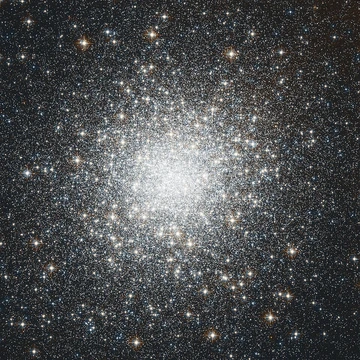
Terzan 5
A bulge fossil fragment with multiple stellar generations and many pulsars.

Terzan 5 is a stellar system located in the dense central bulge of the Milky Way. In 2026, astronomers reclassified it as a "bulge fossil fragment," a new category of object. Before that, it was thought to be a heavily obscured globular cluster in the galactic bulge. French astronomer Agop Terzan discovered it in 1968 as one of six globulars, originally labeling it Terzan 11. It also appears in the Two-Micron Sky Survey as IRC–20385. The system lies in the constellation Sagittarius, toward the Milky Way’s center. Its orbit around the galaxy is probably complex and unknown, but currently it is moving toward the Sun at roughly 90 km/s.
The system has an absolute magnitude of at least MV = −7.5. Its total luminosity is about 800,000 times that of the Sun, and its mass is around 2 million solar masses. The core is tiny—only about 0.5 parsecs across—yet it has one of the highest star densities in the galaxy. The volume mass density there exceeds 10⁶ solar masses per cubic parsec, and the volume luminosity density exceeds 10⁵·⁵ solar luminosities per cubic parsec. Terzan 5 also has one of the highest metallicities among Milky Way globular clusters, with [Fe/H] = −0.21.
In 2009, astronomers found that Terzan 5 contains at least two generations of stars: one about 12 billion years old and another about 4.5 billion years old, with slightly different metallicities. This suggests it might be the core of a disrupted dwarf galaxy rather than a true globular cluster. Only a few other Milky Way globulars—such as M54, Omega Centauri, and Liller 1—contain stars of different ages. Liller 1, like Terzan 5, is also considered a fossil fragment from the assembly of the galactic bulge. The system hosts roughly 1,300 horizontal branch stars that are burning helium in their cores, including at least one RR Lyrae variable star.
As of December 2023, Terzan 5 contains 49 known millisecond radio pulsars, the largest such population of any globular cluster in the Galaxy; the true number could be as high as 200. The first discovered, PSR B1744-24A, was found in 1990 and spins every 11.56 milliseconds. Among them is PSR J1748–2446ad, the fastest known millisecond pulsar, rotating at 716 Hz (a period of 1.40 milliseconds).
Quick Facts
- Epoch
- J2000
- Class
- G2
- Constellation
- Sagittarius
- Ra
- 17 · 48 · 05
- Dec
- −24 · 46 · 48
- Dist Pc
- 5.9 ± 0.5 kpc
- Appmag V
- 12.8
- Mass Msol
- ~2 million
- Mass Kg
- 436
- V Hb
- 22.5
- Age
- 12 Gyr
Facts from the source article.
Lore & Background
Terzan 5 was discovered by French astronomer Agop Terzan in 1968 and was initially labeled Terzan 11. It was cataloged by the Two-Micron Sky Survey as IRC–20385. It is situated in the Sagittarius constellation in the direction of the Milky Way's center. The system probably follows an unknown complicated orbit around the center of the galaxy, but currently it is moving towards the Sun with a speed of around 90 km/s.
In 2009 it was discovered that Terzan 5 consists of at least two generations of stars with ages of 12 and 4.5 billion years and slightly different metallicities, possibly indicating that it is the core of a disrupted dwarf galaxy, not a true globular cluster. There are only a few other globular clusters in the Milky Way that contain stars with different ages, including M54, Omega Centauri, and Liller 1. The latter, like Terzan 5, is thought to be a fossil fragment from the assembly of the galactic bulge.
The small core of Terzan 5—about 0.5 pc in size—has one of the highest star densities in the galaxy. Its volume mass density exceeds 10^6 M☉/pc^3, while its volume luminosity density exceeds 10^5.5 L☉/pc^3. The cluster also contains around 1300 core helium burning horizontal branch stars, including at least one RR Lyrae variable star.
Reader's Guide
Terzan 5's significance lies in its reclassification as a bulge fossil fragment, a novel category that distinguishes it from typical globular clusters. Its discovery of two distinct stellar populations with ages differing by billions of years suggests it may be the surviving core of a dwarf galaxy that merged with the Milky Way, providing a window into the assembly history of the galactic bulge. The system holds the record for the largest number of millisecond radio pulsars among all globular clusters in the Galaxy, with 49 known as of December 2023 and a potential total as high as 200. It contains the fastest known millisecond pulsar, PSR J1748–2446ad, spinning at 716 Hz. The high density of its core leads to frequent star collisions and the formation of close binaries, including neutron star systems, which explains the abundance of X-ray sources and pulsars. Terzan 5 also produces diffuse non-thermal X-ray emission and gamma-rays at high and ultra-high energies, likely originating from its pulsar population. Its unique properties make it a key object for studying stellar evolution, binary formation, and the early formation of the Milky Way's bulge.
Did You Know?
- Terzan 5 was reclassified in 2026 as a bulge fossil fragment, a novel category of stellar system.
- Its core has one of the highest star densities in the galaxy, exceeding 10^6 solar masses per cubic parsec.
More in Globular Clusters, Part 2 1-24
Spotted an error? Know more?
Reader corrections go straight into our review queue. Suggest an edit · How this site is sourced