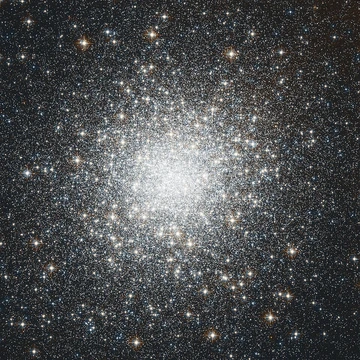
Segue 1
One of the smallest, faintest Milky Way satellites with extreme dark matter content.

Segue 1 is a dwarf spheroidal galaxy or globular cluster discovered in 2006 by the Sloan Digital Sky Survey, located in the Leo constellation. It is notable for being one of the smallest and faintest satellites of the Milky Way, with an extremely high mass-to-light ratio that suggests it may be dominated by dark matter, though a 2025 study proposes a central supermassive black hole instead.
Quick Facts
- Epoch
- J2000
- Ra
- 10 · 07 · 04
- Dec
- 16 · 04 · 55
- Dist Ly
- 75 ± 6.5 kly (23 ± 2 kpc)
- Mass Light Ratio
- 3400 (V)
- Appmag V
- 13.8 ± 0.5
- Constellation Name
- Leo
- Names
- Segue 1, PGC 4713559
Facts from the source article.
Lore & Background
Segue 1 was discovered in 2006 by the Sloan Digital Sky Survey, and its name derives from the SEGUE program (Sloan Extension for Galactic Understanding and Exploration). It has a noticeably elongated shape with an axis ratio of about 2:1, which may be caused by tidal forces from the Milky Way if it is being disrupted. However, more recent studies concluded that Segue 1 is not actually associated with the Sagittarius stream and is not being tidally disrupted. It may once have been a globular cluster of the Sagittarius Dwarf Elliptical Galaxy, later stripped by tidal forces, or it may have been a satellite of that galaxy in the past.
The stellar population consists mainly of old stars formed more than 12 billion years ago, with very low metallicity ([Fe/H] ≈ -2.5 ± 0.8), meaning they contain 300 times fewer heavy elements than the Sun. No current star formation is occurring, and no neutral hydrogen has been detected (upper limit 13 solar masses). The chemical composition indicates no substantial chemical evolution, supporting the idea that Segue 1 may be a surviving first galaxy that experienced only one burst of star formation—a fossil from the early universe.
Its mass is about 600,000 solar masses, but its integrated luminosity is only about 300 times that of the Sun, yielding a mass-to-light ratio of around 3400—the highest known for any observed galaxy as of 2011. This high ratio implies it may be dominated by dark matter, though mass estimates are difficult due to foreground contamination and the assumption that the object is gravitationally bound. In 2025, a study claimed that stellar dynamics are best modeled by a point-like mass of (4.5±1.5)×10⁵ solar masses at its center, interpreted as a supermassive black hole rather than dark matter.
Reader's Guide
Segue 1 holds significance as one of the smallest and faintest satellites of the Milky Way, with an integrated luminosity of only about 300 times that of the Sun—much smaller than a typical globular cluster. Its extreme mass-to-light ratio of around 3400, the highest known for any observed galaxy as of 2011, suggests it may be dominated by dark matter, making it a key object for studying dark matter in dwarf systems. However, this interpretation is complicated by significant foreground contamination that inflates velocity dispersion, and by the assumption that the object is gravitationally bound, which may not hold if it is being disrupted. A 2025 study challenged the dark matter interpretation, proposing instead that a central supermassive black hole of about 450,000 solar masses best models its stellar dynamics. The object's stellar population—old, metal-poor stars formed over 12 billion years ago with no subsequent star formation—indicates it may be a fossil galaxy from the early universe that experienced only one burst of star formation. Its location in the Sagittarius Stream and possible past association with the Sagittarius Dwarf Elliptical Galaxy add to its legacy as a potential stripped cluster or former satellite, though recent studies dispute tidal disruption. Segue 1 remains a contested but crucial laboratory for understanding dark matter, black holes, and early galaxy formation.
Did You Know?
- Segue 1 has a mass-to-light ratio of about 3400, the highest known for any observed galaxy as of 2011.
- A 2025 study proposed that Segue 1's dynamics are best explained by a central supermassive black hole of about 450,000 solar masses.
- Segue 1 is located in the middle of the Sagittarius Stream and may once have been a globular cluster of the Sagittarius Dwarf Elliptical Galaxy.
More in Globular Clusters, Part 2 1-24
Spotted an error? Know more?
Reader corrections go straight into our review queue. Suggest an edit · How this site is sourced